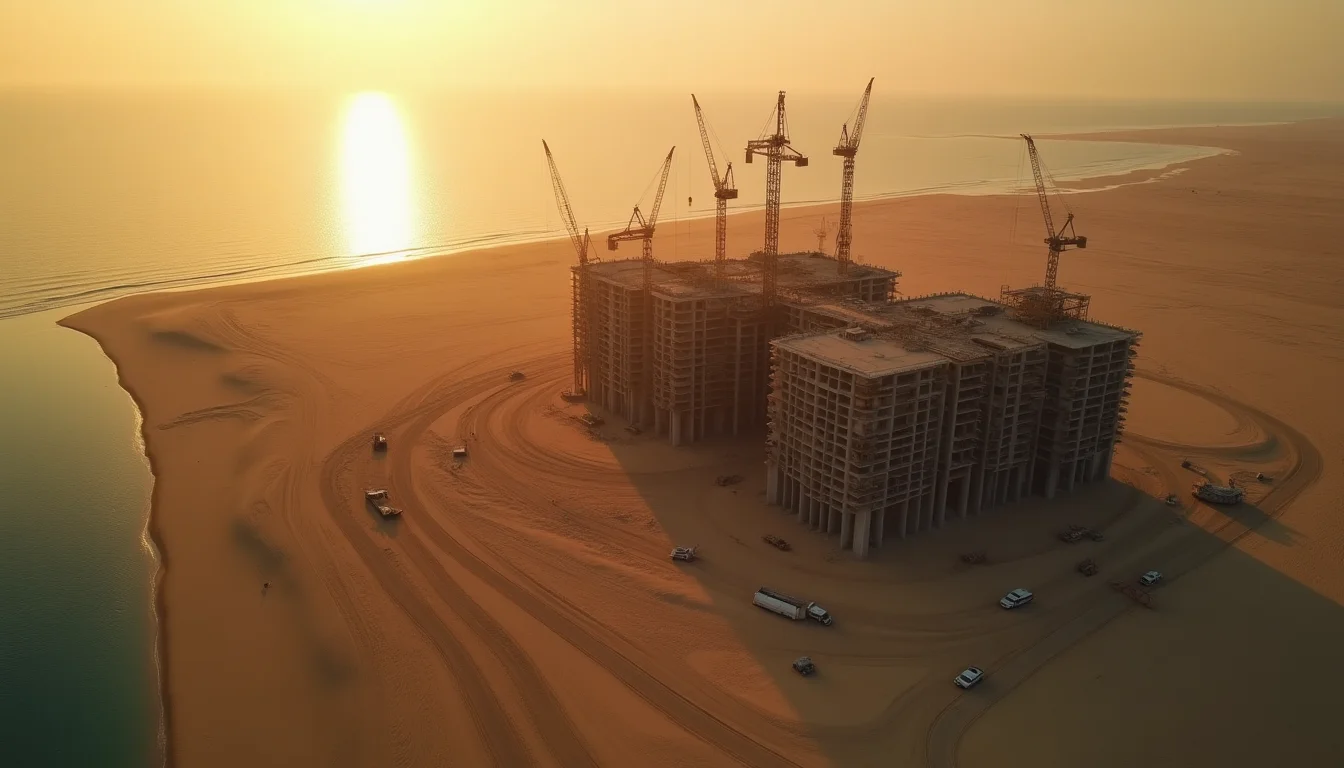
Dubai Property Bubble (2004-2009)
Dubai's megaproject ambitions — The Palm, The World islands, the tallest buildings — created a property bubble that crashed 50% and required Abu Dhabi bailout.
By Twin · @TwinTowerCity·
Key Takeaways
- →Dubai's property bubble reached its peak in 2008, fueled by massive megaprojects including The Palm and World islands.
- →State-owned entities pursued debt-financed prestige projects like the world's tallest buildings without proven underlying economic demand.
- →The 2008 global financial crisis triggered the bubble's collapse as international investment and tourism revenues dried up.
- →Dubai property prices crashed by 50 percent, forcing the emirate to seek a bailout from Abu Dhabi.
- →The crisis demonstrated that iconic real estate developments cannot substitute for diversified economic fundamentals and sustainable growth.
Peak Year
2008
Crash Year
2009
Location
United Arab Emirates
Asset Class
Real Estate
Severity
What Caused the Dubai Property Bubble?
Dubai's transformation from a modest trading port to a global luxury destination accelerated dramatically after 2002, when the emirate allowed foreign nationals to purchase freehold property for the first time. The decision was part of a broader strategy to diversify away from oil dependence — Dubai's oil reserves were already declining and contributed less than 5% of GDP by the mid-2000s. Government-backed developers like Emaar Properties, Nakheel, and Dubai Properties launched increasingly ambitious projects, including the Palm Jumeirah artificial island and the Burj Khalifa tower. Low interest rates following the Federal Reserve's post-2001 easing cycle, combined with a massive influx of petrodollar wealth across the Gulf states, created ideal conditions for a property boom.
The Mania Phase
Between 2002 and 2008, property prices in Dubai increased by an estimated 300-400% depending on the area. At the peak, Dubai had approximately 30,000 construction cranes — estimated to represent roughly 25% of all construction cranes operating worldwide. Speculators purchased units off-plan and 'flipped' them multiple times before construction was completed, often making profits of 50-100% within months. Some developments were resold three or four times before a single brick was laid. The population grew from approximately 1 million in 2000 to over 1.5 million by 2008, driven by an influx of construction workers, real estate agents, and financial services professionals.
Peak Conditions
At the market's peak in late 2008, Dubai had approximately $400 billion worth of construction projects either underway or planned. The Palm Jumeirah alone cost an estimated $12 billion. Residential property prices in premium areas like the Palm Jumeirah and Dubai Marina had reached levels comparable to London and New York, despite Dubai lacking the institutional, cultural, and economic depth of those established cities. Credit was freely available with minimal documentation requirements, and developers accepted deposits as low as 5-10% on off-plan purchases.
How Did the Dubai Property Bubble Crash?
The global financial crisis hit Dubai with devastating speed. As international credit markets froze in late 2008, the speculative buying that had sustained the boom evaporated almost overnight. Property prices fell approximately 50-60% from peak to trough between 2008 and 2011. In November 2009, Dubai World — the government-owned conglomerate behind many of the emirate's largest developments — announced it would seek to restructure approximately $26 billion in debt, including $4.05 billion owed by its subsidiary Nakheel. The announcement sent shockwaves through global financial markets, briefly raising fears of a sovereign debt default. Thousands of expatriate workers left the country, and news reports documented hundreds of luxury cars abandoned at Dubai International Airport by fleeing debtors — under UAE law at the time, failure to repay debts was a criminal offence.
Aftermath and Recovery
Abu Dhabi, Dubai's oil-rich neighbour and fellow UAE member, ultimately provided a $10 billion bailout that prevented a complete financial collapse. Dubai World reached a restructuring agreement with creditors in 2011, extending repayment timelines. Many planned construction projects were cancelled or indefinitely postponed, including the ambitious Dubai Waterfront development. Property prices did not return to 2008 peak levels until approximately 2014, and the recovery was uneven — some developments that had been marketed to speculators remained partially empty years after completion. Dubai subsequently introduced more stringent property regulations, including higher down payment requirements and restrictions on off-plan sales.
Lasting Legacy
The Dubai property bubble demonstrated the risks of building an economy around speculative real estate development, even with strong government backing. It showed how rapidly sentiment can reverse in markets dependent on foreign capital flows and expatriate populations with no permanent commitment to the location. The crisis also revealed the interconnectedness of Gulf state finances — Abu Dhabi's willingness to bail out Dubai was driven partly by concern about contagion across the UAE. Dubai's subsequent recovery, while real, followed a more measured path, though critics argue that many of the same speculative dynamics re-emerged in later property cycles, particularly around Expo 2020.
The Freehold Ownership Law as Trigger
Dubai's emergence as a global property speculation centre began with a single regulatory decision. Until 2002, foreigners were prohibited from owning freehold property anywhere in the United Arab Emirates. The May 2002 decree by Sheikh Mohammed bin Rashid Al Maktoum, then Crown Prince of Dubai, designated specific zones (initially Emirates Hills, Arabian Ranches, and Dubai Marina) where foreign nationals could purchase freehold title for the first time. The law was formalised in March 2006 with the Property Law of Dubai, which established the Dubai Land Department as the registry for foreign ownership and clarified the legal framework for off-plan sales.
The price response was immediate and dramatic. Properties in the newly designated freehold zones rose 200 to 300% within two years of the law's announcement, drawing speculative capital from across the Middle East, South Asia, the former Soviet Union, and Western Europe. The off-plan sales model that developers introduced (selling units that existed only as architectural renderings, with payments staged through construction milestones) allowed buyers to flip contracts before completion, replicating the binder system that had characterised the Florida land boom of the 1920s.
The Project Excess
The scale of construction announced in Dubai between 2003 and 2008 had no historical parallel for a city of its size. The Palm Jumeirah, an artificial archipelago of 5,000 villas and apartments built on land reclaimed from the Persian Gulf, opened in stages from 2006. The World, a development of 300 artificial islands arranged in the shape of a world map, was announced in 2003 with a budget of $14 billion. The Burj Khalifa, planned at 828 metres to become the world's tallest building, broke ground in 2004 and topped out in 2010. Beyond these signature projects, Dubai approved the Dubailand entertainment complex (planned to be twice the size of Disney World), the Mall of Arabia (briefly the world's largest), and dozens of mixed-use towers across the Sheikh Zayed Road corridor.
By 2008, the construction crane density in Dubai had reached approximately 20% of all construction cranes in active use globally, an extraordinary concentration of building activity in a city of just over 2 million residents. The labour force that built the boom consisted of approximately 700,000 South Asian migrant workers (primarily from India, Pakistan, and Bangladesh) housed in labour camps on the outskirts of the city, working under conditions that international human rights organisations including Human Rights Watch repeatedly documented as exploitative. The physical monuments of the boom were built on labour terms that would not have been legally permitted in the home countries of the developers and investors who profited from them.
The 2009 Collapse and Abu Dhabi Rescue
Dubai property prices fell approximately 50 to 60% from their late 2008 peak by mid-2009, the sharpest correction in the emirate's modern history. The collapse exposed how completely Dubai's apparently private property sector had been entangled with state finances. Dubai World, the sovereign-controlled investment vehicle that owned Nakheel (the developer behind the Palm Jumeirah and the World), DP World (the global ports operator), and Istithmar World (the international investment arm), held approximately $60 billion in debt and was unable to service its obligations as construction stopped and pre-sale buyers walked away from off-plan deposits.
The 25 November 2009 announcement that Dubai World would seek a six-month standstill on debt repayments triggered a global financial market shock that briefly threatened to reignite the broader post-Lehman crisis. The resolution came on 14 December 2009 in the form of a $10 billion bailout from Abu Dhabi, channelled through the UAE central bank, which provided the liquidity required to make immediate bond payments and gave Dubai the time required to negotiate a comprehensive debt restructuring. The price of the Abu Dhabi rescue was symbolic as well as financial: the Burj Dubai, which was scheduled to open in early 2010, was renamed the Burj Khalifa in honour of Abu Dhabi's ruler at the opening ceremony.
The Recovery and Reinflation
The Dubai property market began recovering in 2012 as the regional economy stabilised and the emirate's positioning as a regional safe haven attracted capital flight from the Arab Spring upheavals in Egypt, Syria, and Libya. A mini-boom in 2014 was cut short by the 2014 to 2016 oil price collapse, which depressed regional liquidity and produced a 25 to 30% correction in Dubai prices over the following four years. The COVID-19 pandemic produced a brief further downturn in 2020 before the most extraordinary phase of Dubai's property history began in 2021.
The 2021 to 2023 ultra-luxury boom in Dubai was driven by a unique combination of factors that had no precedent in earlier cycles. Russian capital flight following the February 2022 invasion of Ukraine added an estimated $30 to $50 billion in real estate purchases. Cryptocurrency wealth from the 2020 to 2021 bull market sought tangible assets in jurisdictions with limited international tax cooperation. Remote work normalisation allowed wealthy professionals to relocate from London, New York, and Mumbai. The result was a 40 to 60% rise in luxury property prices over three years, with individual transactions for villas on the Palm Jumeirah exceeding $80 million. Whether the 2023 to 2024 market represents a new bubble or genuine structural demand from a globalising world city remains the central question facing Dubai's property sector and one that will not be answered until the next downturn tests it.
"Dubai has rebuilt itself three times in twenty years. Each cycle is bigger than the last and each crash is shorter. The question is whether this is genuine global demand or simply liquidity looking for somewhere with no questions asked." — Hashim Sarkis, architect and former Dean of MIT School of Architecture
Recommended Reading
Key Statistics
Price Increase
226% (2004-2008)
Price Decline
~50%
Dubai World Debt
$59 billion
Abu Dhabi Bailout
$10 billion
Nakheel Sukuk
$3.5 billion
Warning Signs
- Off-plan properties flipping multiple times before construction
- State-owned entities taking on massive debt for prestige projects
- 226% price appreciation in 4 years
- Mega-projects designed for spectacle rather than demand
Timeline
2001
The Palm Jumeirah announced — mega-project era begins
2004-08
Property prices rise 226% — off-plan speculation peaks
2008
Global Financial Crisis hits — demand evaporates
Nov 2009
Dubai World requests debt standstill — $59 billion
2009-10
Abu Dhabi provides $10 billion bailout
2011
Property prices stabilize at ~50% below peak
Lessons Learned
Dubai demonstrates the risks of building an economy on real estate spectacle and debt. When state-owned entities pursue prestige projects funded by debt rather than proven demand, the eventual reckoning affects the sovereign itself. The moral: iconic buildings and artificial islands are not substitutes for diversified economic fundamentals.
Frequently Asked Questions
What caused the Dubai property bubble of 2004-2009?
The Dubai property bubble was driven by massive government-backed megaprojects including The Palm artificial islands, The World islands, and record-breaking skyscrapers like Burj Khalifa. Easy credit, foreign investment influx, speculation, and Dubai's vision to become a global financial hub fueled unsustainable property price growth and overdevelopment across the emirate.
How much did Dubai property prices fall during the 2008-2009 crash?
Dubai property prices crashed approximately 50% from their peak by 2009. Some areas experienced even steeper declines, with luxury properties falling up to 60%. The Dubai Financial Market dropped over 70% from its 2005 highs, while many construction projects were halted or cancelled as the bubble burst.
What were the warning signs of the Dubai property bubble?
Warning signs included massive oversupply of luxury properties, speculative buying by investors who never intended to occupy properties, property prices rising faster than incomes, excessive construction crane counts, and unrealistic megaproject announcements. High debt-to-GDP ratios and dependence on foreign investment also signaled unsustainable market conditions.
What lessons does the Dubai property bubble teach investors?
The Dubai bubble demonstrates the dangers of speculation-driven markets, government-backed megaproject overreach, and excessive leverage in property development. Key lessons include the importance of fundamental economic drivers over hype, the risks of monoculture economies, and how even oil-rich regions can experience severe property crashes requiring external bailouts.
Current Relevance
Dubai has experienced a new property boom post-2020, raising questions about whether lessons were learned. The pattern of building prestige projects to attract global capital, while effective as a marketing strategy, remains dependent on continued external demand.
Explore gold storage options
Gold is not a guaranteed hedge against crashes. Prices can fall; storage fees and custody risks also matter.
Affiliate link: Bubblepedia may earn a commission. Not a recommendation; investment values can fall.
Recommended Reading
Recent Analysis
South Africa Gas Prices Hit Record High After Oil Shock
5 Oct 2026
Dubai's 2004-2009 Property Bubble: Lessons
5 Sept 2026
Dubai 2009: External Capital & Real Estate Collapse
5 Aug 2026
Palm Jumeirah: Real Innovation, Speculative Crash
5 July 2026
SpaceX IPO Limits Echo Dubai's 2008 Investment Controls
5 June 2026
Get Bubblepedia in your inbox
Asset bubbles and market-history insights in your inbox.