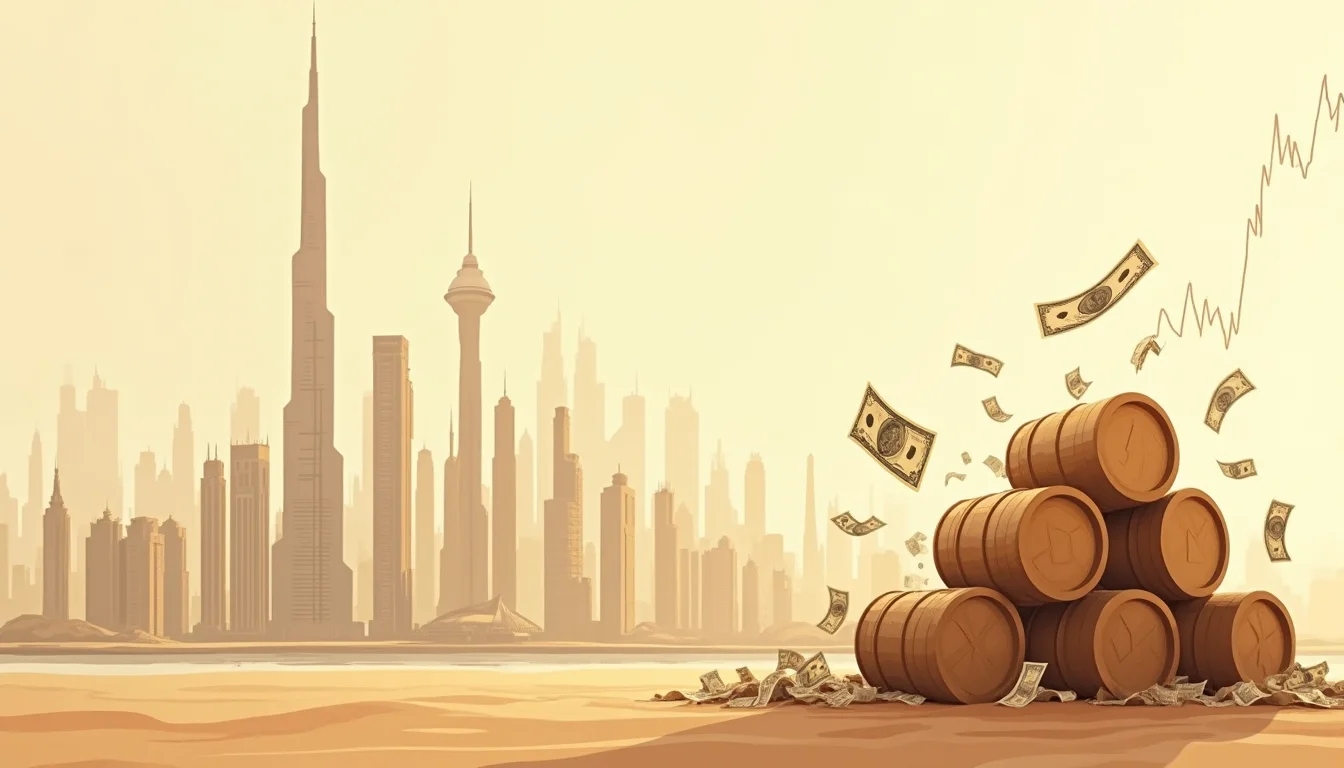
According to Bloomberg Markets, South African gasoline prices are heading toward record highs following a fresh oil shock. Oil price shocks of this kind have broader ripple effects across global markets, and historically, elevated crude prices have coincided with increased petrodollar-driven capital flows into Gulf property markets — a dynamic that has played out repeatedly in Dubai's property market.
An Oil Shock and a Familiar Capital Pattern
Dubai itself holds negligible oil reserves — by the mid-2000s, hydrocarbons contributed a small share of the emirate's GDP. But Dubai's property market has always been a downstream beneficiary of oil price cycles elsewhere in the Gulf. When crude prices rise, petrodollar wealth accumulates in Saudi Arabia, Qatar, Kuwait, and Abu Dhabi, and a share of that wealth has historically found its way into Dubai real estate, drawn by the emirate's freehold ownership laws, tax-free status, and aggressive marketing of itself as the region's financial and lifestyle hub. The current oil shock, whatever its ultimate magnitude, is a reminder that this transmission mechanism has not disappeared — it has simply been dormant during periods of lower prices.
The Original Displacement Story: From Oil Port to Global Hub
Every bubble needs a credible story before it needs speculators, and Dubai's story in the 2002-2008 period was genuinely compelling. The 2002 decision to permit foreign freehold ownership was a real policy innovation, not a marketing gimmick, and it coincided with a deliberate, well-documented strategy to diversify the economy away from a declining oil base. Government-backed developers — Emaar Properties, Nakheel, and Dubai Properties — built actual infrastructure: the Palm Jumeirah artificial islands, the Burj Khalifa, an expanding Dubai International Airport, and a financial free zone designed to attract regional headquarters. Low US interest rates following the Federal Reserve's post-2001 easing cycle, combined with a historic run-up in oil prices through the mid-2000s, supplied the capital. The diversification thesis was real. The infrastructure was real. That is precisely what made the subsequent mania so durable — displacement narratives work best when they contain a genuine kernel of truth.
The unwind was abrupt. Prices fell by approximately 50% from their peak as the 2008 global financial crisis cut off credit and foreign buyers retreated simultaneously. Dubai World, the state-owned conglomerate behind Nakheel, disclosed roughly $59 billion in debt it could not service, triggering a standstill request that rattled global credit markets. Abu Dhabi ultimately provided a $10 billion bailout to stabilize the situation, and a $3.5 billion Nakheel sukuk payment became one of the most closely watched debt events of the post-crisis period, resolved only after the Abu Dhabi support arrived.
Déjà Vu: Golden Visas and a New Capital Cycle
Dubai's property market has again been in a pronounced upswing since 2020, driven by a mix of pandemic-era relocation, long-term residency and 'golden visa' programs, and renewed inflows of capital seeking a jurisdiction outside the reach of sanctions regimes and currency controls elsewhere. As in the mid-2000s, there is a genuine underlying story: Dubai has continued to build out financial infrastructure, cryptocurrency and commodities trading hubs, and a tourism base that has materially diversified its revenue mix since the last bust. The question the current oil shock raises is whether the latest wave of price appreciation is still primarily a function of that structural diversification, or whether it has once again become a trade — one dependent on continued, and inherently cyclical, flows of external capital. Readers tracking the broader risk environment across property markets can review current bubble risk indicators alongside the full Bubblepedia encyclopedia for comparable cases.
The Historical Parallel
Read the full Dubai Property Bubble (2004-2009) entry in the Bubblepedia Encyclopedia. The core lesson from that episode is not that diversification narratives are false — Dubai's was substantially true — but that genuine structural stories and speculative excess are not mutually exclusive. They frequently coexist, with the speculative layer eventually overwhelming the fundamental one. Assessing whether that layering is recurring requires examining who is actually buying today: end-users and long-term residents, or short-horizon capital seeking a safe harbor from macro volatility elsewhere, a distinction with relevance for macro-driven capital flow analysis across emerging and Gulf-linked markets more broadly.
Dubai's 2004-2008 cycle did not end because the diversification story was wrong. It ended because leverage and off-plan speculation were layered on top of a real story at a pace the underlying economy could not absorb once global credit tightened.
None of this means the current Dubai cycle will necessarily follow the same path. Government debt management has visibly improved since the Dubai World episode, and the emirate's revenue base is less oil-dependent than it was twenty years ago. But the mechanism linking oil shocks, petrodollar accumulation, and Gulf property inflows has not been repealed — only interrupted by lower oil prices for much of the past decade. A sustained new oil shock is exactly the kind of catalyst that, in 2004-2008, turned a credible diversification story into a credit-fueled property mania.