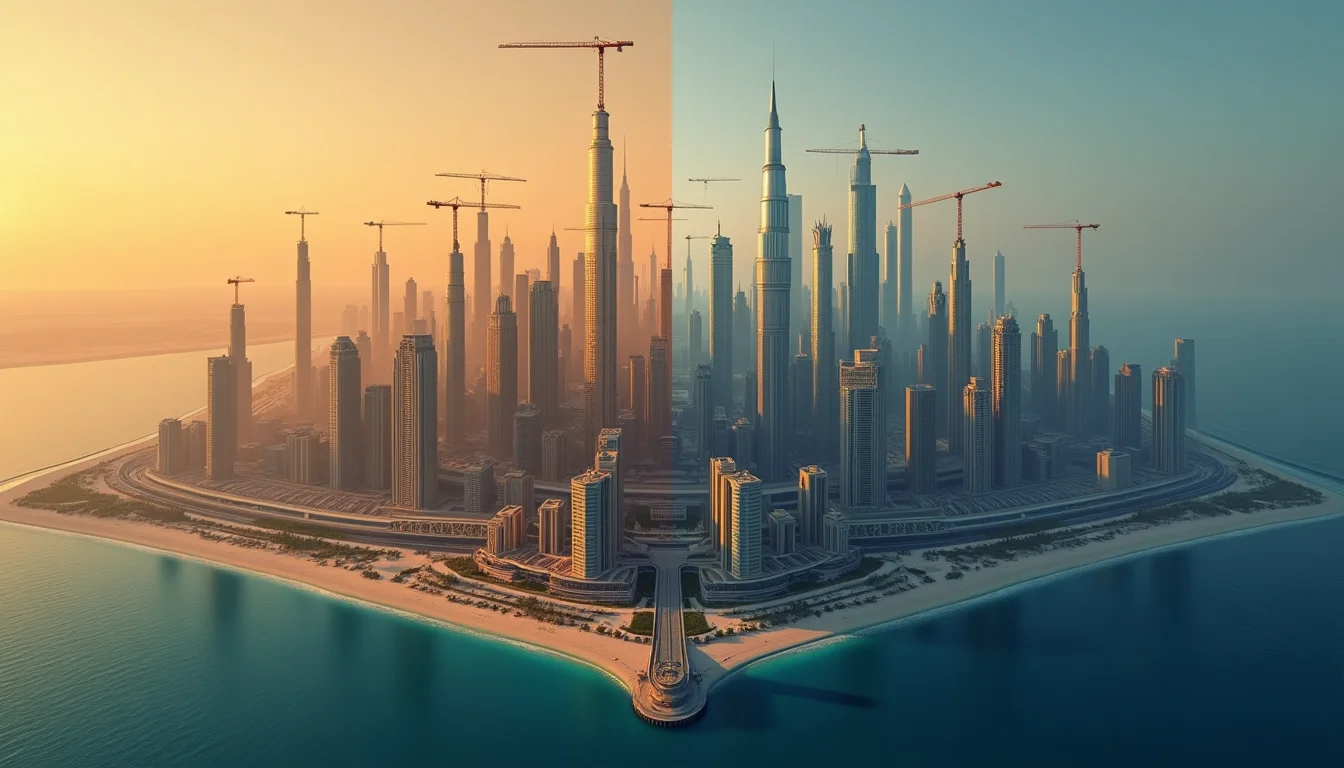
There is a seductive logic to every great bubble: something genuinely changed. The internet really did rewire commerce. Fibre optic cable really did carry more data than copper wire. And Dubai really did transform itself, within a single decade, from a modest Gulf trading port into a globally recognised luxury destination. The displacement was authentic. The innovation was real. And that is precisely what made the subsequent mania so dangerous.
According to the Bubblepedia Dubai Property Bubble (2004-2009) entry, Dubai's shift accelerated after 2002, when the emirate allowed foreign nationals to purchase freehold property for the first time — a structural policy shift, not mere marketing. The decision was part of a deliberate strategy to diversify away from oil dependence; Dubai's oil reserves were already declining and contributed less than 5% of GDP by the mid-2000s. For the first time, the emirate was offering the global investor class something it had never offered before: permanent ownership stakes in one of the world's fastest-growing cities.
The Displacement Narrative That Launched a Thousand Cranes
The analytical concept of displacement — borrowed from the economist Hyman Minsky and popularised by Charles Kindleberger in Manias, Panics, and Crashes — describes the external shock that shifts profit expectations and draws new money into an asset class. In Dubai's case, the displacement was unusually powerful because it was simultaneously structural (a legal change), demographic (a rapidly growing expatriate population), and macroeconomic (low global interest rates following the Federal Reserve's post-2001 easing cycle, combined with a massive influx of petrodollar wealth across Gulf states).
Government-backed developers including Emaar Properties, Nakheel, and Dubai Properties responded with projects of extraordinary ambition: the Palm Jumeirah artificial island, The World archipelago, and the Burj Khalifa tower. These were not phantom assets. They were being built — visibly, photographically, spectacularly. And that visibility fed the narrative. When a speculative asset can be photographed from space, it is very difficult to argue that nothing is there.
Between 2004 and 2008, property prices in Dubai rose by 226%, according to the verified figures in the Bubblepedia Dubai Property Bubble entry. At the market's peak, Dubai hosted approximately 30,000 construction cranes — estimated to represent roughly 25% of all construction cranes operating worldwide. Speculators purchased units off-plan and flipped them multiple times before construction was completed, sometimes recording profits of 50–100% within months. Some developments changed hands three or four times before a single foundation was laid. Population grew from approximately one million in 2000 to over 1.5 million by 2008, driven by construction workers, real estate agents, and financial professionals flooding in to participate in the boom.
When Innovation Becomes Justification
This is the core mechanism that the Dubai bubble illustrates with unusual clarity: genuine innovation does not inoculate a market against speculative excess. It accelerates it. The legitimate displacement narrative — Dubai as a new global financial hub, a tax-free property haven, an Arab Singapore — provided intellectual cover for increasingly irrational price expectations. Investors who might have been sceptical of a property market with no underlying economic shift instead pointed to the cranes, the airports, the foreign direct investment, and the government's stated diversification strategy as proof that prices could only go higher.
The same dynamic has appeared in every major speculative episode. The dot-com bubble was not built on fiction — the internet was changing commerce, and many of the companies that survived the crash (Amazon, Google) went on to justify extraordinary valuations. The AI infrastructure buildout of the mid-2020s rests on real computational advances. Compare the dot-com bubble with the current AI infrastructure cycle here. In each case, the displacement narrative is not wrong — it is incomplete. It describes what is real without accounting for how much of that reality is already priced in, and how much speculative premium has been layered on top.
For macro context on how displacement narratives interact with credit cycles, the Dubai episode is among the most instructive case studies of the post-2000 era precisely because the underlying innovation was so tangible and the collapse so severe.
The Anatomy of the Crash
When the global financial crisis arrived in late 2008, external demand for Dubai property evaporated almost instantly. The emirate's property market, which had been sustained by international capital flows rather than domestic income growth, had no organic floor. Prices fell by approximately 50% from peak to trough. Dubai World, the state-linked conglomerate that had financed much of the megaproject buildout, disclosed debts of $59 billion and sought a standstill on repayments. The Nakheel sukuk — an Islamic bond instrument issued by the Palm Jumeirah developer — totalled $3.5 billion and could not be repaid on schedule. Abu Dhabi ultimately extended a $10 billion bailout to stabilise the situation.
The speed of the reversal was instructive. Markets that appear structurally sound because they rest on genuine innovation can collapse as rapidly as any purely speculative mania, because the speculative premium built on top of the structural story is just as fragile as any other form of excess. The cranes did not prevent the crash. In a sense, they were the crash — physical evidence of supply that had been commissioned on the assumption of demand that never fully materialised.
Dubai After 2020: Lessons Learned, or Lessons Repeated?
Dubai's property market has experienced a significant new boom since 2020, driven by an influx of high-net-worth individuals relocating from Russia, India, and Western Europe, alongside renewed interest from global investors seeking a politically neutral, low-tax jurisdiction. The displacement narrative has been refreshed: remote work, geopolitical uncertainty, and tax pressure in Western economies have generated genuine new demand for Dubai residency and property ownership.
Whether this constitutes a new structural shift or a replay of the pre-2008 dynamic is a question that honest analysts cannot yet answer with certainty. What the historical record does establish is that the presence of a legitimate displacement narrative — foreign buyers, government-backed developers, prestige infrastructure — is not sufficient evidence that prices are sustainable. It is, if anything, a warning sign, because it is precisely the conditions under which speculative excess becomes most difficult to identify and most easy to rationalise.
The bubble indicators worth monitoring are the same ones that mattered in 2007: the ratio of prices to local incomes, the proportion of off-plan purchases relative to completed-stock transactions, the volume of short-hold flipping, and the degree to which demand is sourced from external capital flows rather than domestic economic fundamentals. Current bubble risk indicators across global property markets are tracked at Bubblepedia's Bubble Watch.
The Dubai bubble's most important lesson is not that megaprojects are dangerous, or that foreign capital is unreliable, or that Gulf property is inherently speculative. It is that the strength of a displacement narrative is inversely correlated with investors' willingness to stress-test it — and that the most convincing stories are precisely the ones that deserve the most scrutiny.
What This Means for Today's Prestige-Project Markets
The pattern of building prestige projects to attract global capital — effective as a marketing strategy, dependent on continued external demand — has spread well beyond Dubai. Cities from Riyadh to Colombo to Phnom Penh have adopted variants of the model. Each has its own displacement narrative. Each can point to real infrastructure, real population growth, real foreign interest. None of that makes the speculative premium on top of those fundamentals any more durable than it was in Dubai in 2007.
For readers who want to examine the full mechanics of how the Dubai boom became a bust, Read the full Dubai Property Bubble (2004-2009) entry in the Bubblepedia Encyclopedia. The history is detailed, the data is specific, and the parallels to current prestige-property markets are uncomfortably close.