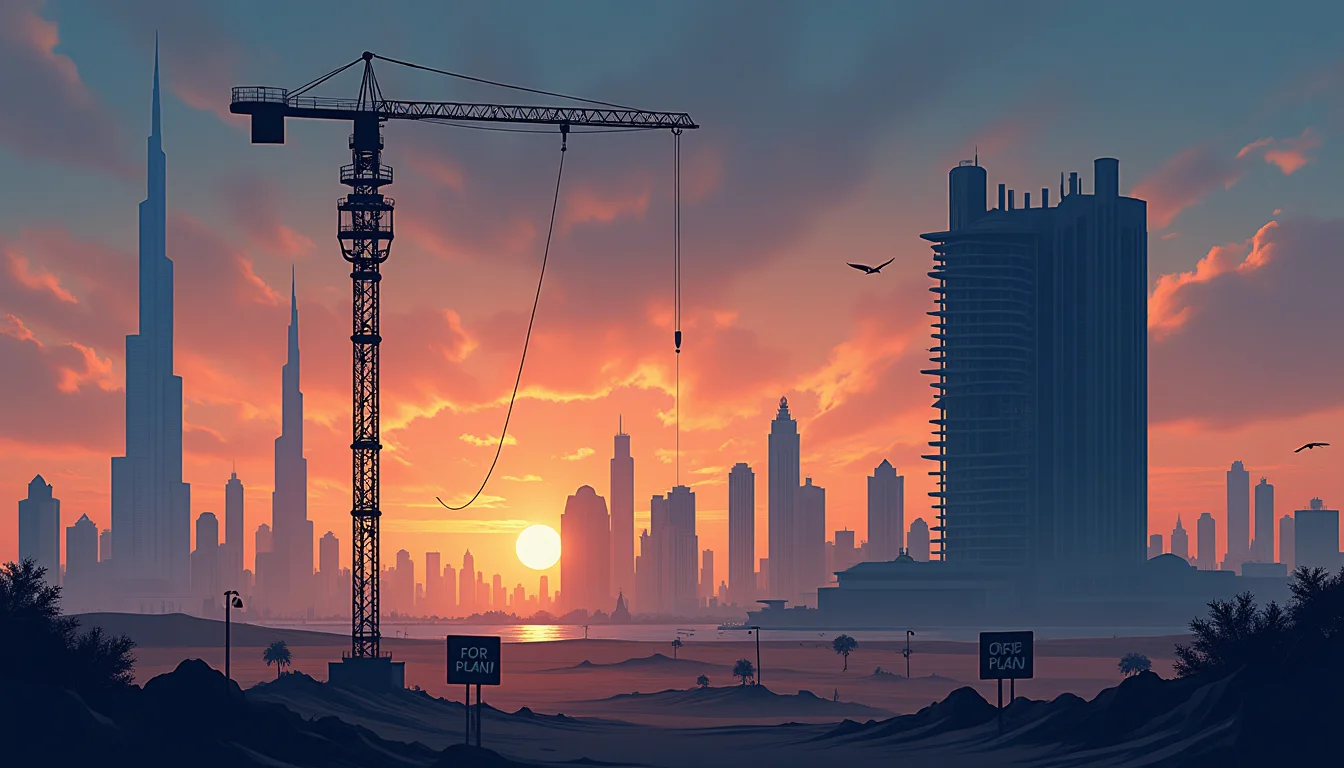
The Genuine Innovation That Justified the Initial Gains
Before examining the excess, it is essential to acknowledge what was real. Dubai's early-2000s property liberalisation was not a fiction. In 2002, the emirate made the landmark decision to allow foreign nationals to purchase freehold property — a genuine policy innovation that had no precedent in the Gulf region. For a small city-state whose oil reserves were already declining and contributing a modest share of GDP, the move represented a credible and necessary economic pivot. The logic was sound: attract global capital, build a world-class city, and replace oil rents with tourism, finance, and real estate income.
The projects that followed — Palm Jumeirah, the Burj Khalifa, the World Islands — were not mere vanity. They were marketing infrastructure. Each prestige development served as a signal to the global investor class that Dubai was a serious destination for capital. Government-backed developers including Emaar Properties, Nakheel, and Dubai Properties delivered projects of genuine architectural ambition. The population grew substantially over the period. Foreign professionals, construction workers, and financial services staff arrived in large numbers. The displacement narrative — the idea that something fundamentally new was being built — was grounded in observable reality.
This is precisely what makes Dubai such an instructive case. The bubble did not emerge from pure speculation on nothing. It emerged from rational optimism that was then systematically extrapolated far beyond what the underlying demand could support.
The mechanism that enabled this was the same one that enables most property bubbles: the conflation of a genuine long-term demand story with a short-term financing structure that required continuous price appreciation to remain solvent. Low interest rates following the US Federal Reserve's post-2001 easing cycle, combined with an enormous influx of petrodollar wealth across Gulf states, provided the liquidity. The foreign buyer — whether a British speculator, an Indian professional, or a Russian investor — provided the demand. Neither group was asking what would happen if they all tried to exit simultaneously.
At the peak of Dubai's boom, the emirate's government-linked developer Nakheel had issued a large sukuk (Islamic bond) that would become the focal point of the 2009 crisis — a single instrument embodying the distance that had opened between project ambition and repayment capacity.
The speed of the collapse was directly proportional to the degree to which the market had been built on external rather than domestic demand. Residents who had purchased to live in Dubai faced a different outcome from speculators who had purchased to flip — but both groups discovered that valuations premised on perpetual foreign inflows are not valuations at all. They are bets on sentiment.
Dubai itself offers a partial answer to whether lessons were learned. The emirate has experienced a substantial new property boom since 2020, driven in part by an influx of capital from Russia following sanctions, from crypto-wealthy individuals seeking residency, and from a global professional class reassessing where to base themselves post-pandemic. The prestige project model — now extending to branded residences, ultra-luxury towers, and new artificial island schemes — has resumed. Whether this cycle represents a more sustainable demand base or a repetition of the same structural dependency is a question that current bubble risk indicators are beginning to probe.
For broader macro context on how capital flow reversals transmit through property markets, the Dubai episode remains one of the most compressed and legible examples in modern financial history — a full cycle from genuine innovation to speculative excess to collapse, completed within a single decade.
What the Displacement Narrative Gets Right — and Wrong
The displacement narrative is not wrong. Dubai did build something real. The Burj Khalifa is real. The Palm Jumeirah is real. The financial services sector that grew up around the Dubai International Financial Centre is real. The error was not in believing that something new was being created — it was in assuming that the pace of price appreciation was a permanent feature of that creation rather than a temporary consequence of the financing conditions that accompanied it.
This distinction matters for every market currently experiencing a version of the same story. Genuine innovation — whether in urban development, technology infrastructure, or financial products — does justify initial price appreciation. The question analysts must ask is not whether the underlying innovation is real, but whether current prices reflect the long-term value of that innovation or the short-term enthusiasm of the capital that arrived to fund it. In Dubai's case, the answer became clear only after the capital left. By then, the correction was already underway.
Explore how this pattern has recurred across different asset classes and geographies in the Bubblepedia bubble encyclopedia, or review the historical timeline of major speculative episodes.