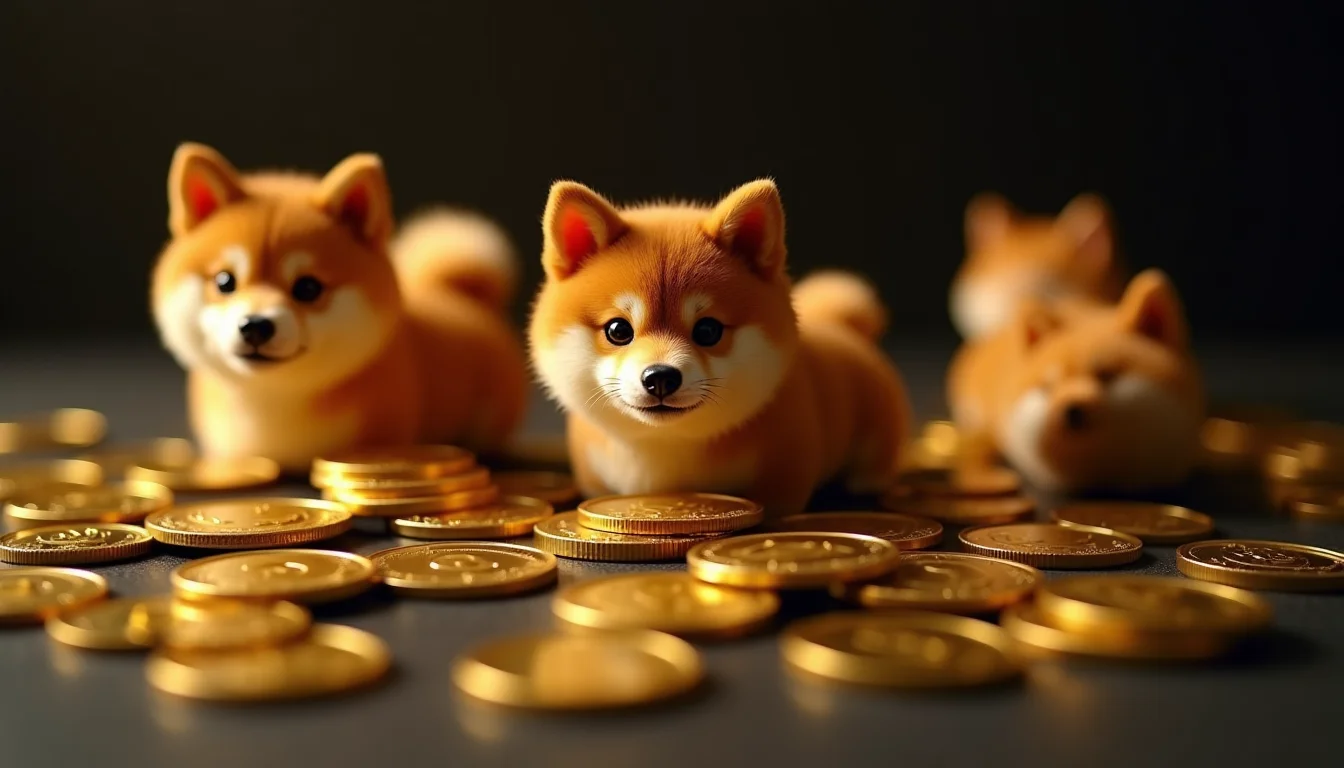
The Meme Coin Bubble — Dogecoin, Shiba Inu, and the Joke That Became a $90 Billion Mania
Dogecoin and Shiba Inu — joke cryptocurrencies with no technical innovation — reached a combined peak market cap exceeding $90 billion in 2021 before collapsing 90%+, driven by Elon Musk tweets, retail unit-bias psychology, and pandemic-era stimulus speculation.
By Twin · @TwinTowerCity·
Key Takeaways
- →Dogecoin and Shiba Inu meme cryptocurrencies reached a combined peak market capitalization exceeding $90 billion in 2021.
- →Elon Musk's social media endorsements and retail investor unit-bias psychology drove the speculative mania in joke cryptocurrencies.
- →The meme coin bubble began collapsing when social media hype faded and regulatory concerns about cryptocurrencies increased.
- →Both Dogecoin and Shiba Inu lost over 90% of their peak values, erasing tens of billions in market cap.
- →The meme coin bubble demonstrated how social media influence can create massive speculative bubbles in assets with no fundamental value.
Peak Year
2021
Crash Year
2022
Location
Global
Asset Class
Cryptocurrency
Severity
The meme coin bubble of 2020-2021 represents one of the most extraordinary episodes in financial history: a cryptocurrency based on an internet joke about a Shiba Inu dog reached a market capitalization larger than Ford Motor Company. What began in December 2013 as Billy Markus and Jackson Palmer's satirical response to altcoin proliferation evolved into a $90 billion phenomenon that challenged fundamental assumptions about value, money, and market rationality. Unlike previous bubbles centered on companies with revenues or assets, meme coins represented pure speculation on cultural relevance—digital assets whose primary utility was their own virality. The episode demonstrated how social media influence could concentrate market-moving power in unprecedented ways, while mobile trading platforms democratized access to speculative assets far beyond traditional financial gatekeepers.
The Joke Origin: Dogecoin's Creation (2013)
Billy Markus, an IBM software engineer based in Portland, Oregon, and Jackson Palmer, an Adobe marketing executive working in Sydney, Australia, created Dogecoin in December 2013 as an explicit parody of the growing altcoin ecosystem. The cryptocurrency's branding drew from the "Doge" internet meme featuring a Shiba Inu dog surrounded by broken English phrases in Comic Sans font—a deliberately absurd choice that signaled the project's satirical intent. Palmer's conception began when he purchased the domain dogecoin.com after joking about the proliferation of alternative cryptocurrencies, while Markus provided the technical implementation through his programming background.
Technically, Dogecoin represented no innovation whatsoever. Markus forked Litecoin's existing codebase, changing only the branding parameters and removing the 84 million coin supply cap to create unlimited inflation through continuous block rewards. The network maintained Litecoin's one-minute block times and Scrypt mining algorithm, offering faster transaction confirmation than Bitcoin's ten-minute blocks but no fundamental technological advancement over existing cryptocurrencies. The entire development process required mere days, highlighting the low barriers to creating new digital assets during the early altcoin proliferation period.
Despite its joke origins and lack of technical innovation, Dogecoin developed an authentic community culture centered on tipping and charitable fundraising within months of launch. The network's low transaction fees and fast confirmation times made it suitable for small-value internet transactions, while the lighthearted branding attracted users uncomfortable with Bitcoin's serious monetary rhetoric. The community's early philanthropic initiatives became legendary: $25,000 raised to send the Jamaican bobsled team to the 2014 Winter Olympics in Sochi, and $55,000 to sponsor NASCAR driver Josh Wise, whose car prominently displayed the Dogecoin logo during televised races at Talladega Superspeedway.
These charitable campaigns established Dogecoin's unique identity as the "fun" cryptocurrency, contrasting sharply with Bitcoin's emerging store-of-value narrative and Ethereum's smart contract functionality. The community's genuine enthusiasm for using the currency rather than hoarding it reflected the inflationary tokenomics that discouraged speculation in favor of circulation. However, Palmer became increasingly uncomfortable with the cryptocurrency space's speculative excesses, regulatory ambiguity, and what he perceived as growing toxicity among participants.
In 2015, Palmer withdrew from the project entirely, later describing the crypto ecosystem as fundamentally "toxic" and "controlled by a powerful cartel of wealthy figures." His departure left Dogecoin effectively leaderless from a development perspective, though the network continued operating through decentralized mining and occasional community-driven updates. Throughout the 2015-2020 period, DOGE traded consistently below $0.01, maintaining an active mining network and online community but attracting minimal speculative interest compared to newer altcoin projects.
The Elon Musk Factor
Elon Musk's first public Dogecoin endorsement appeared via Twitter in April 2019—a characteristically casual statement reading "Dogecoin might be my fav cryptocurrency. It's pretty cool." This seemingly offhand comment from the world's second-richest person marked the beginning of an unprecedented relationship between a single individual and what would become a $40 billion asset. The tweet generated moderate price movement, but established a precedent that Musk's social media activity could influence DOGE valuations in ways impossible for traditional securities.
The pattern intensified dramatically in July 2020 when Musk tweeted "It's inevitable" alongside a Dogecoin meme, driving DOGE prices up 14% within hours. This response demonstrated the extraordinary concentration of market-moving power in Musk's Twitter account, as retail traders began monitoring his posts for investment signals. The dynamic reflected several structural factors: Dogecoin's relatively thin liquidity compared to major cryptocurrencies, concentrated ownership among early adopters who could be easily influenced, and a retail-heavy investor base that responded emotionally to celebrity endorsements rather than fundamental analysis.
The real Musk-driven mania began in December 2020 with a series of tweets that propelled Dogecoin from $0.003 to $0.073—a staggering 2,300% increase over several weeks. Posts like "One word: Doge" and "Dogecoin is the people's crypto" coincided with the GameStop short squeeze phenomenon, as retail investors organized on platforms like r/SatoshiStreetBets began treating meme investments as coordinated wealth redistribution from institutional players to individual traders. This convergence of anti-establishment sentiment, celebrity endorsement, and social media coordination created perfect conditions for speculative excess.
The climax arrived on May 8, 2021, when Musk was scheduled to host Saturday Night Live. His pre-show tweet identifying himself as "The Dogefather" drove DOGE up 20% intraday to an all-time high of $0.73, representing a market capitalization of approximately $88 billion. However, during the broadcast, when cast member Michael Che asked Musk to explain Dogecoin during the Weekend Update segment, he replied "Yeah, it's a hustle"—triggering a 35% crash in real-time as millions of viewers watched. The episode perfectly captured the absurdity of market dynamics where comedic timing and word choice could determine billion-dollar wealth transfers.
"The spectacle of a single individual moving a $40 billion market cap through Twitter posts represented the complete breakdown of traditional price discovery mechanisms. When Elon Musk could generate or destroy $10 billion in market value with a Saturday Night Live joke, financial markets had entered territory without historical precedent. The concentration of such power in one person's social media account exposed the fundamental fragility underlying meme-based asset valuations."
Musk's influence persisted beyond the SNL incident, with subsequent tweets continuing to generate significant price movements throughout 2021. His stated rationale for supporting Dogecoin centered on its accessibility and transaction efficiency compared to Bitcoin, though critics argued his motivations remained primarily entertainment-focused rather than monetary policy considerations. The phenomenon demonstrated how celebrity culture had merged with financial markets in ways that traditional regulatory frameworks could not address, as Musk faced no restrictions on his ability to influence asset prices through social media commentary.
The Shiba Inu Replication and the Meme Coin Ecosystem
In August 2020, an anonymous developer operating under the pseudonym "Ryoshi" launched Shiba Inu (SHIB) as the self-proclaimed "Dogecoin killer." The project replicated Dogecoin's meme-based branding while leveraging Ethereum's infrastructure for smart contract functionality and ERC-20 token compatibility. Most significantly, SHIB launched with a total supply of one quadrillion tokens—a number so astronomically large that individual tokens traded for fractions of a cent, enabling unit prices measured in decimal places to the fifth or sixth digit.
This extreme supply inflation directly exploited unit bias psychology, where investors demonstrate strong preferences for owning large quantities of low-priced assets over fractional shares of higher-priced equivalents. Purchasing 10 million SHIB tokens for $100 created a psychological sense of wealth accumulation that felt superior to buying 0.001 Ethereum for identical dollar exposure, despite mathematically equivalent risk and return profiles. The project also launched ShibaSwap, a decentralized exchange that provided limited utility beyond token trading but helped legitimize the ecosystem through additional smart contract functionality.
Shiba Inu's development faced an unexpected existential crisis when Ethereum co-founder Vitalik Buterin received 50% of the total SHIB supply—approximately 505 trillion tokens—as an unsolicited marketing stunt by the anonymous creators. The developers presumably expected Buterin to hold the tokens indefinitely, creating artificial scarcity while associating their project with Ethereum's prestigious founder. However, in May 2021, Buterin donated SHIB tokens worth approximately $1 billion to India's COVID-19 relief fund and burned the remainder of his holdings—permanently destroying over 40% of the total token supply.
Buterin's actions initially crashed SHIB prices by 40% as markets processed the massive supply dump and uncertain implications for tokenomics. However, the burn inadvertently created genuine scarcity where none had existed before, contributing to renewed speculation as investors realized the circulating supply had permanently contracted. The episode highlighted the experimental nature of meme coin projects and the unintended consequences of celebrity involvement in cryptocurrency ecosystems.
The combined success of Dogecoin and Shiba Inu spawned hundreds of derivative meme coins throughout 2021: Floki Inu (named after Musk's dog), Samoyedcoin, Baby Doge, Dogelon Mars, and countless others bearing dog-related branding or internet culture references. However, 99% of these copycat projects ultimately collapsed to near-zero values within months, lacking both the community longevity and celebrity endorsements that sustained the original meme coins. The pattern demonstrated that successful meme coin investing required not just cultural relevance but precise timing, significant luck, and the ability to exit before inevitable collapses.
The proliferation and subsequent failure of derivative projects revealed the winner-take-all dynamics within meme coin categories. Each cultural niche could typically support only one or two sustainable projects, with later entrants struggling to differentiate themselves beyond marginal branding variations. This ecosystem evolution established Dogecoin and Shiba Inu as the dominant meme coins, while hundreds of competitors faded into obscurity despite raising millions in initial investment.
The Mania Mechanics: Why People Bought
The meme coin bubble exploited several well-documented psychological biases that traditional financial assets cannot access due to regulatory constraints and professional intermediation. Unit bias represented the primary psychological driver: retail investors consistently demonstrated strong preferences for owning 100,000 coins priced at $0.001 over 0.001 Bitcoin at $50,000, despite mathematically identical dollar exposure and risk profiles. This preference for whole numbers over fractional ownership created artificial demand for low-unit-price assets regardless of their fundamental merits or utility.
Community identity formation played an equally crucial role in sustaining speculative interest. Dogecoin and Shiba Inu holders developed tribal affiliations similar to sports team loyalty, with social media profiles displaying dog-themed imagery, diamond hand emojis, and meme-specific vocabulary. These communities created echo chambers where positive price predictions received amplification while skeptical analysis faced social ostracism. The coins' joke origins paradoxically lowered psychological resistance to investment—purchasing a "meme" felt less serious than buying stocks or traditional cryptocurrencies, reducing the cognitive burden of due diligence that might otherwise discourage speculative behavior.
Social media platforms, particularly TikTok, amplified the mania through algorithmic promotion of viral content showcasing dramatic portfolio gains. Videos featuring young investors celebrating $100 investments that grew to $10,000 in weeks received millions of views and inspired copycat behavior. These success stories systematically ignored selection bias by featuring only exceptional winners while millions of losing positions remained invisible to audiences. TikTok's engagement-driven algorithm preferentially promoted high-emotion content, creating feedback loops where meme coin wealth appeared both common and easily achievable.
The democratization of cryptocurrency trading through mobile applications eliminated traditional barriers to speculative investment. Unlike traditional securities requiring brokerage accounts, identity verification, and business-hour limitations, meme coins traded 24/7 with minimal KYC requirements and $1 minimum purchases. This friction-free access enabled impulse purchases during viral moments, converting social media engagement directly into trading volume. The combination of mobile accessibility and social media virality created unprecedented speed in speculative bubble formation.
The joke-framing paradox represented perhaps the most sophisticated psychological mechanism underlying meme coin adoption. By explicitly branding their investments as jokes or memes, participants could engage in high-risk speculation while maintaining psychological distance from potential losses. This framing reduced cognitive dissonance and enabled continued investment despite obvious fundamental weaknesses. Investors could simultaneously acknowledge the absurdity of meme coin valuations while participating in the speculation, creating a form of knowing participation in irrational behavior.
| Asset | Supply | Use Case | Developer Activity | Institutional Adoption | % from Peak |
|---|---|---|---|---|---|
| Dogecoin | Unlimited | Digital currency | Minimal | Limited | -92% |
| Shiba Inu | 1 Quadrillion | Ecosystem token | Moderate | None | -91% |
| Bitcoin | 21 Million | Store of value | High | Significant | -77% |
| Ethereum | 120 Million | Smart contracts | Very high | Growing | -83% |
Fear of missing out (FOMO) reached pathological levels during peak meme coin mania, with individuals mortgaging homes and liquidating retirement accounts to purchase speculative tokens. The 24/7 nature of cryptocurrency markets meant price movements never paused, creating constant anxiety about missing the next surge. This psychological pressure was amplified by social media feeds filled with apparent success stories and community pressure to "hold the line" during price corrections.
Structural Comparison with Tulip Mania and Collectibles Bubbles
The meme coin bubble shares remarkable structural parallels with history's most famous speculative manias, particularly the Dutch Tulip Mania of 1634-1637. Both phenomena involved assets with minimal intrinsic utility whose values derived entirely from community belief and social contagion rather than underlying economic fundamentals. Neither tulip bulbs nor meme coins generated cash flows, served essential economic functions, or possessed scarcity justified by production costs—their prices reflected pure speculation on future buyer demand and social status signaling.
However, meme coins lacked even the limited aesthetic utility of historical bubble assets. Tulips produced flowers that provided visual enjoyment and social prestige display, while rare bulb varieties required years of cultivation expertise to develop. Meme coins existed primarily as vehicles for speculation and community membership, with their blockchain infrastructure serving mainly to facilitate trading rather than genuine utility. The comparison extends to collapse mechanisms: both bubbles ended when marginal buyers disappeared and early adopters rushed toward exits, causing cascading liquidations as liquidity evaporated.
Modern comparisons with the Pokémon Card Bubble and NFT Bubble reveal important distinctions in underlying value propositions. Pokémon cards possessed genuine nostalgia value and brand recognition spanning decades, providing some psychological floor during market corrections as collectors maintained emotional attachment independent of investment returns. The franchise's continued commercial success and cultural relevance offered hope for long-term value retention even after speculative excess correction.
NFTs claimed digital scarcity and blockchain-verified ownership as their fundamental value propositions, regardless of broader market acceptance of these arguments. Proponents could point to technical uniqueness and creator royalty mechanisms as differentiating factors from traditional digital files. Meme coins offered neither brand longevity nor technical scarcity—their appeal rested solely on viral momentum, celebrity endorsement, and community participation without sustainable economic foundations.
The psychological aspects mirror findings from behavioral finance research on bubble formation and collapse patterns. Social proof drove investment decisions as individuals observed peers achieving rapid gains and feared missing similar opportunities. Confirmation bias led investors to seek information supporting their positions while systematically ignoring contrary evidence or risk factors. The democratization of trading through mobile applications accelerated these psychological feedback loops beyond anything possible in previous centuries, enabling global coordination of speculative behavior at unprecedented speed and scale.
Unlike historical bubbles that required physical presence or traditional media for information transmission, meme coins leveraged digital social networks to create instantaneous global communities. This technological infrastructure enabled bubble formation and collapse to occur over months rather than years, compressing traditional speculative cycles into highly concentrated periods of extreme volatility.
The 2022 Collapse and Crypto Winter
The meme coin collapse began in earnest during May 2022 alongside broader cryptocurrency market weakness triggered by macroeconomic factors and industry-specific crises. Dogecoin fell precipitously from its $0.73 peak to approximately $0.06—a devastating 92% decline that eliminated over $80 billion in market value. Shiba Inu experienced similarly catastrophic losses, dropping 91% from its all-time high of $0.000086 to $0.000008, destroying tens of billions in paper wealth as speculative interest evaporated.
These losses significantly exceeded those of major cryptocurrencies during the same period. Bitcoin declined 77% from peak to trough while Ethereum fell 83%, demonstrating how speculative meme assets suffered disproportionately during market stress due to their lack of institutional support, utility-based demand, or defensive characteristics. The differential performance highlighted the extreme risk concentration in assets whose values depended entirely on sentiment and momentum rather than economic fundamentals.
Several macroeconomic and crypto-specific factors amplified meme coin weakness relative to established digital assets. The Federal Reserve's aggressive interest rate increases throughout 2022 made yield-bearing traditional assets more attractive than speculative plays offering no income generation. Institutional investors, who had begun allocating to Bitcoin and Ethereum, showed zero appetite for meme-based investments that lacked serious institutional infrastructure or compliance frameworks.
The collapse of Terra Luna's UST algorithmic stablecoin in May 2022 created broader cryptocurrency market contagion that disproportionately affected meme coins due to their retail-heavy holder base and thin institutional support. The subsequent November 2022 bankruptcy of FTX exchange—one of the largest cryptocurrency trading platforms—further undermined confidence in digital asset markets generally, with meme coins bearing the brunt of risk-off sentiment as investors fled to perceived safety in traditional assets.
Regulatory pressure from the Securities and Exchange Commission intensified throughout 2022, with enforcement actions targeting various cryptocurrency projects and exchanges. While meme coins largely avoided direct regulatory scrutiny due to their joke origins, the broader crackdown created an environment hostile to speculative digital assets and encouraged institutional withdrawal from cryptocurrency markets generally.
Despite the devastating collapse, meme coin cycles proved structurally persistent within cryptocurrency markets, suggesting they had become a permanent feature of digital asset bull runs. The 2023-2024 Solana blockchain revival spawned new meme coins like BONK, WIF (dogwifhat), and POPCAT, each reaching market capitalizations in the hundreds of millions during renewed retail speculation periods.
These subsequent projects demonstrated several key patterns: each blockchain ecosystem develops its own native meme coin variants, community-driven launches can achieve massive valuations within weeks, and speculative cycles repeat with remarkable consistency despite previous losses. The persistence suggests meme coins serve a structural function within crypto markets, providing retail investors with low-barrier entry points during bull runs while offering psychological relief through humor and community participation during bear markets.
The 2023 emergence of Solana-based meme coins also reflected technological improvements that reduced transaction costs and increased accessibility. Unlike Ethereum-based tokens that required significant gas fees for transactions, Solana's low-cost infrastructure enabled micro-transactions and smaller-scale speculation that attracted broader retail participation. This pattern suggests each new blockchain ecosystem will likely spawn its own meme coin variants as the model's durability transcends specific technological platforms.
Is Dogecoin Money? The Serious Case
Despite its satirical origins and speculative history, Dogecoin has accidentally developed several characteristics that distinguish it from other meme coins and position it as a potentially viable digital currency. The network's one-minute block times enable significantly faster transaction confirmation than Bitcoin's ten-minute blocks, while transaction fees averaging $0.01-0.03 make microtransactions economically viable. These technical characteristics align more closely with medium-of-exchange functionality than store-of-value optimization.
The unlimited token supply and predictable annual inflation of approximately 5 billion coins theoretically discourage hoarding behavior that undermines currency utility. Unlike Bitcoin's deflationary 21 million coin cap that incentivizes speculation over spending, Dogecoin's inflationary structure theoretically supports circulation and everyday transactions. This monetary policy resembles traditional fiat currencies more than digital gold analogies, potentially making DOGE more suitable for payments than investment.
Merchant adoption has achieved meaningful scale across diverse industries, exceeding that of most established cryptocurrencies outside of Bitcoin and Ethereum. Tesla accepts Dogecoin for merchandise purchases including clothing and accessories, while major retailers including Newegg, AMC Theaters, and various online merchants integrated DOGE payment systems. The Dallas Mavericks basketball team accepts Dogecoin for tickets and concessions, demonstrating mainstream business willingness to transact in the currency despite its meme origins.
The most significant potential catalyst for genuine adoption remains Elon Musk's planned integration of Dogecoin into X (formerly Twitter) as a payments system. Should this integration materialize as repeatedly hinted by Musk, Dogecoin could gain access to X's approximately 500 million user base as a micropayment system for content creators, digital transactions, and social media tipping. Such utility would represent genuine adoption rather than purely speculative trading, potentially justifying sustained valuation above pure meme status.
Dogecoin's eleven-year operational history and continuous network security through proof-of-work mining provides longevity credentials unmatched by any other meme coin. The network has processed millions of transactions without major technical failures or security breaches, demonstrating functional reliability despite its joke origins. This operational track record exceeds that of many serious cryptocurrency projects and provides infrastructure foundation for expanded adoption.
For analysis of Dogecoin and the broader crypto market cycle, see CoinHours →
However, fundamental challenges remain significant. Dogecoin lacks smart contract functionality that enables complex financial applications, limiting utility compared to more sophisticated blockchain platforms. The development team remains small and under-resourced relative to major cryptocurrency projects, raising questions about long-term innovation capacity and security maintenance. Mining centralization among large pools creates potential vulnerabilities, while the absence of institutional custody solutions limits enterprise adoption potential.
The fundamental valuation question facing Dogecoin involves three potential scenarios: complete obsolescence if meme status proves unsustainable and utility fails to develop, moderate success in the $10-50 billion market cap range if niche payment adoption occurs among specific communities, or significant appreciation if mass adoption through platforms like X materializes alongside broader cryptocurrency integration into traditional commerce. Unlike other meme coins that exist purely for speculation, Dogecoin represents a meme that accidentally created functional payment infrastructure whose ultimate value depends on adoption outcomes rather than continued speculation.
Recommended Reading


Lessons Learned
Frequently Asked Questions
What caused the meme coin bubble of 2021?
The meme coin bubble was driven by Elon Musk's Twitter endorsements of Dogecoin, retail investor FOMO, unit-bias psychology (investors preferring cheap coins over fractional expensive ones), pandemic stimulus money, and social media hype. GameStop's success showed retail could move markets, leading speculators to seek the next viral investment in joke cryptocurrencies with no underlying technology.
How much did Dogecoin and Shiba Inu prices rise and fall during the bubble?
Dogecoin surged over 12,000% in 2021, reaching $0.74 from under $0.01. Shiba Inu gained over 45,000,000% at its peak. Together, they achieved a combined market capitalization exceeding $90 billion. Both coins subsequently crashed over 90% from their highs, with Dogecoin falling to around $0.06 and Shiba Inu losing most gains.
What were the warning signs of the meme coin bubble?
Warning signs included celebrities and influencers promoting coins with no technical merit, extreme price volatility tied to social media posts, new investors buying based on low unit prices rather than fundamentals, and widespread FOMO despite the tokens being explicitly created as jokes with unlimited supply and no innovation or utility.
What lessons does the meme coin bubble teach investors?
The bubble demonstrates dangers of celebrity-driven investing, unit-bias psychology leading to poor decisions, and speculating on assets without intrinsic value. It shows how social media can create massive bubbles, the importance of understanding tokenomics, and that even joke investments can temporarily reach enormous valuations before inevitable crashes when fundamentals reassert themselves.
Current Relevance
Act on what you've learned
Crypto markets are cyclical. Trade informed.
Affiliate link: Bubblepedia may earn a commission. Not a recommendation; investment values can fall.
Recommended Reading
Recent Analysis
Korea Equity Volatility: AI Uncertainty & Market Concentrati
17 Nov 2026
Stablecoin Supply Growth and Reserve Risks
18 Oct 2026
Rosenberg on $90B Bubble and Today's Market Risk
13 Oct 2026
Dogecoin ETF Debut: Meme Coin Speculation Goes Institutional
30 Sept 2026
Bitcoin Miner Capitulation: Hash Ribbons & 2021 Parallels
14 Sept 2026
Get Bubblepedia in your inbox
Asset bubbles and market-history insights in your inbox.