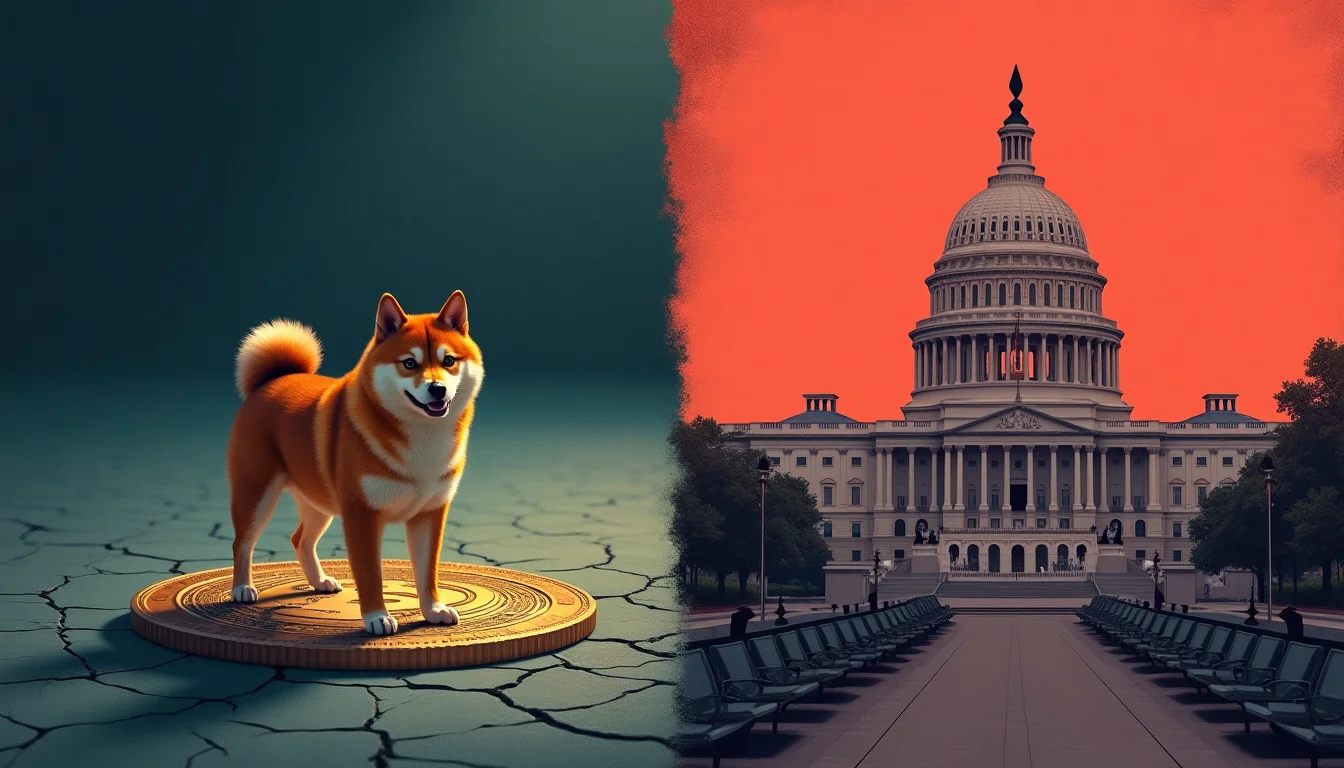
A Veteran Strategist's Alarm
According to Bloomberg Markets, economist David Rosenberg said he now views the current US equity market as the most dangerous of his four-decade career, pointing to stretched valuations and speculative concentration across asset classes. Rosenberg has spent much of his career flagging excess before it becomes obvious to the rest of the market — a role that invites comparison to the few voices who warned, correctly and mostly in vain, that the 2020-2021 meme coin mania was a symptom rather than an anomaly.
That mania is worth revisiting not for its absurdity — a joke currency based on a Shiba Inu meme briefly became the world's fourth-largest cryptocurrency — but for what happened afterward, or rather, what didn't. The political and regulatory response to a $90 billion speculative episode built on no cash flows, no product, and no claim on any underlying asset was remarkably thin. That thinness is the real lesson for anyone trying to calibrate the risk Rosenberg is now describing.
What $90 Billion in Speculation Bought Washington
Dogecoin, created in December 2013 by Billy Markus and Jackson Palmer as a parody of altcoin proliferation, reached a peak market capitalization of roughly $88 billion in May 2021. Combined with Shiba Inu — a token with a supply of one quadrillion units designed explicitly to exploit the psychological appeal of a low unit price — the pair's peak valuation exceeded $90 billion, larger than many constituents of the S&P 500. A single tweet from Elon Musk calling himself "the Dogefather" ahead of a Saturday Night Live appearance moved the asset 20% intraday before a 35% collapse followed the broadcast.
The episode exposed, in the starkest possible terms, that an unregulated market could allocate tens of billions of dollars based on internet virality alone. Yet the regulatory aftermath produced no meme-coin-specific framework. The Securities and Exchange Commission pursued scattered enforcement actions against exchanges and token issuers under existing securities law, while jurisdictional disputes between the SEC and the Commodity Futures Trading Commission over which agency even had authority to police digital assets dragged on for years. Congress held hearings, commissioned reports, and introduced competing market-structure bills, but comprehensive legislation addressing speculative tokens with no economic function never passed in the window when political attention was highest.
The Cost of Doing Nothing
The political calculus was straightforward: meme coin losses were diffuse, borne mostly by retail traders rather than concentrated institutions, and the broader crypto industry had strong enough lobbying incentive to resist blanket restrictions. Stablecoin regulation eventually advanced because it touched the banking and payments system directly. Meme coins, by contrast, were allowed to persist as a permanent feature of crypto markets — Dogecoin and Shiba Inu both still trade today, and new meme tokens launch by the thousands on platforms with essentially no vetting. The regulatory aftermath of the 2021 episode was not reform; it was tolerance dressed as caution.
This is the pattern regulatory-aftermath analysis keeps finding across bubbles: the cost of inaction is rarely paid by the institutions capable of preventing it. It was paid by retail investors who bought at the top, and it will likely be paid again by whoever is exposed when the next speculative wave — AI infrastructure spending, private credit, or renewed crypto leverage — unwinds. Rosenberg's warning sits inside that same unresolved tension: markets have been allowed to run on the assumption that intervention arrives only after the damage is done.
The Historical Parallel
The meme coin bubble remains one of the clearest modern illustrations of pure narrative-driven valuation, distinct from dot-com stocks or housing debt because meme coins carried no claim on revenue, assets, or even a working product roadmap. Their value was entirely a function of attention. Read the full The Meme Coin Bubble — Dogecoin, Shiba Inu, and the Joke That Became a $90 Billion Mania entry in the Bubblepedia Encyclopedia for the full account of how a parody currency briefly outvalued major industrial companies.
Why It Matters Now
Rosenberg's caution lands at a moment when equity valuations, concentrated AI capital expenditure, and renewed retail risk appetite are once again drawing comparisons to past speculative peaks. For readers assessing whether current pricing reflects fundamentals or momentum, macro conditions shaping this cycle deserve the same scrutiny applied retrospectively to 2021's meme coin frenzy. The lesson of that episode is not that regulators failed to predict Dogecoin's rise — it is that they failed to build durable guardrails after watching it happen in real time.
A market that tolerates a $90 billion valuation for an asset with no underlying claim on value, without producing lasting regulatory reform, has not resolved its speculative excess — it has simply priced it as acceptable.
Whether Rosenberg's warning marks the top of this cycle or merely another false alarm is, as with most bubble calls, impossible to know in advance. What is knowable is that the institutional and political response to the last clear case of pure speculation — tracked continuously at Bubble Watch and catalogued across the full Bubblepedia encyclopedia — was to let it pass without meaningful structural change. That omission, more than any single tweet or token, is the part of the meme coin story still shaping market risk today.