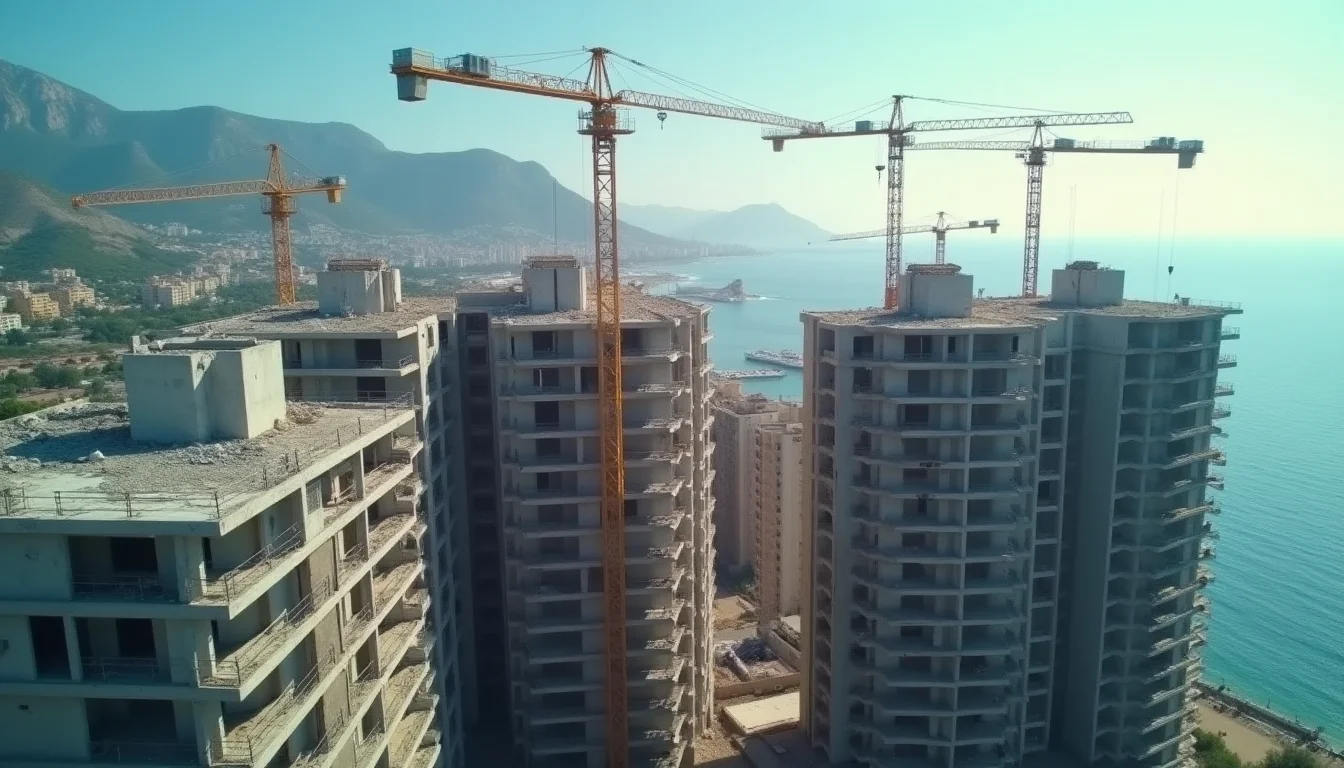
Spanish Property Bubble (1997-2008)
Spain built more houses than Germany, France, and the UK combined, leaving over 3 million empty homes and ghost towns of unfinished developments.
By Twin · @TwinTowerCity·
Key Takeaways
- →Spain built more houses from 1997-2008 than Germany, France, and the UK combined, leaving over 3 million empty homes.
- →Low eurozone interest rates designed for Germany's economy inappropriately fueled Spain's construction boom throughout the 2000s.
- →The Spanish property bubble peaked in 2007 and collapsed when the global financial crisis reduced demand and credit.
- →The burst left Spain with ghost towns of unfinished developments and construction unemployment reaching devastating levels.
- →Spain shows how one-size-fits-all monetary policy fails when construction reaches 12% of national GDP dependency.
Peak Year
2007
Crash Year
2008
Location
Spain
Asset Class
Real Estate
Severity
What Caused the Spanish Property Bubble?
Spain's property bubble was rooted in the country's 1999 entry into the eurozone, which dramatically lowered borrowing costs. Spanish interest rates fell from double digits in the early 1990s to below 4% by 2003, as the country adopted Germany's monetary policy despite having very different economic fundamentals. The 1998 Land Law liberalised construction permits, effectively allowing building on any land not specifically protected. A culture of property ownership — approximately 85% of Spaniards owned their homes, one of the highest rates in Europe — combined with cheap credit and light regulation to create ideal bubble conditions. Immigration also surged, with Spain's foreign-born population growing from under 2% in 1998 to over 12% by 2008, adding genuine housing demand.
The Mania Phase
At the height of the boom, Spain was building more houses annually than France, Germany, and the United Kingdom combined. In 2006, approximately 800,000 new housing units were started — roughly three times the rate justified by population growth and household formation. Property prices more than tripled between 1997 and 2007 in real terms. The construction sector grew to represent approximately 12% of GDP directly, with related industries pushing the total to an estimated 18-20%. The cajas — regional savings banks with close ties to local politicians — provided increasingly risky mortgage lending, often financing 100% or more of property values. Land prices in some coastal areas increased tenfold.
Peak Conditions
By 2007, household debt had reached approximately 130% of disposable income, up from 55% in 1997. Spanish banks' total exposure to construction and real estate lending exceeded €400 billion. Entire towns had been built on speculation — Seseña, south of Madrid, planned for 13,500 apartments in an area with no significant employment base. The ratio of house prices to household income reached approximately 7.7 nationally, compared to a long-term average of around 4. Despite these warning signs, Spanish authorities and European institutions largely dismissed concerns about a bubble, arguing that strong economic fundamentals — GDP growth, falling unemployment, rising immigration — justified valuations.
How Did the Spanish Property Bubble Crash?
The global financial crisis triggered Spain's property collapse, but domestic imbalances made it inevitable. Housing starts fell from 800,000 in 2006 to under 60,000 by 2013 — a decline of over 90%. Property prices fell approximately 35-40% nationally from peak to trough, with some coastal developments losing 60-70% of their value. Unemployment rose from 8% in 2007 to over 26% by early 2013, with youth unemployment exceeding 55%. The construction sector shed approximately 1.5 million jobs. The cajas suffered catastrophic losses, and in 2012, Spain requested a €41.3 billion European bailout specifically for its banking sector. Bankia, formed from the merger of seven troubled cajas, required a €22.4 billion rescue alone.
Aftermath and Recovery
Spain established SAREB (the 'bad bank') in 2012 to absorb approximately €50 billion in toxic real estate assets from failing lenders. The country underwent severe austerity measures, with budget cuts to healthcare, education, and public sector wages. Hundreds of thousands of completed but unsold apartments remained empty years after the crash — the 'ghost towns' became symbols of the excess. Evictions became a major social crisis, with approximately 400,000 foreclosure proceedings between 2008 and 2014. Social movements like the Plataforma de Afectados por la Hipoteca (PAH) emerged to resist evictions and advocate for housing rights. Property prices did not bottom out until approximately 2014 and did not return to pre-crisis levels in most areas until the early 2020s.
Lasting Legacy
The Spanish property bubble exposed fundamental flaws in the eurozone's architecture — a single monetary policy could not simultaneously serve economies with vastly different conditions. It demonstrated how construction-driven growth creates an illusion of prosperity that masks structural weaknesses. The crisis also revealed the dangers of politically connected lending through the cajas system, which prioritised local development projects over sound risk management. Spain's experience became a case study in how euro adoption could amplify rather than dampen boom-bust cycles in peripheral economies, contributing to broader debates about eurozone reform and fiscal integration.
EU Funds, the Euro, and the Flood of Cheap Credit
Spain entered the 1990s as a peripheral European economy with persistent fiscal deficits, double-digit interest rates, and a peseta that had been devalued repeatedly throughout the previous decade. The transformation that produced the property bubble was structural, not cyclical, and it began with two specific policy events: Spain's accession to the European Economic Community in 1986 and its adoption of the euro in 1999.
EU structural and cohesion funds delivered approximately €150 billion to Spain between 1986 and 2013, the largest cumulative transfer to any member state. These funds financed the motorway network, high-speed rail, water infrastructure, and the urbanisation of formerly agricultural land along the Mediterranean coast. Spain became, by the early 2000s, a country in which the act of building was institutionally subsidised at every level of government. Regional governments received construction-linked transfers; municipal governments depended on rezoning fees as a primary revenue source; the central government counted construction as roughly 12% of GDP at the bubble's peak — more than double the EU average.
Euro adoption was the more consequential shock. Between 1999 and 2007, ten-year Spanish sovereign yields fell from 5.8% to 4.3%, converging almost exactly with German Bunds despite Spain's structurally weaker fiscal position. Mortgage rates fell from above 11% in 1995 to 3.5% by 2005. For Spanish households accustomed to two decades of double-digit borrowing costs, the shift was transformational. Mortgage debt outstanding rose from 25% of GDP in 1995 to 65% by 2007. Per-capita housing starts reached the highest level in any developed economy: in 2006 Spain built roughly 760 000 new housing units, more than France, Germany, and Italy combined despite having less than half the combined population.
The Cajas — Political Banks and Reckless Lending
The institutional vehicle that channelled this credit boom was Spain's network of cajas de ahorros — regional savings banks. The cajas were unusual hybrid entities: legally not-for-profit foundations, but functionally retail and commercial banks. Their governing boards were dominated by appointees of regional and municipal governments, trade unions, and church bodies. They were politically captured by design.
The combination of political governance and rapid balance-sheet growth proved catastrophic. Cajas lent aggressively to local property developers — frequently those connected to regional politicians — without rigorous credit analysis. Loan-to-value ratios above 100% became routine for new-build properties; "soft seconds" (additional unsecured loans for furniture and white goods) pushed total exposure higher still. By 2008 the cajas held more than half of Spanish mortgage debt and roughly 70% of construction-sector loans.
The most infamous case was Caja Madrid, which merged with six smaller cajas in 2010 to form Bankia, a vehicle so fragile that its 2011 IPO at €3.75 per share collapsed within twelve months. Bankia required a €19 billion state recapitalisation in May 2012 — the largest single bank rescue in Spanish history — and the IPO was eventually ruled fraudulent by the Spanish Supreme Court, with directors including former IMF managing director Rodrigo Rato convicted of mismanagement. The "tarjetas black" scandal, in which Bankia executives spent €15.5 million on undisclosed corporate credit cards, became the public symbol of caja governance failure.
The Human Cost — A Lost Generation
The construction sector, which had employed roughly 2.7 million Spanish workers at the 2007 peak, shed more than 1.6 million jobs by 2013. The unemployment rate rose from 8% in 2007 to 27% in 2013 — the highest in the EU and a level not seen in Spain since the early years of the post-Franco transition. Youth unemployment (under 25) exceeded 55% by 2013, peaking at 56.1% in early 2013 according to Eurostat.
The demographic consequences are still working through Spanish society. Net emigration of working-age Spaniards to the United Kingdom, Germany, France, and Latin America averaged roughly 80 000 per year between 2010 and 2015 — the first sustained net outflow since the Franco era. Birth rates fell from 1.46 in 2008 to 1.19 by 2018, well below replacement and among the lowest in the EU. Household formation among Spaniards aged 25–34 collapsed; by 2014, more than 60% of young adults still lived with their parents, the highest share in Western Europe.
"The Spanish bubble was not paid for by the speculators who profited from it. It was paid for by a generation of young Spaniards who entered the labour market between 2008 and 2015 and have, in measurable terms, never recovered."
The Bailout, the Ghost Cities, and the Lasting Legacy
Spain formally requested EU assistance for its banking system on 9 June 2012. The eventual programme drew €41.3 billion from the European Stability Mechanism, conditional on the creation of SAREB — Spain's "bad bank" — to absorb the cajas' worst property exposures at a 50–60% discount to book value. The bailout was conditional on banking sector reforms, including the consolidation of 45 cajas into roughly 10 surviving entities and the imposition of bondholder losses through the controversial conversion of preferred shares.
The physical legacy of the bubble is still visible across the Spanish landscape. Seseña, a development outside Madrid, was built to house 30 000 residents and held fewer than 5 000 a decade after completion. Valdeluz, near Guadalajara, similarly stranded. The airports of Castellón (built for €150 million, no commercial flights for years after opening), Ciudad Real (closed in 2012 after operating for less than four years), and Lleida-Alguaire (built for €100 million, almost no scheduled traffic) became iconic illustrations of construction-driven misallocation.
Roughly 3.4 million Spanish properties were classified as vacant in the 2011 census; the figure had only modestly improved by 2021. The combination of overbuild, demographic stagnation, and continuing migration to coastal and metropolitan areas means that significant portions of Spain's interior face permanent oversupply. See Ireland and the United States for the contemporaneous parallels in similar credit-driven property booms.
Recommended Reading


Key Statistics
Housing Starts (peak year)
600,000–800,000 annually
Empty Homes (est.)
3–3.5 million (various estimates)
Construction % of GDP
~10–12% at peak
Peak Unemployment
~27% (56% youth, 2013)
Banking Bailout (ESM)
€41.3 billion
Warning Signs
- Building more homes than DE+FR+UK combined
- Construction growing from 7% to 12% of GDP
- Interest rates set for Germany applied to Spain
- Entire coastlines of speculative developments
Timeline
1999
Spain joins Eurozone — German interest rates applied
2002-06
Construction boom — 600–800K housing starts/year
2007
Property prices peak — first defaults emerge
2008
Global Financial Crisis triggers collapse
2012
€41 billion European banking bailout
2013
Unemployment peaks at 27%
Lessons Learned
Spain demonstrates the danger of one-size-fits-all monetary policy within a currency union. Interest rates appropriate for Germany's sluggish growth were wildly inappropriate for Spain's booming economy, fuelling construction that had no fundamental demand. When construction becomes 12% of GDP, the economy becomes structurally dependent on continued building — a dependency that cannot survive any slowdown.
Frequently Asked Questions
What caused the Spanish property bubble?
The Spanish property bubble was caused by low interest rates after joining the eurozone, massive capital inflows from Northern Europe, relaxed lending standards, and government policies encouraging homeownership. Banks offered 100% mortgages with minimal documentation. Regional governments rezoned agricultural land for development, while speculation drove demand as property became an investment vehicle rather than housing.
How much did Spanish house prices rise and fall during the property bubble?
Spanish house prices rose approximately 180% between 1997-2007, with average prices increasing from €100,000 to €280,000. After the crash, prices fell roughly 40% from peak to trough by 2013. Some areas experienced even steeper declines, with coastal developments and remote locations seeing drops of 60% or more from their bubble-era highs.
What were the warning signs of the Spanish property bubble?
Warning signs included construction comprising 20% of GDP (double the EU average), Spain building 800,000 homes annually versus Germany's 200,000, household debt reaching 130% of income, and property prices rising faster than wages. Ghost airports, empty developments, and cranes dominating skylines became symbols of unsustainable overbuilding across the country.
What lessons does the Spanish property bubble teach investors?
The Spanish bubble teaches that sustained low interest rates can create dangerous asset bubbles, government policies can distort markets, and geographic diversification within property isn't always protective. It demonstrates how entire economies can become dangerously dependent on construction, and shows that 'safe' real estate investments can experience devastating crashes when fundamentals disconnect from prices.
Current Relevance
Spain's experience is directly relevant to ongoing debates about Eurozone monetary policy and to any country where construction has become an outsized proportion of economic activity. China's current property crisis — with similarly vast overbuilding — invites direct comparison.
Explore gold storage options
Gold is not a guaranteed hedge against crashes. Prices can fall; storage fees and custody risks also matter.
Affiliate link: Bubblepedia may earn a commission. Not a recommendation; investment values can fall.
Recommended Reading
Recent Analysis
Spain's Immigration Boom: Warning Signs for Australia
20 Oct 2026
Ireland's Celtic Tiger Collapse: A Housing Bubble Case Study
15 Oct 2026
Construction Bubbles: Learning From 2008
9 Oct 2026
Spain's 2007 Cajas Bubble: A Warning for Today's IPO Rush
4 Oct 2026
Construction Bubbles: Spain, Ireland, US & Australia Risk
4 Oct 2026
Get Bubblepedia in your inbox
Asset bubbles and market-history insights in your inbox.