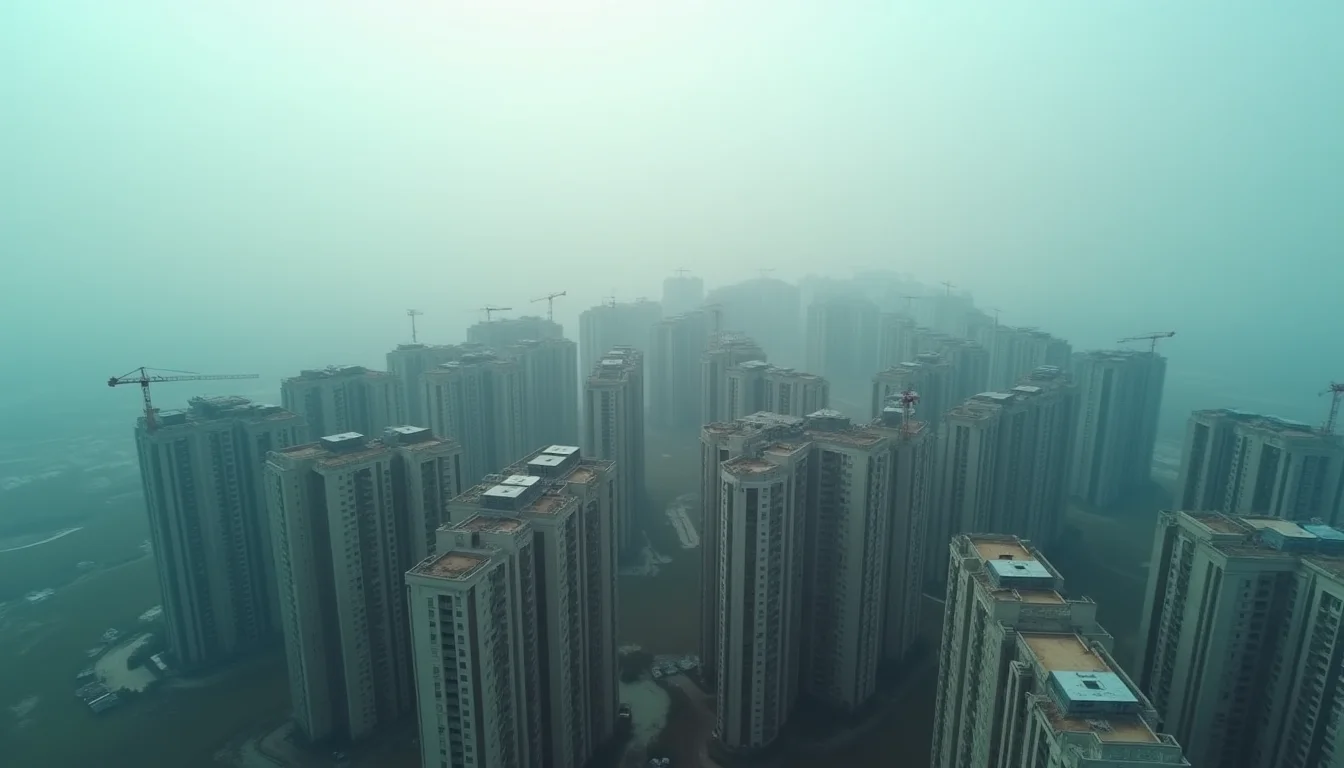
Chinese Property Bubble and Evergrande Crisis (2000-Present)
China's property sector reached an estimated $62 trillion in value. Evergrande's $300 billion+ liabilities triggered a crisis threatening the world's second-largest economy.
By Twin · @TwinTowerCity·
Key Takeaways
- →China's property sector reached an estimated $62 trillion in value by 2021, becoming the world's largest asset bubble.
- →Property became China's primary household savings vehicle, local government revenue source, and GDP growth driver simultaneously.
- →Evergrande's collapse in 2021 with over $300 billion in liabilities triggered China's broader property crisis.
- →The crisis threatened China's position as the world's second-largest economy through systemic real estate exposure.
- →Even powerful governments cannot prevent structural overbuilding consequences when economies become addicted to construction growth.
Peak Year
2021
Crash Year
2021
Location
China
Asset Class
Real Estate
Severity
What Caused the Chinese Property Bubble and Evergrande Crisis?
China's property sector grew to become the single largest asset class in the world, with an estimated total value exceeding $60 trillion by 2020 — roughly twice the size of the US residential property market. The sector's importance to the Chinese economy was difficult to overstate: property construction and related industries contributed an estimated 25-30% of GDP when including upstream suppliers (steel, cement, glass) and downstream services (furnishing, appliances, property management). The boom was rooted in China's 1998 housing reform, which privatised the housing market and established property ownership as the primary vehicle for household wealth accumulation. With limited investment alternatives — capital controls restricted foreign investment, the domestic stock market was volatile and mistrusted, and bank deposit rates were below inflation — property became the default savings vehicle for hundreds of millions of Chinese families.
The Mania Phase
Chinese property developers adopted a high-leverage, high-turnover model pioneered by companies like Country Garden and perfected by China Evergrande Group. Developers pre-sold apartments years before completion, using the deposits to fund land purchases for new projects — a self-perpetuating cycle that required constant sales growth to remain solvent. Evergrande, founded in 1996 by Xu Jiayin, grew to become China's largest developer by sales, with over 1,300 projects in more than 280 cities. By 2020, the company had accumulated approximately $300 billion in total liabilities. The broader sector's debt levels were staggering: Chinese property developers collectively owed an estimated $5 trillion. Housing prices in tier-1 cities like Beijing and Shenzhen reached price-to-income ratios of 30-50 — among the highest in the world. Yet approximately 65 million apartments stood empty across China, purchased as investments rather than homes.
Peak Conditions
By 2020, the Chinese property market exhibited multiple signs of overextension. Land sales revenue constituted approximately 40% of local government fiscal revenue nationwide and over 60% in some provinces, creating a dangerous fiscal dependency. Chinese households had approximately 70% of their wealth in property — far higher than in most developed economies. Annual housing completions reached approximately 10 million units, roughly 10 times the rate of the United States despite a population only 4 times larger. The central government, recognising the systemic risk, introduced the 'three red lines' policy in August 2020, imposing strict limits on developer borrowing based on three financial ratios. This policy, while prudent, effectively cut off the credit lifeline that the sector's business model depended upon.
How Did the Chinese Property Bubble and Evergrande Crisis Crash?
Evergrande's liquidity crisis became public in late 2021 when the company missed payments on its offshore dollar bonds. The crisis rapidly spread across the sector. Country Garden, previously considered a more conservative developer, teetered on the brink of default in 2023. Dozens of smaller developers defaulted outright. Most consequentially, the pre-sale model collapsed: homebuyers who had paid deposits on unfinished apartments staged a nationwide 'mortgage boycott' in mid-2022, refusing to make payments on homes that might never be completed. An estimated 2 million pre-sold apartments across China were stalled or abandoned. New home sales fell approximately 40% from 2021 peaks. Property investment declined for the first time in modern Chinese history. Land sales revenue collapsed, blowing holes in local government budgets and triggering a fiscal crisis in provinces that had become dependent on development-related income.
Aftermath and Recovery
The Chinese government's response evolved from initial restraint to increasingly desperate intervention. Measures included reducing mortgage rates, lowering down payment requirements, relaxing purchase restrictions in major cities, and establishing rescue funds to complete stalled projects. The PBOC created a 200 billion yuan relending facility specifically for housing completion. However, unlike previous Chinese economic slowdowns, the property downturn proved resistant to stimulus. Consumer confidence was shattered: potential buyers delayed purchases, expecting further price declines — a dynamic unfamiliar in a market where prices had only ever risen. Evergrande was eventually ordered into liquidation by a Hong Kong court in January 2024. The demographic backdrop made recovery even more challenging — China's population began declining in 2022, undermining the fundamental demand case for continued property construction.
Lasting Legacy
The Chinese property crisis represents potentially the largest real estate correction in human history by absolute value. Its implications extend far beyond the property sector: it has forced a fundamental rethinking of China's economic growth model, which relied heavily on infrastructure and property investment to generate GDP growth. The crisis exposed the risks of a development model where local government revenue, household wealth, and banking system stability were all simultaneously dependent on continuously rising property values. The social consequences have been profound — a generation of young Chinese people facing declining property values, limited job prospects, and the expectation of supporting aging parents in a country without a comprehensive pension system. The 'lying flat' and 'let it rot' social movements, while predating the property crisis, have been amplified by it. The episode has drawn comparisons to Japan's post-1989 experience and raised questions about whether China might face a similar prolonged period of economic stagnation.
The Three Red Lines Policy
In August 2020, the People's Bank of China and the Ministry of Housing announced a regulatory framework that became known as the three red lines. The policy set three financial thresholds for property developers: liabilities to assets must be below 70%, net debt to equity must be below 100%, and cash holdings must exceed short-term debt obligations. Developers that breached all three lines were prohibited from increasing their debt at all. Those that breached two were limited to 5% annual debt growth. Those that breached one were limited to 10%. Developers that complied with all three were permitted 15% annual debt growth.
The policy represented a deliberate decision by Beijing to deflate a property bubble that had been building for two decades. Chinese property prices had risen approximately 700% in real terms between 2000 and 2020, and household leverage had reached levels comparable to the United States in 2007. The Communist Party's calculation was that the political and economic damage of an extended slow-motion deflation was preferable to allowing the bubble to continue inflating until it produced a more catastrophic correction. The policy was a textbook example of authoritarian capacity to make decisions that democratic political systems typically cannot, and its consequences would unfold over the following four years.
The Evergrande Collapse in Detail
China Evergrande Group, founded by Hui Ka Yan in 1996, had grown by 2020 into the second largest property developer in China by sales, with total liabilities of approximately $300 billion (equivalent to roughly 2% of Chinese GDP). The company breached all three red lines immediately upon their introduction. Throughout 2021, Evergrande attempted to raise cash through asset sales, but the broader market deterioration meant that buyers either could not be found or would only transact at distressed prices. On 23 September 2021, Evergrande missed an $83.5 million coupon payment on its dollar bonds, triggering the formal default that international markets had been anticipating for months.
The human and operational scale of the Evergrande collapse was staggering. The company had pre-sold approximately 1.4 million apartments to Chinese households who had paid deposits of 30 to 100% of the purchase price for properties that had not yet been built. Approximately 200,000 employees and an estimated 3.8 million construction workers depended on the company's continued operation. The Hong Kong High Court ordered the company's liquidation on 29 January 2024, more than two years after the initial default, with offshore creditors expected to recover a few cents on the dollar against the $25 billion in dollar bonds the company had issued. The onshore restructuring affecting Chinese suppliers, employees, and home buyers remains incomplete.
The Contagion Across Chinese Developers
Evergrande was the largest but far from the only casualty. Country Garden, which at its peak had been the largest Chinese developer by contracted sales, defaulted on dollar bond payments in October 2023. Sunac China defaulted in May 2022 and completed a restructuring in November 2023. Fantasia Holdings, Kaisa Group, Modern Land, and dozens of smaller developers entered default between 2021 and 2023. The total dollar-denominated bond defaults by Chinese property developers exceeded $140 billion by the end of 2023, the largest sectoral default cycle in emerging market history.
The crisis extended beyond the developers themselves to the local government financing vehicles (LGFVs) that Chinese provinces and municipalities had used to fund infrastructure investment. LGFV revenues depended substantially on land sales to property developers, and as the developers stopped buying land, provincial fiscal positions deteriorated rapidly. By 2024, total LGFV debt was estimated at approximately 50 trillion yuan (roughly $7 trillion), with several provinces including Guizhou and Yunnan facing acute liquidity stress. The property crisis had become a fiscal crisis at the subnational level, and the central government's reluctance to provide explicit bailouts created persistent uncertainty about ultimate loss allocation.
"China's property sector contributes 25 to 30 percent of GDP when all the upstream and downstream linkages are counted. A correction of this magnitude has no historical precedent in a major economy outside wartime." — Kenneth Rogoff, Harvard economist, 2023
The Macroeconomic Consequences
Property and related industries had grown to represent 25 to 30% of Chinese GDP at the 2020 peak, a share higher than any major economy in modern history (the United States peaked at approximately 18% in 2006, Spain at 22% in 2007, and Ireland at 24%). The contraction of the sector therefore produced a sustained drag on Chinese growth that monetary and fiscal policy struggled to offset. GDP growth slowed from the 6% range that had characterised the prior decade to approximately 4.5 to 5% in 2023 and 2024, with substantial concerns about the accuracy of the official figures.
The wealth effect on Chinese households has been the more politically sensitive consequence. Approximately 70% of Chinese household wealth is held in residential property, and the price declines (estimated at 10 to 20% nationally and 30%+ in over-built second and third-tier cities) have translated directly into reduced consumer spending, falling marriage and birth rates, and rising youth unemployment. The parallels with Japan's 1990s property collapse are explicit and increasingly acknowledged within the Chinese policy debate. The risk of a Chinese lost decade, in which deflationary pressure from the property correction prevents the economy from achieving its growth potential, is no longer dismissed by mainstream analysts. The eventual scale and duration of this episode will likely place it alongside the Japanese bubble as one of the defining property crises of the modern era.
Recommended Reading
Key Statistics
Chinese RE Value at Peak (est.)
~$62 trillion (Goldman Sachs est.)
Evergrande Liabilities
$300+ billion (company filings)
Unfinished Pre-Sold Homes (est.)
Tens of millions (exact figure debated)
Vacant Apartments (est.)
Tens of millions (methodology varies widely)
Price Decline (major cities)
~30% from peak (NBS data)
RE + Related % of GDP (est.)
~25–29% (various estimates)
Warning Signs
- Property and related sectors representing 29% of GDP
- Tens of millions of estimated vacant apartments across the country
- Local governments dependent on land sales for revenue
- Property as primary household savings with no alternatives
- Developer presale model creating massive unfinished inventory
Timeline
2000s
Chinese property boom begins with urbanisation
2015
Ghost cities documented — massive overbuilding visible
Aug 2020
Three red lines policy restricts developer borrowing
Dec 2021
Evergrande defaults on $300B+ in liabilities
2022-23
Multiple major developers default — Country Garden, Sunac
2024
Prices down 30% in major cities, 50%+ in smaller cities
Lessons Learned
China's property crisis demonstrates that even the most powerful government in the world cannot prevent the consequences of structural overbuilding. When property becomes simultaneously the primary household savings vehicle, the primary source of local government revenue, and the primary driver of GDP growth, the economy becomes structurally addicted to continued building regardless of demand. The parallel with Japan's 1989 bubble — including the initial belief in government exceptionalism — is uncomfortable but instructive.
Frequently Asked Questions
What caused the Chinese property bubble and Evergrande crisis?
The bubble was caused by excessive government stimulus, loose monetary policy, and speculation treating real estate as investment vehicles. Local governments relied heavily on land sales for revenue. Developers like Evergrande used aggressive leverage and pre-sales financing to fuel rapid expansion, creating unsustainable debt levels that eventually triggered the crisis when financing dried up.
How much did Chinese property prices rise during the bubble?
Chinese property prices increased dramatically over two decades, with some tier-1 cities seeing 10-15x price increases since 2000. The sector reached an estimated $62 trillion in total value. However, prices began declining in 2021, with some cities experiencing 20-30% drops as the bubble deflated and developer defaults mounted.
What were the warning signs of the Chinese property bubble?
Key warning signs included ghost cities with millions of empty apartments, property-to-income ratios exceeding international norms, developers' extreme leverage ratios, and real estate comprising over 25% of China's GDP. Evergrande's debt-to-equity ratio exceeded 200%, while pre-sales financing created dangerous cash flow dependencies signaling unsustainable growth patterns.
What lessons does the Chinese property bubble teach investors?
The crisis demonstrates that government support doesn't guarantee perpetual asset appreciation, and 'too big to fail' assumptions can be wrong. It highlights dangers of excessive leverage in property development, interconnected systemic risks, and how demographic shifts can puncture property bubbles. Diversification and sustainable debt levels remain crucial for long-term stability.
Current Relevance
The Chinese property crisis is ongoing and represents arguably the single largest risk to the global economy. With $62 trillion in property value at stake and Chinese GDP growth directly dependent on property sector stabilisation, the resolution of this crisis will shape global economic conditions for a decade or more.
Explore gold storage options
Gold is not a guaranteed hedge against crashes. Prices can fall; storage fees and custody risks also matter.
Affiliate link: Bubblepedia may earn a commission. Not a recommendation; investment values can fall.
Recommended Reading
Recent Analysis
Anthropic Cash Burn: AI Systemic Risk Warning
19 Nov 2026
Chip Selloff Overwhelms Inflation Relief
13 Nov 2026
AI Trade Unwind Sparks Asian Portfolio Rotation
8 Nov 2026
China's $62 Trillion Property Bust Meets Export Boom
11 Oct 2026
Construction & GDP: Ireland vs China Property Busts
14 Sept 2026
Get Bubblepedia in your inbox
Asset bubbles and market-history insights in your inbox.