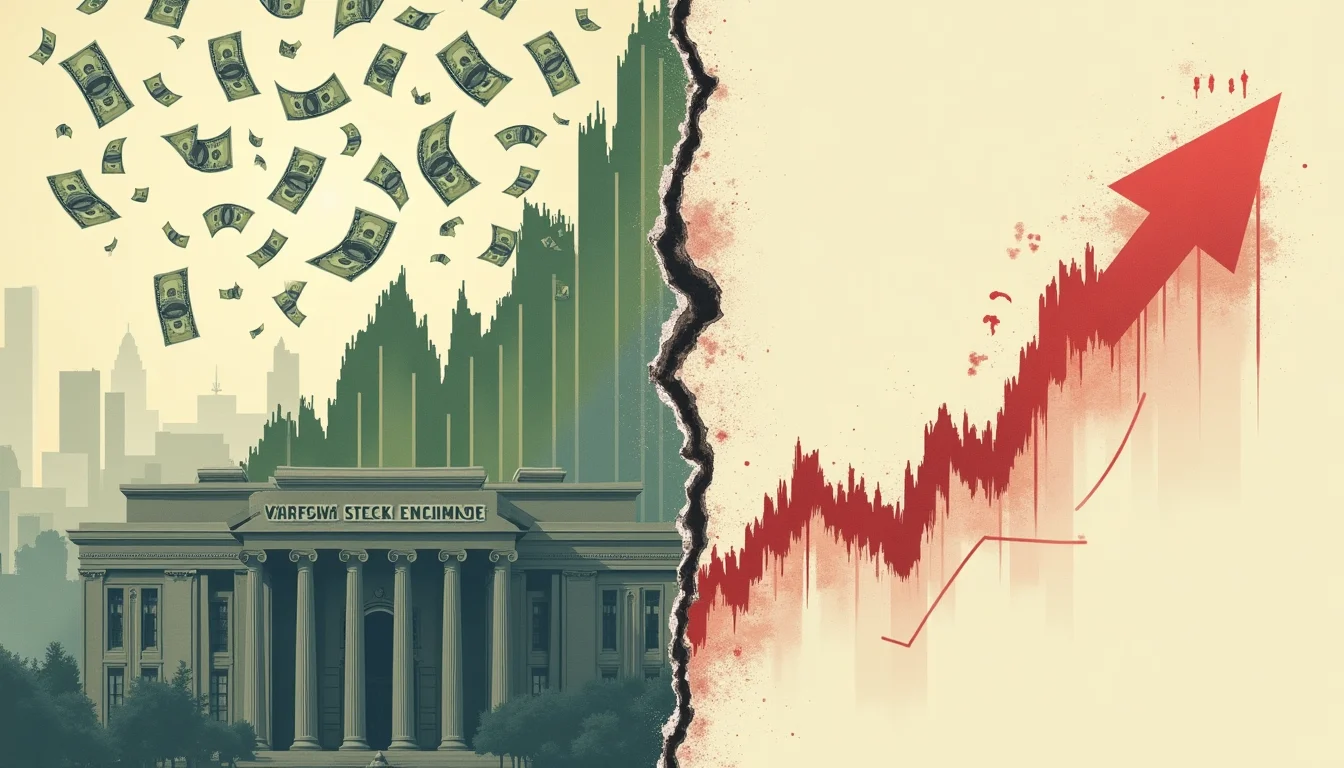
When Foreign Capital Meets a Thin Market
Poland's equity market, while sophisticated by emerging-market standards, remains structurally thin compared to the major indices. The Warsaw Stock Exchange's total market capitalisation is a fraction of the DAX or CAC 40. When foreign capital enters a thin market rapidly, the price-discovery mechanism can be overwhelmed — not because the underlying businesses have changed, but because the marginal buyer is operating with a different time horizon and risk appetite than domestic participants. This dynamic is not unique to Poland. It is, in fact, one of the defining structural features of every significant emerging-market equity bubble of the past three decades.
The most instructive recent precedent is not the 1997 Asian financial crisis, nor the 2008 Eastern European credit crunch. It is China's Shanghai Composite between mid-2014 and June 2015 — a bubble that was, at its core, a story about credit structure overwhelming price rationality. Read the full Chinese Stock Market Bubble (2014-2015) entry in the Bubblepedia Encyclopedia for the complete anatomy of that episode.
China 2015: The Margin Architecture of a Collapse
The Shanghai Composite rose dramatically from mid-2014 to a peak in June 2015 — a substantial gain in roughly twelve months. The catalyst was not organic earnings growth. It was credit. Margin lending on the Shanghai and Shenzhen exchanges expanded enormously in under eighteen months, representing a many-fold increase. Regulators loosened margin requirements, state media promoted equity investment as a patriotic act, and new brokerage accounts were being opened at very high rates by early 2015.
Critically, the official margin figures understated the true exposure. A substantial volume of shadow margin lending operated through online platforms and trust companies, entirely outside the regulatory perimeter. When the Shanghai Composite began to fall in June 2015, margin calls on this invisible debt layer amplified the decline with brutal efficiency. The index fell sharply over the following months, destroying an enormous amount of market value.
This observation, derived from the documented structure of the 2015 Chinese crash, is not merely a historical curiosity. It is a framework for evaluating any market where price momentum is outrunning fundamental valuation.
The Leverage Anatomy: What to Watch in Emerging-Market Rallies
The Chinese bubble's credit structure had four identifiable components, each of which contributed to the eventual cascade. First, there was regulated margin lending — visible, measurable, and ultimately inadequate as a warning signal because it captured only part of the picture. Second, there was shadow margin through online peer-to-peer platforms and trust products, which grew faster than the regulated segment and was largely invisible to the China Securities Regulatory Commission until the crash was already underway. Third, there was stock-pledged lending, where controlling shareholders borrowed against their own holdings, creating a feedback loop between falling prices and forced selling by the very people who should have been stabilising the market. Fourth, there were structured products — umbrella trusts and layered wealth management products — that embedded equity exposure inside fixed-income wrappers, exposing conservative retail investors to equity volatility they did not know they held.
In the Polish context, the relevant question is not whether Warsaw has replicated this exact architecture — it almost certainly has not, given the different regulatory environment and the dominance of institutional rather than retail flows. The relevant question is what the marginal buyer's credit structure looks like. Foreign institutional flows into emerging markets are frequently accompanied by derivatives overlays, currency hedges, and leverage at the fund level that is invisible at the asset level. A stock that appears to be held by a long-only foreign pension fund may in practice sit inside a structure that includes embedded leverage. When redemptions come, the selling is not proportional to the nominal position — it is amplified.
For broader macro context on how credit cycles interact with emerging-market equity flows, the historical pattern is consistent: capital inflows compress risk premiums, rising prices validate the inflows, and the resulting momentum attracts further capital until a reversal — triggered by currency movement, a rate decision, or simply exhaustion of the marginal buyer — exposes the leverage embedded in the structure.
State Promotion and the Policy Trap
One of the most underappreciated elements of the Chinese 2015 bubble was the role of state endorsement in suppressing investor caution. When People's Daily publishes editorials arguing that share prices have significant room to rise, retail investors rationally update their priors — not because they believe the editorial analysis, but because state endorsement signals that the government will not allow a significant decline. This implicit put option encourages risk-taking that would not otherwise occur, and it creates a policy trap: if the government does not intervene when prices fall, it loses credibility; if it does intervene, it validates the assumption that drove the excess in the first place.
China's government has been managing precisely this trap since 2015, and the experience directly informs its current responses to both property sector stress and periodic equity volatility. The lesson embedded in the 2015 episode — that state-endorsed credit expansion into equities creates a fragility that intervention cannot easily resolve — remains one of the most important in contemporary financial history. Our current bubble risk indicators track several markets where analogous policy dynamics are present.
Why the Credit Structure Is the Story
The Warsaw rally may prove entirely justified on fundamentals. Poland's fiscal position, its integration into European supply chains, and its demographic path relative to Western Europe all provide legitimate reasons for a valuation rerating. But the history of emerging-market bubbles — from Shanghai in 2015 to the dot-com era to the Asian crisis — consistently shows that the question of whether a rally is fundamentally justified is secondary to the question of how it is financed. A fundamentally justified rally financed by excessive margin debt will still produce a crash when the margin calls arrive. The underlying value does not prevent the liquidation cascade — it merely determines where prices eventually stabilise after the leverage is purged.
The Chinese Stock Market Bubble of 2014-2015 destroyed an enormous amount of market value in a matter of months, not because Chinese companies had no worth, but because the credit structure supporting their prices was built to amplify gains in one direction and losses in the other. Any market experiencing rapid foreign inflows, thin liquidity, and compressed risk premiums deserves to have that same question asked of it — clearly, specifically, and without the comfort of assuming that this time the fundamentals will protect against the mechanics.