The Mechanism, Not the Asset
The 1970s commodity supercycle is most commonly remembered for its headline numbers — crude oil roughly quadrupling in the months following the 1973 OPEC embargo, US CPI reaching historically extreme levels around 1980, gold peaking at very high nominal levels in January 1980. These figures are dramatic, but the underlying financial mechanism is more instructive than any single price point.
The supercycle was not simply a story about oil or gold. It was a story about what happens when three forces converge simultaneously: a genuine supply disruption in a commodity that has no short-term substitute, a monetary framework that has lost its anchor, and a speculative layer that amplifies both. Remove any one of those three elements and the outcome changes substantially. All three together produced a decade of stagflation that broke the post-war Keynesian consensus and forced a fundamental rethinking of central bank mandates.
Europe's Structural Analogy
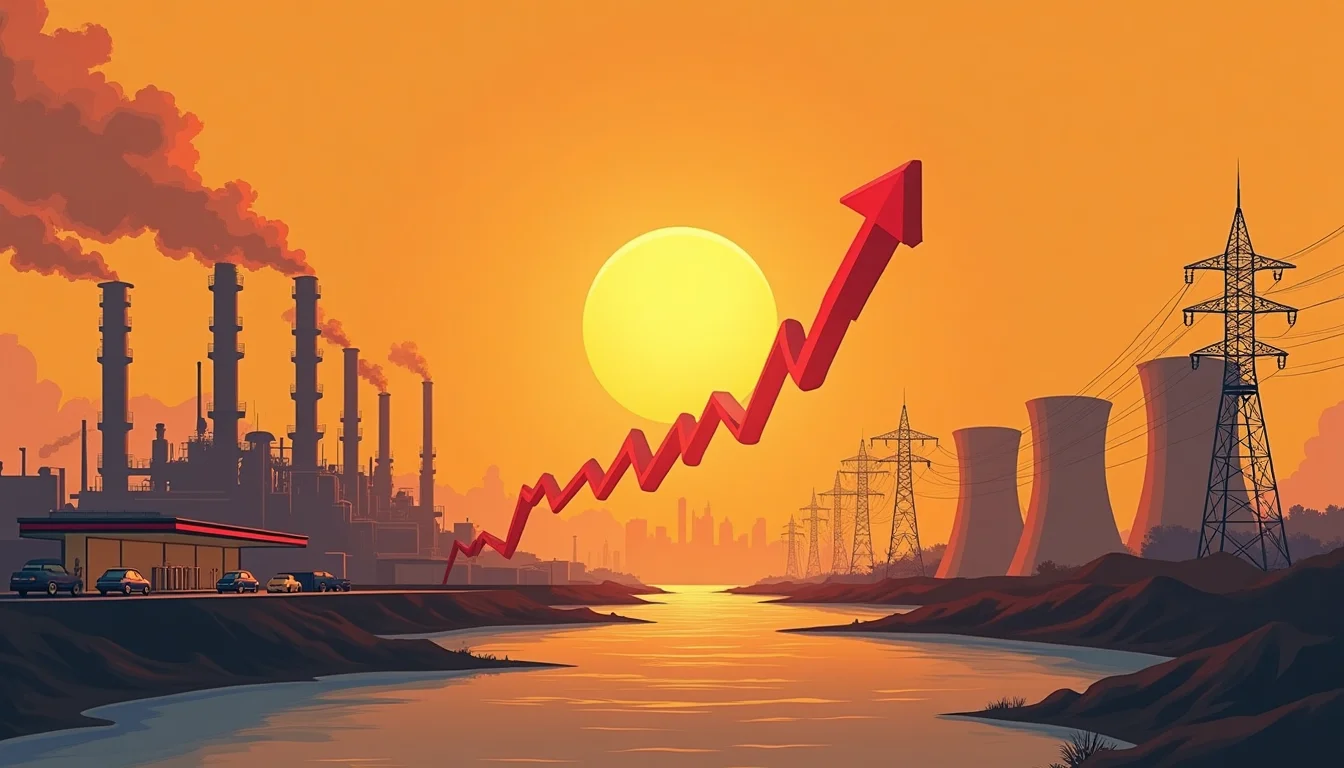
The structural parallel emerging in Europe in 2026 is not identical to 1973, but the mechanism shares recognisable features. European power markets face a supply-side constraint that is becoming less episodic and more structural: heat reduces the cooling capacity of nuclear reactors, lowers river levels that hydroelectric dams depend on, and increases demand precisely when generation capacity is most constrained. These are not speculative risks — they are documented operational outcomes that European grid operators have been managing with increasing difficulty across successive summers.
The monetary context is different from 1971 but not entirely dissimilar in its uncertainty. The European Central Bank managed a difficult inflation cycle between 2021 and 2024, and while headline inflation has moderated, the transmission of energy price volatility into broader price levels remains a live concern. Any renewed energy price spike — driven by climate-related supply disruption rather than geopolitical embargo — would arrive in a monetary environment where central bank credibility has been tested but not fully restored. For macro context on how monetary regimes interact with commodity shocks, the post-Bretton Woods period remains the most thoroughly studied case.
The third element — speculative amplification — is present in European energy markets through the structure of power purchase agreements, carbon pricing mechanisms, and the increasing financialisation of energy contracts. When physical supply tightens, financial positions built on assumptions of stable supply do not simply unwind; they amplify the price signal, sometimes dramatically. This is precisely what happened in European gas markets in 2021-2022, when the initial supply tightening from reduced Russian pipeline flows was magnified by a derivatives market that had not priced tail risk adequately.
Successive Waves, Not a Single Event
One of the most analytically useful features of the 1970s supercycle is that it arrived in waves rather than as a single shock. The 1973 oil crisis was followed by a partial price stabilisation, then the 1979 Iranian supply disruption removed a meaningful share of world supply and drove prices sharply higher. Each wave was treated by policymakers as a discrete event rather than a symptom of a structural condition. The result was that policy responses were consistently calibrated to the previous shock rather than the underlying dynamic.
Europe's heat-wave energy problem has followed a similar episodic pattern. Each summer's disruption has been managed as an operational emergency, with emergency capacity measures and demand-response programs providing short-term relief. The structural question — whether the combination of climate variability and the current generation mix creates a permanently higher floor for energy price volatility — has been addressed in policy documents but not yet in market pricing in any consistent way.
This is the gap that historically precedes the most damaging phase of a supply-driven price cycle. When the market finally prices the structural condition rather than the episodic event, the adjustment is rarely orderly. In 1979, oil markets had already experienced one major shock; the second arrived faster and harder because the underlying fragility had not been resolved.
The lesson is not that Europe is heading for a 1970s-style decade of stagflation. The energy mix is different, the monetary institutions are different, and the geopolitical context is different. The lesson is about the mechanism: supply shocks that are treated as temporary events, arriving against a backdrop of monetary uncertainty, with a financialised market structure that amplifies price signals, tend to produce outcomes that are larger and more persistent than contemporaneous forecasts suggest. Investors and policymakers who track current bubble risk indicators can monitor how these pressures are evolving at /bubble-watch.
The 1970s did not announce itself as a supercycle in 1971. It announced itself as a series of manageable disruptions, each of which was managed — until the accumulated structural pressure produced an outcome that was not manageable at all. That pattern is worth watching carefully in European energy markets today.
See also: 1970s Oil Crisis vs 2020s Energy Transition — Two Commodity Supercycles.