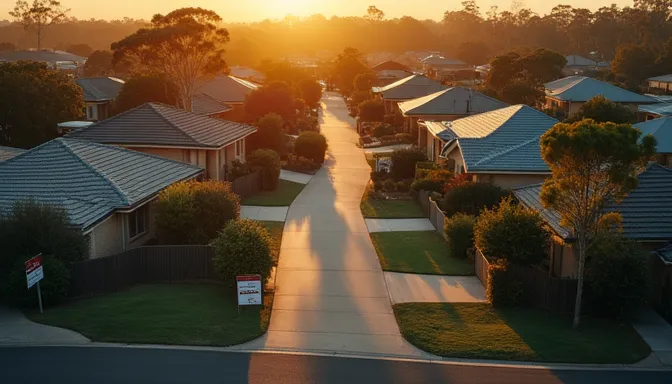
The Scale of the Decline
According to Bloomberg Markets, Australia's Home Value Index for major cities slid 1.4% in October and is down 8.1% over the past seven months, property consultancy Cotality reported on Monday. Brisbane led the declines with a 2% drop, followed by Perth at 1.7%, Sydney at 1.6%, and Adelaide at 1.2%, demonstrating that the downturn is geographically broad rather than concentrated in a single market.
This monthly persistence is significant.
Auction Market Signals Deepening Distress
Bloomberg also reported that Australia's auction clearance rate fell to a six-year low as a public holiday in Melbourne and the threat of higher interest rates weighed on the residential real estate market. A total of 1,735 homes were taken to auction in the nation's capital cities in the past week, down 7.3% from a week earlier and 17.7% lower than the same period last year, according to preliminary data from Cotality.
Auction volume and clearance rate are forward-looking indicators that often lead price declines. When fewer properties reach auction and a smaller percentage sell at listing, it signals that vendors and agents expect further price weakness. The six-year low in clearance rates, combined with the 17.7% year-on-year drop in auction volume, suggests that participants on both sides of the market are hedging against further decline.
The Rate Hike Catalyst and Credit Availability
The Reserve Bank of Australia is expected to raise borrowing costs again this week, according to Bloomberg's reporting.
Bubblepedia analysis: Rate increases, when applied to markets where credit has already begun to tighten and prices have begun falling, often accelerate rather than moderate the decline. The relationship is not simply mechanical; rather, further rate increases signal to borrowers and lenders that the central bank expects credit conditions to remain restrictive. This expectation becomes self-fulfilling. Borrowers who were sitting on the fence accelerate their decision to exit, amplifying downward price pressure.
Historical Precedent: Credit Availability as the True Turning Point
When banks reduce lending to property investors, increase serviceability tests, or raise loan-to-value caps, the volume of qualified buyers shrinks before any price movement registers.
Household Debt and the Serviceability Squeeze
Households must allocate more of current income to interest payments and less to consumption and investment. This income reallocation has historically preceded property market weakness because it reduces the pool of potential buyers who can qualify for new mortgages at higher rates and existing borrowers' capacity to refinance or hold investment properties at current prices.
Declining prices trigger margin calls and forced selling among leveraged investors. Households with negative equity or thin equity buffers face refinancing challenges or forced sales. Each of these mechanisms reinforces the others, making the early stages of a property correction self-accelerating once credit conditions tighten.
The 40-Year Comparison and Structural Risk
The prospect of a 40-year worst decline is not merely a historical curiosity.
The RBA's expectation of another rate increase this week signals that the central bank does not yet see its policy stance as restrictive enough to justify a pause. This suggests more rate increases may follow unless inflation data or financial stability concerns force a policy reversal.
Market Participant Behavior and Forward Guidance
The sharp drop in auction volumes and clearance rates reflects a shift in participant expectations. Buyers are delaying purchases, anticipating lower entry prices. This expectations shift is a hallmark of market regime change. Once enough participants shift from "buy now before prices rise further" to "wait, prices are falling," the transition becomes self-reinforcing.
The RBA's continued rate increase bias, despite evidence of property market stress, suggests that central bank officials perceive the credit conditions as still accommodative relative to inflation targets. If this assessment is incorrect — if credit has already tightened sufficiently to warrant a policy pause — then the additional rate increase could prove the catalyst that accelerates the correction from cyclical adjustment to structural crisis. Conversely, if credit remains loose enough to justify further tightening, the RBA's actions are appropriate defensive policy, but the side effects on property market participants will be severe.
Conclusion: The Interaction of Credit, Prices, and Policy
Australia's property market is no longer adjusting incrementally. Seven consecutive monthly price declines, six-year-low auction clearance rates, 17.7% year-on-year volume drops, and the expectation of an imminent RBA rate increase form a chain reaction pattern. Each reinforces the others.
Further reading and context
Bitcoin First Bubble (2013), The Global Bond Bubble and Zero Interest Rate Era (2009-2022), Canadian Property Bubble (2002-Present).