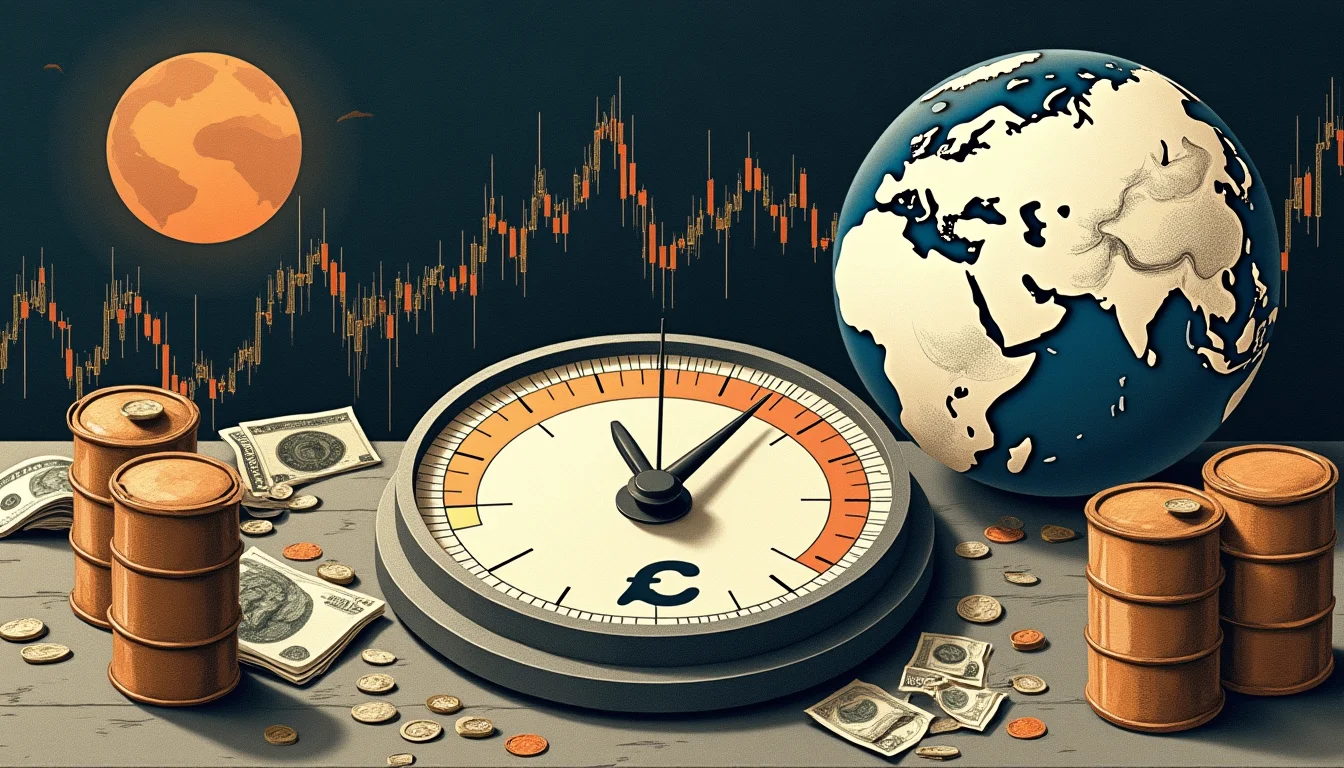
The Transmission Mechanism Markets Prefer to Ignore
Geopolitical supply shocks do not announce themselves with orderly price adjustments. They move through markets in stages — first through commodity and currency channels, then into sovereign bond spreads, and finally into equity volatility — and the lag between each stage creates the illusion that each is a separate, containable event. The yen's current path illustrates this precisely. A currency at a multi-decade low is not merely a reflection of Bank of Japan policy divergence from the Federal Reserve; it is a signal that Japan's capacity to absorb external price shocks — in energy, in food, in dollar-denominated debt service — has materially eroded. Japan imports the vast majority of its energy needs. A structurally weak yen means every barrel of oil, every cubic metre of liquefied natural gas, costs significantly more in domestic currency terms than it did even two years ago.
The Iran dimension compounds this. Oil markets had already begun pricing in a modest geopolitical risk premium on Middle East supply disruption. If US-Iran negotiations produce a durable framework — and the keyword here is if — a meaningful volume of Iranian crude could re-enter global supply chains, suppressing energy prices. For New Zealand, a small open economy sensitive to global commodity cycles, that prospect justifies trimming rate-hike bets. But for Japan, the calculus is more complex: cheaper oil would ease import cost pressure, but the yen's structural weakness reflects deeper imbalances that a single geopolitical development cannot resolve.
The parallel to current conditions is not that a crash is imminent — it is that the architecture of vulnerability is similar. Currency dislocation (then the dollar; now the yen), commodity price uncertainty (then oil after the 1986 price collapse; now oil contingent on Iran), and a policy environment in which central bank independence is under political pressure. On that last point, equity valuation and market risk analysis has tracked the ongoing legal contest over Federal Reserve governance — a contest that introduces its own form of institutional uncertainty into an already stressed macro environment.
Portfolio Insurance Then, Risk Model Complacency Now
In 1987, the instrument that turned a correction into a crash was portfolio insurance — a quantitative strategy designed to protect institutional portfolios by selling futures as prices fell. The strategy worked in theory but assumed liquid, orderly markets. When every institution tried to sell simultaneously, liquidity evaporated and the model's assumptions collapsed in real time.
Today's analogue is not a single product but a broader condition: risk models calibrated to recent volatility regimes that systematically underweight tail scenarios involving simultaneous currency, commodity, and political shocks. Value-at-risk frameworks trained on the post-2009 low-volatility era assign low probability to the kind of multi-factor stress now visible in the yen, oil, and US institutional governance simultaneously. This is not a theoretical concern. It is the same category of model failure that produced the 1987 cascade, the 1998 Long-Term Capital Management crisis, and the 2008 correlation breakdown. The current bubble risk indicators tracked by Bubblepedia reflect elevated readings across currency stress and sovereign spread divergence — two of the three channels that were active in the months before Black Monday.
"When geopolitical developments move faster than institutional rebalancing cycles, the gap between model risk and actual risk becomes the market's most dangerous unpriced asset."
Iran, Oil, and the False Comfort of De-escalation
The market's initial response to US-Iran peace progress — trimming rate expectations, softening energy risk premiums — reflects a rational first-order adjustment. But geopolitical de-escalation in the Middle East has historically been a source of its own volatility. The 1986 oil price collapse, which contributed directly to the macro backdrop of Black Monday, was itself partly a product of Saudi Arabia's decision to abandon production restraint and flood markets. Supply shocks cut in both directions: scarcity shocks raise prices and compress margins; abundance shocks collapse producer revenues, destabilise petrodollar recycling flows, and remove the inflation buffer that had been supporting certain bond market assumptions.
If Iranian supply returns to global markets at scale, the deflationary impulse could be significant enough to alter the Federal Reserve's rate path — but not in a clean, orderly way. It would interact with a yen that is already under structural pressure, a Japanese economy with limited monetary policy room, and a US political environment in which Fed independence remains contested. For a fuller historical perspective on how macro shocks of this type have played out across different bubble episodes, the Bubblepedia bubble encyclopedia documents the recurring pattern of geopolitical catalysts that markets price as temporary before they prove structural.
The lesson of both the 1929 crash and Black Monday is not that geopolitical events cause crashes directly. It is that they arrive into markets already stretched by valuation excess, model complacency, and institutional herding — and that the combination, not any single factor, is what produces discontinuous price adjustment. On all three of those preconditions, mid-2026 warrants serious attention.