
Long-Term Capital Management Crisis (1998)
Long-Term Capital Management combined two Nobel laureates, the former vice chairman of the Federal Reserve, and Wall Street's most respected bond traders into a hedge fund leveraged 25-to-1 on convergence trades worth $1.25 trillion notional. When Russia defaulted in August 1998, correlations went to one and LTCM lost $4.6 billion in four months, forcing a Federal Reserve-orchestrated bailout that prefigured the moral hazard of 2008.
By Twin · @TwinTowerCity·
Key Takeaways
- →Long-Term Capital Management operated with 25-to-1 leverage on $1.25 trillion notional value in convergence trades by 1998.
- →LTCM's strategy relied on mathematical models assuming normal market correlations would persist across global bond markets.
- →Russia's debt default in August 1998 caused all correlations to approach one, invalidating LTCM's risk models.
- →LTCM lost $4.6 billion in four months during 1998, representing 90% of its capital base.
- →The Federal Reserve orchestrated LTCM's bailout, establishing dangerous precedent for too-big-to-fail moral hazard expectations.
Peak Year
1998
Crash Year
1998
Location
Greenwich, Connecticut / Global
Asset Class
Fixed Income
Severity
Long-Term Capital Management — When Nobel Laureates Nearly Broke the World
The Dream Team
When John Meriwether left Salomon Brothers in February 1994 following the Treasury bidding scandal, he carried with him something more valuable than capital: credibility. The former head of Salomon's bond arbitrage group had assembled what would become Wall Street's most intellectually formidable hedge fund, Long-Term Capital Management, founded in Greenwich, Connecticut with $1.25 billion in initial capital. Meriwether's recruitment strategy bordered on academic. He poached his former Salomon colleagues — Larry Hilibrand, Greg Hawkins, William Krasker, and Dick Leahy — traders who had refined the art of convergence trading throughout the 1980s. More significantly, he convinced Myron Scholes and Robert Merton to join as principals. These were not merely advisors; they were architects of modern financial theory whose Black-Scholes options pricing model had fundamentally altered derivatives markets since 1973. The intellectual framework underlying LTCM rested on identifying and exploiting temporary pricing anomalies between related securities. The fund's core thesis held that these spreads would converge to theoretical fair value over time, allowing profits with supposedly minimal risk. Their initial trades epitomised this philosophy: purchasing 30-year Treasury bonds while shorting 29.75-year bonds (the spread between "off-the-run" and "on-the-run" issues), exploiting swap spreads between corporate and government rates, and arbitraging mortgage-backed securities against underlying Treasury curves. The academic pedigree proved its worth immediately. Major banks and sovereign wealth funds, impressed by the Nobel-calibre talent, extended credit lines at institutional rates typically reserved for AAA-rated entities. The fund's borrowing costs were often below those of many investment banks, a crucial advantage in a business model dependent on capturing small spreads through massive positions."We thought we were diversified because we had different types of trades in different markets," Meriwether later reflected. "What we didn't realize was that they were all essentially the same trade — we were long liquidity and short volatility in every position."
The Model and Its Fatal Assumption
At LTCM's core lay the Black-Scholes-Merton framework, a mathematical architecture that assumed asset price returns followed a normal distribution. This assumption, fundamental to virtually all derivatives pricing, implied that extreme market movements were extraordinarily rare — so rare as to be effectively impossible over reasonable investment horizons. The convergence trades depended entirely on mean reversion: temporary dislocations would correct themselves as markets returned to equilibrium. Historical data supported this view. The fund's early performance appeared to validate the theoretical framework completely. After earning 21% in its inaugural year of 1994, LTCM posted returns of 43% in 1995 and 41% in 1996, even after returning $2.7 billion to investors who were deemed to have insufficient sophistication for the fund's strategies. Yet cracks appeared early for those willing to see them. Nassim Taleb, then running his own options trading operation, had been arguing since the early 1990s that financial markets exhibited "fat tails" — extreme events occurred far more frequently than Gaussian models predicted. His critique struck at the heart of LTCM's methodology: strategies that appeared low-risk based on historical normal distributions contained enormous tail risk that models systematically underestimated.The Russian Default and Liquidity Crisis
August 17, 1998, marked a watershed in modern financial history: Russia defaulted on its domestic GKO bonds, becoming the first major economy to default on domestic-currency government debt in peacetime. This was not merely another emerging market crisis — it was a scenario that LTCM's models had deemed virtually impossible. The Russian default triggered an immediate flight to quality that moved every one of LTCM's convergence trades in the wrong direction simultaneously. On August 21, 1998, the fund lost $553 million in a single day — nearly 15% of its remaining capital. The carefully constructed portfolio, designed to be market-neutral, became catastrophically correlated as liquidity evaporated across all risk assets. The crisis revealed a fundamental flaw in the convergence trading model: liquidity itself was not a constant. As other institutions holding similar trades faced margin calls and redemption requests, forced selling created a vicious cycle. The more prices moved against these positions, the more selling pressure emerged, driving prices further from theoretical fair value rather than toward convergence.| Trade Type | Expected Behavior | August-September 1998 Reality | Loss Approximation |
|---|---|---|---|
| On-the-run/Off-the-run Treasury spread | Spread narrows as liquidity premium fades | Spread widened dramatically as flight to quality intensified | $1.6bn |
| Swap spreads | Corporate-government spread mean reverts | Credit spreads blew out to historic extremes | $1.3bn |
| Equity volatility trades | Short volatility profits as markets calm | VIX spiked above 40 as correlation approached 1.0 | $800m |
| European bond convergence | EMU convergence continues smoothly | Risk premium returned to peripheral European debt | $900m |
The Federal Reserve Rescue
By September 1998, LTCM's capital had collapsed from $4.6 billion in January to less than $400 million, while their derivatives positions remained at $1.25 trillion notional. The fund faced a mathematical impossibility: they needed to unwind positions forty times larger than their remaining capital in markets that had become entirely illiquid for exactly those trades. William McDonough, President of the Federal Reserve Bank of New York, faced a stark choice. LTCM's failure would force the liquidation of positions so large they could destabilize global fixed-income markets. More alarmingly, every major Wall Street bank had significant exposure to LTCM through prime brokerage relationships, derivatives counterparty agreements, or copycat trading strategies. On September 23, 1998, McDonough convened representatives from fourteen major financial institutions in the Federal Reserve's offices. The solution was elegant in its simplicity: a private sector bailout that avoided direct government intervention while preventing systemic collapse. The consortium provided $3.6 billion in fresh capital in exchange for 90% ownership of LTCM, effectively removing Meriwether and his partners from control while providing time for orderly liquidation."The Federal Reserve organized the rescue not to help Long-Term Capital, its partners, or its investors," McDonough testified to Congress, "but to reduce the risk of a significant and immediate systemic shock to world financial markets."The rescue established a template that would define crisis response for the next two decades. Markets learned that the Federal Reserve would intervene to prevent the failure of any institution whose collapse might threaten financial stability — the birth of the modern "too big to fail" doctrine. The moral hazard was immediate and obvious: if sophisticated investors knew they would be bailed out when their bets went wrong, what incentive remained for prudent risk management?
What the Models Missed
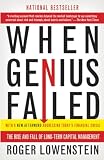
LTCM's collapse revealed fundamental flaws in the mathematical foundations of modern finance. The most critical error was assuming that correlations remained stable during crises. The fund's risk models showed diversified exposure across multiple strategies and markets, but this diversification evaporated precisely when it was most needed. Assets that had moved independently during calm periods suddenly moved together when liquidity disappeared. The models also suffered from a severe endogeneity problem: they assumed LTCM was a price-taker in markets where the fund had actually become a major price-maker. When LTCM tried to exit positions, their selling pressure moved prices further against them. The firm had grown so large that their own trading activity influenced the very price relationships they sought to exploit. Roger Lowenstein, in his definitive account "When Genius Failed," captured the essential hubris: "The professors had looked at the problem backwards; they had used their desktop computers to model the market, forgetting that their own market activities were now of a size that their behavior would affect the market itself.""Long-Term Capital's traders had confused the precision of their models with the accuracy of their models. They had mistaken the map for the territory, believing that their mathematical representations captured the full complexity of financial markets."The leverage mathematics were brutally simple: at 25:1 leverage, a 4% adverse move would eliminate all capital. LTCM's partners, despite their academic credentials, had created a structure where they could be correct about long-term convergence but still face bankruptcy from short-term volatility. They had sufficient time or sufficient capital, but not both. The specific lesson on tail risk proved prescient. Events that the models suggested should occur once in several billion years actually happened multiple times during a two-month period. The normal distribution assumption that underpinned their entire framework was not merely wrong — it was catastrophically wrong in exactly the way that mattered most for their survival.
The Legacy for Modern Finance
LTCM established the template for every subsequent quantitative hedge fund disaster. The pattern is now familiar: sophisticated models based on historical relationships, enormous leverage to amplify small edges, diversification that disappears during crises, and forced liquidation at precisely the worst moment. Bear Stearns' hedge funds in 2007, AIG's derivatives book in 2008, and Archegos Capital in 2021 all followed variations of the same script. The irony runs deeper than mere repetition. Myron Scholes and Robert Merton had won the 1997 Nobel Prize in Economics for developing models that enabled the very risks their framework could not properly measure. The Black-Scholes equation had democratized derivatives trading, but it had also created systemic vulnerabilities that its own mathematical structure was blind to. The professors had built the tools that made LTCM possible, then discovered those same tools were inadequate for managing the risks they had created.Recommended Reading
Lessons Learned
Frequently Asked Questions
What caused the Long-Term Capital Management crisis?
LTCM's crisis was caused by excessive leverage (25-to-1) combined with convergence trading strategies that assumed market correlations would remain stable. When Russia defaulted on its debt in August 1998, global market correlations suddenly moved to one, causing LTCM's diversified positions to move against them simultaneously, creating massive losses across their $1.25 trillion notional portfolio.
How much money did LTCM lose during the 1998 crisis?
Long-Term Capital Management lost $4.6 billion in just four months following the Russian default in August 1998. This represented nearly 90% of the fund's capital, forcing the Federal Reserve to orchestrate a $3.6 billion bailout by 14 major Wall Street firms to prevent systemic collapse of the global financial system.
What were the warning signs before LTCM collapsed?
Warning signs included LTCM's extreme 25-to-1 leverage ratio, concentration in convergence trades that required stable market correlations, and overconfidence in mathematical models. The fund's massive $1.25 trillion notional exposure across global markets created systemic risk, while their strategies became less effective as more competitors adopted similar approaches, narrowing profit margins.
What lessons does the LTCM crisis teach investors?
LTCM's collapse demonstrates that mathematical models cannot predict extreme market events, excessive leverage amplifies losses catastrophically, and diversification fails when correlations spike during crises. The Federal Reserve bailout established dangerous moral hazard precedents, encouraging future risk-taking by suggesting large institutions would be rescued, directly contributing to the 2008 financial crisis mentality.
Current Relevance
Explore gold storage options
Gold is not a guaranteed hedge against crashes. Prices can fall; storage fees and custody risks also matter.
Affiliate link: Bubblepedia may earn a commission. Not a recommendation; investment values can fall.
Recommended Reading
Recent Analysis
Anthropic Leveraged ETF Race Heats Up: When Volatility Becomes a Retail Product
20 Nov 2026
Anthropic Cash Burn: AI Systemic Risk Warning
19 Nov 2026
PBOC Liquidity Drain Signals Caution on Rate Cuts
16 Nov 2026
AI Trade Unwind Sparks Asian Portfolio Rotation
8 Nov 2026
Yen Shorts Hit 2007 Extremes Amid Fed-BOJ Divergence
7 July 2026
Get Bubblepedia in your inbox
Asset bubbles and market-history insights in your inbox.