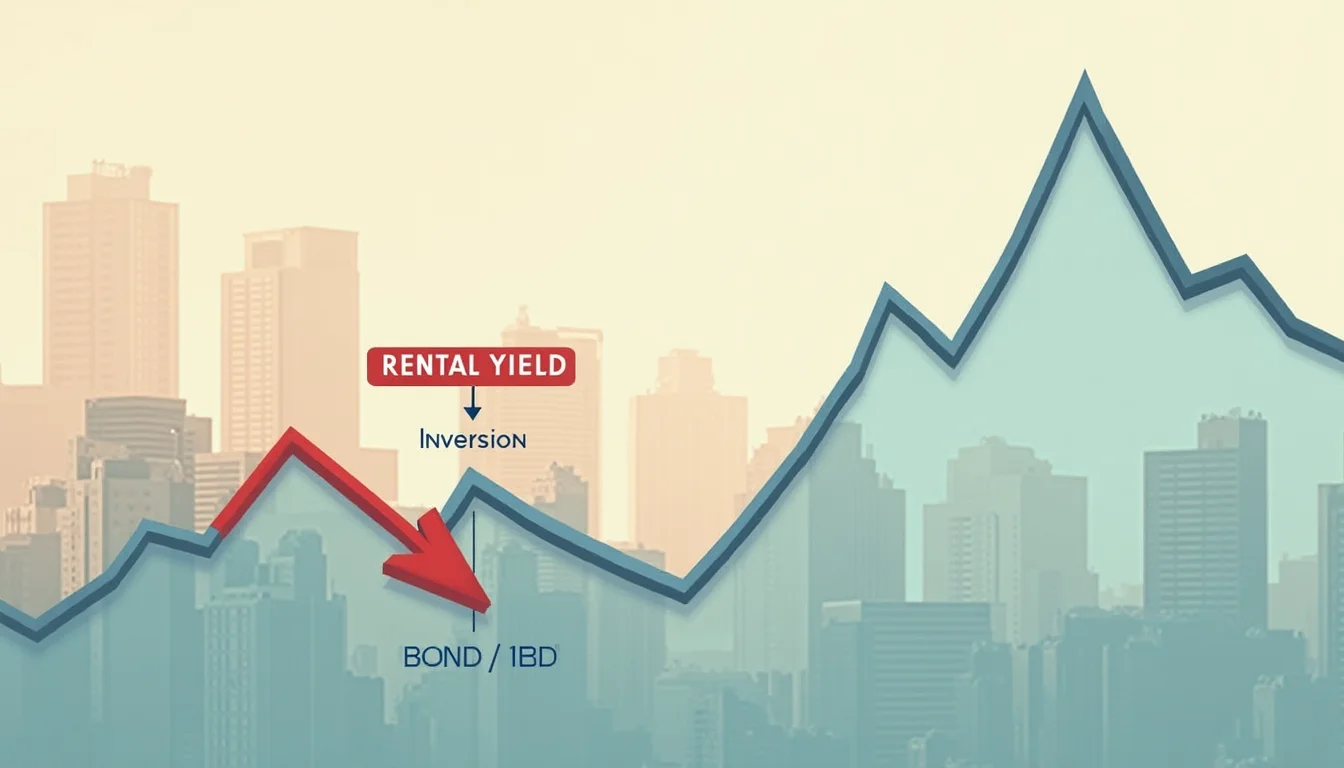
Australia's current rental yield environment warrants the same analytical scrutiny.
The gap between net rental yield and the risk-free rate is therefore deeply negative. This is not a marginal compression. It represents a structural inversion that, in historical terms, has rarely persisted without either a significant correction in asset prices, a sharp fall in interest rates, or both.
For context on current Australian property market dynamics, the analysis at Australian Property Forum outlines how the RBA's rate settings are feeding through to mortgage holders — a transmission mechanism that directly affects the sustainability of yield-negative property ownership at scale.
Why Investors Continue to Buy Below the Risk-Free Rate
The persistence of yield-negative property investment is not irrational in isolation. It reflects a specific set of assumptions: that capital gains will compensate for income shortfalls, that rental growth will eventually close the gap, and that property remains a superior inflation hedge to fixed income. Each of these assumptions has historical support — but each also has historical limits.
The capital gains assumption is self-referential in a rising rate environment. Higher bond yields reduce the present value of future cash flows, including future rents, which mechanically compresses the multiple a rational buyer should pay. The rental growth assumption faces the constraint that rents are ultimately bounded by tenant incomes and rental affordability ratios, which in Australia's major cities are already at historically elevated levels. The inflation hedge argument is valid over long cycles but provides cold comfort during the correction phase of a bubble, when nominal price falls can exceed inflation for extended periods.
What sustains yield-negative markets is not fundamental logic but expectational momentum — the belief that the next buyer will pay more. This is precisely the dynamic that characterised Tokyo in 1989, Dublin in 2006, and Las Vegas in 2006. Our current bubble risk indicators track several of these momentum signals in real time.
This duration mismatch becomes acute when investors are also carrying floating-rate mortgage debt. The income from the property does not adjust upward automatically when the mortgage rate rises. The result is a cash flow squeeze that, at sufficient scale, generates forced selling — the mechanism that converts a slow yield compression into an abrupt price correction.
What Would Restore the Gap
Three scenarios could close the current inversion without a price correction. First, a sustained fall in bond yields — either through RBA rate cuts or a global flight to safety — would restore the spread arithmetically. Second, a sharp acceleration in rental growth, beyond what tenant affordability can sustain, could lift gross yields. Third, a combination of both. None of these scenarios is impossible, but all require conditions that are not currently in evidence. The RBA's stated priority remains inflation control, and rental growth, while elevated, is already showing signs of moderation as household formation rates adjust.
When the income return from the largest asset class in an economy falls below the risk-free rate for an extended period, the market is no longer pricing assets — it is pricing expectations. And expectations, unlike bond coupons, can reprice without notice.