According to the Bubblepedia Australian Property Bubble entry, Australian household debt as a share of disposable income has remained among the highest of any advanced economy for over a decade. That structural overhang matters less when credit flows freely. It becomes acutely dangerous when it does not.
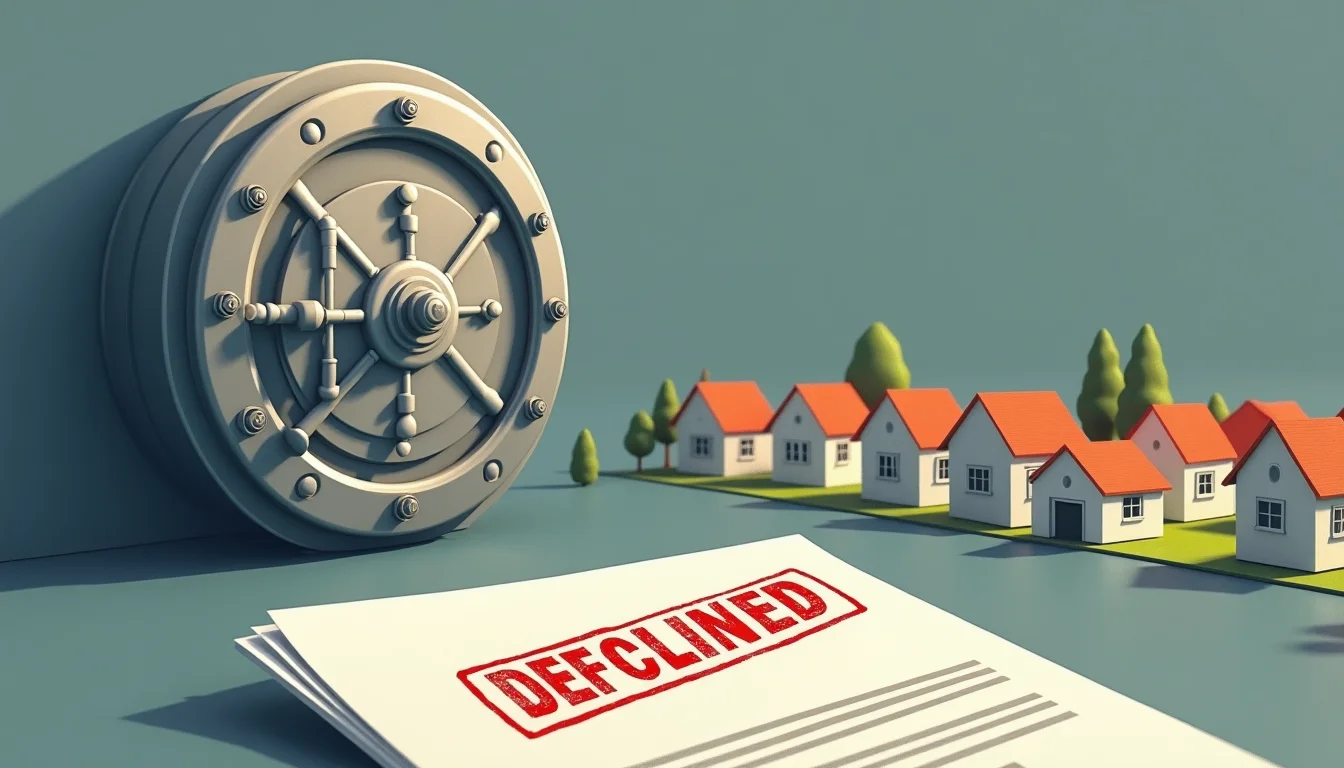
The most reliable early warning in any property cycle is not the price index — it is the lending officer's answer when a borrower asks for money. Credit availability turns before prices do, every time.
The Sequence That Repeats
Across every major property bust of the past four decades, the sequence has been consistent. First, debt accumulates during a period of loose credit and rising prices. Then, quietly and without fanfare, lending standards tighten — through higher serviceability floors, lower loan-to-value ratios, or outright volume restrictions. Prices hold briefly, sustained by inertia and the residual confidence of recent buyers. Then transaction volumes fall. Then prices follow.
What Tightening Actually Looks Like From Inside the Cycle
Credit tightening rarely announces itself with a press release. It accumulates through incremental decisions: a bank raises its notional serviceability rate, reducing the maximum loan a given income can support; a mortgage insurer quietly lifts the premium on high-LVR loans; a credit committee adds a new debt-to-income cap that affects a meaningful share of applicants. None of these individually constitutes a shock. Cumulatively, they reduce the pool of eligible buyers.
Australia's current position reflects a subtler but recognisable version of the same dynamic. The Reserve Bank of Australia held the cash rate at elevated levels through 2025 and into 2026, maintaining serviceability buffers that constrain maximum borrowing capacity for median-income households. The Australian Property Forum's analysis of rent inflation and RBA policy documents how global rate divergence has complicated the RBA's path, keeping domestic borrowing costs higher than equivalent economies that have already begun easing. That divergence directly limits credit availability for prospective buyers.
Serviceability Floors as the Invisible Gate
Australia's regulatory architecture includes a serviceability buffer — currently requiring banks to assess borrowers' ability to repay at a rate meaningfully above the actual loan rate. This buffer, introduced and subsequently adjusted by the Australian Prudential Regulation Authority, functions as an invisible gate on credit access. When actual interest rates are high, the buffer compounds the restriction: a borrower assessed at a rate several percentage points above an already-elevated mortgage rate may qualify for a loan substantially smaller than the same borrower would have accessed in 2021.
This mechanism is well-designed for financial stability purposes. It is also, from a market-cycle perspective, precisely the kind of structural credit constraint that precedes price corrections. The borrowing capacity of the marginal buyer — the person whose purchase sets the price at the margin — is directly determined by this buffer. When that capacity contracts, so does the ceiling on sustainable prices, even if existing owners are not forced sellers.
Tracking current property bubble risk indicators reveals that auction clearance rates and new listing volumes are the most visible surface manifestations of a shift that is fundamentally credit-driven. The Australian Property Forum's reporting on Melbourne's spring auction season captures the micro-level reality: individual streets with multiple competing listings, buyers moving cautiously, and vendors adjusting expectations.
Supply-Side Credit Contraction: The Builder Problem
Credit availability does not only affect buyers. Construction finance — the loans that allow developers to build new dwellings — has tightened independently, driven by lender concerns about builder insolvency risk and project completion. When construction lending contracts, new supply falls. Paradoxically, this can sustain prices in the short term even as the broader credit environment weakens, by restricting the inventory available to buyers. The Australian Property Forum's analysis of property tax burdens on builders identifies the regulatory cost layer compounding the financing constraint — a combination that has historically accelerated supply collapses in comparable markets.
For deeper Australian property market context, the interaction between construction credit and buyer credit is critical: both must remain available for a cycle to sustain itself. When either contracts materially, the self-reinforcing mechanism of rising prices and rising collateral values breaks down.
Australia sits at a point on this historical curve that warrants careful attention. The credit availability turn is not hypothetical — it is embedded in the current serviceability architecture and rate environment. Whether it produces a correction of the severity seen in Ireland or a more gradual adjustment of the kind seen in Canada post-2017 depends on variables — employment, migration, and the pace of any RBA easing — that remain genuinely uncertain. What history does not leave uncertain is the sequence itself: credit turns first, prices turn second. That sequence appears to be underway. Readers tracking the full historical context of property cycles can consult the Bubblepedia bubble encyclopedia and the historical timeline for comparable episodes.