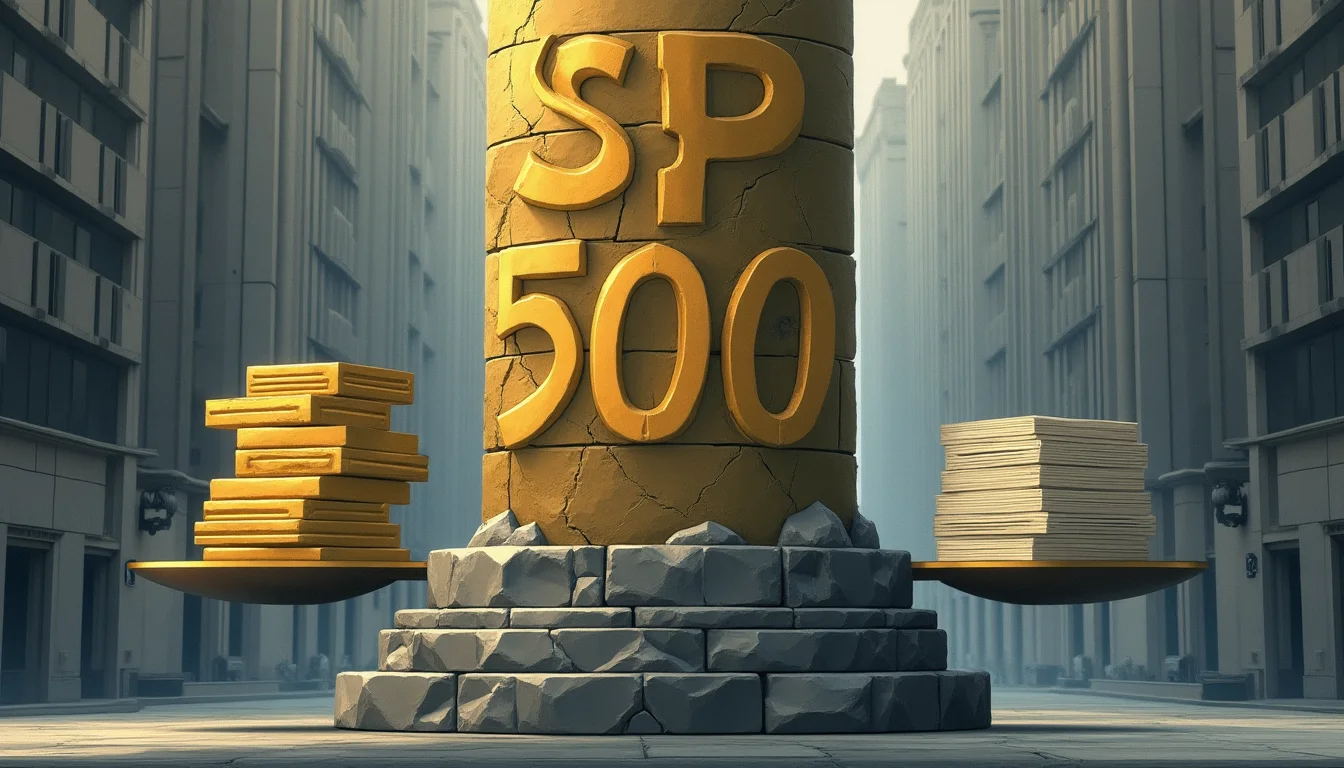
According to Bloomberg Markets, technology firms and sovereign governments are now competing directly for the same pool of long-duration capital — a tension that is repricing risk across global equity markets and forcing investors to reconsider exactly how concentrated their supposedly diversified portfolios have become. That competition is arriving at a moment when the structural architecture of US equity markets has quietly produced one of the most extreme concentrations of index weight in modern financial history.
The Mechanism Behind the Concentration
The story of how seven companies came to represent more than one-third of the S&P 500 is not primarily a story about corporate excellence, though corporate excellence is part of it. It is a story about a financial mechanism — one that operates automatically, at scale, and without any individual actor intending the outcome.
"When the Buffett Indicator approaches 200%, history suggests that expected long-term returns from equities compress dramatically — not because companies stop earning, but because the price paid for those earnings already discounts decades of future growth." — Bubblepedia analysis, drawing on publicly available valuation data
The Nifty Fifty Parallel: Quality as a Justification for Price
The closest structural analogy in modern financial history is the Nifty Fifty episode of the late 1960s and early 1970s. In that era, institutional investors — newly dominant in US equity markets following pension fund growth — concentrated capital into approximately 50 large-capitalisation, high-quality growth companies including Xerox, Polaroid, Avon Products, and IBM. These were genuinely excellent businesses. Their earnings were real, their market positions dominant, and their growth records impressive.
The mechanism was not that the companies were fraudulent or their earnings fabricated. The mechanism was that the purchase price had already discounted all the growth that subsequently arrived. Investors who bought Xerox at elevated multiples in 1972 and held for twenty years earned poor returns, not because Xerox failed, but because 1972 was a terrible time to buy Xerox.
For macro context on historical concentration episodes and their resolution, the pattern is consistent: periods of extreme index concentration have historically resolved through either a sharp correction in the concentrated names, a prolonged period of underperformance relative to broader markets, or both.
What Passive Investing Changes — and What It Does Not
The Nifty Fifty concentration was driven by active institutional managers making deliberate allocation decisions. The Magnificent Seven concentration has been amplified — though not solely created — by passive flows that make no quality judgement whatsoever. This is structurally new.
In the Nifty Fifty era, a portfolio manager could decide to reduce exposure to Polaroid if the valuation looked stretched. Passive funds cannot make that decision. They are mandated to hold the index. As concentration increases, every new dollar of passive inflow reinforces it further. The result is that price discovery — the process by which markets establish whether an asset is fairly valued — is partially suspended for the largest index constituents. Capital flows to them not because of valuation analysis but because of their weight.
This creates a specific fragility. When redemptions arrive — as they inevitably do during periods of market stress — passive funds must sell all constituents proportionally, including the largest. The same mechanical process that drove prices up operates in reverse. The concentrated names that received disproportionate inflows face disproportionate selling pressure. Volatility in a single large constituent can move the entire index in ways that were structurally impossible when ownership was more dispersed.
The tariff uncertainty flagged by Bloomberg's coverage of the Canada tariff deadline illustrates exactly this dynamic. Trade policy shocks that historically would have affected specific sectors now transmit rapidly through concentrated index weights into broad market moves, because the largest companies span multiple sectors simultaneously and carry index weights that amplify their individual price movements.
The addition of Hua Hong and Weichai Power to Hong Kong's benchmark index, as reported by Bloomberg, is a small data point in a larger pattern: index composition changes in Asian markets are gradually expanding the investable universe for capital that is reconsidering its US concentration. Whether that rebalancing becomes meaningful depends on factors well beyond index mechanics, but the valuation gap creates the incentive.
History suggests that extreme concentration episodes end not with a single catalyst but with a gradual recognition that the embedded assumptions — perpetual growth, permanent dominance, indefinite margin expansion — cannot all be simultaneously true at the prices being paid. The Nifty Fifty did not collapse because Xerox stopped being excellent. It collapsed because extreme valuations left no room for any outcome short of perfection.
The current episode has features that make the diagnosis more complex than either the Nifty Fifty or the dot-com bubble. The Magnificent Seven generate genuine, large-scale profits. Their market positions are real. But complexity in diagnosis does not eliminate the underlying arithmetic: at highly elevated forward earnings multiples, the top US firms require decades of above-average growth to justify their current prices, and decades of above-average growth is what history most reliably denies.
Investors tracking real-time concentration risk indicators can consult the Bubblepedia Bubble Watch dashboard for current valuation and flow data. For the full structural analysis of this episode, read the full The Magnificent Seven Concentration — When Seven Stocks Became the Market entry in the Bubblepedia Encyclopedia.