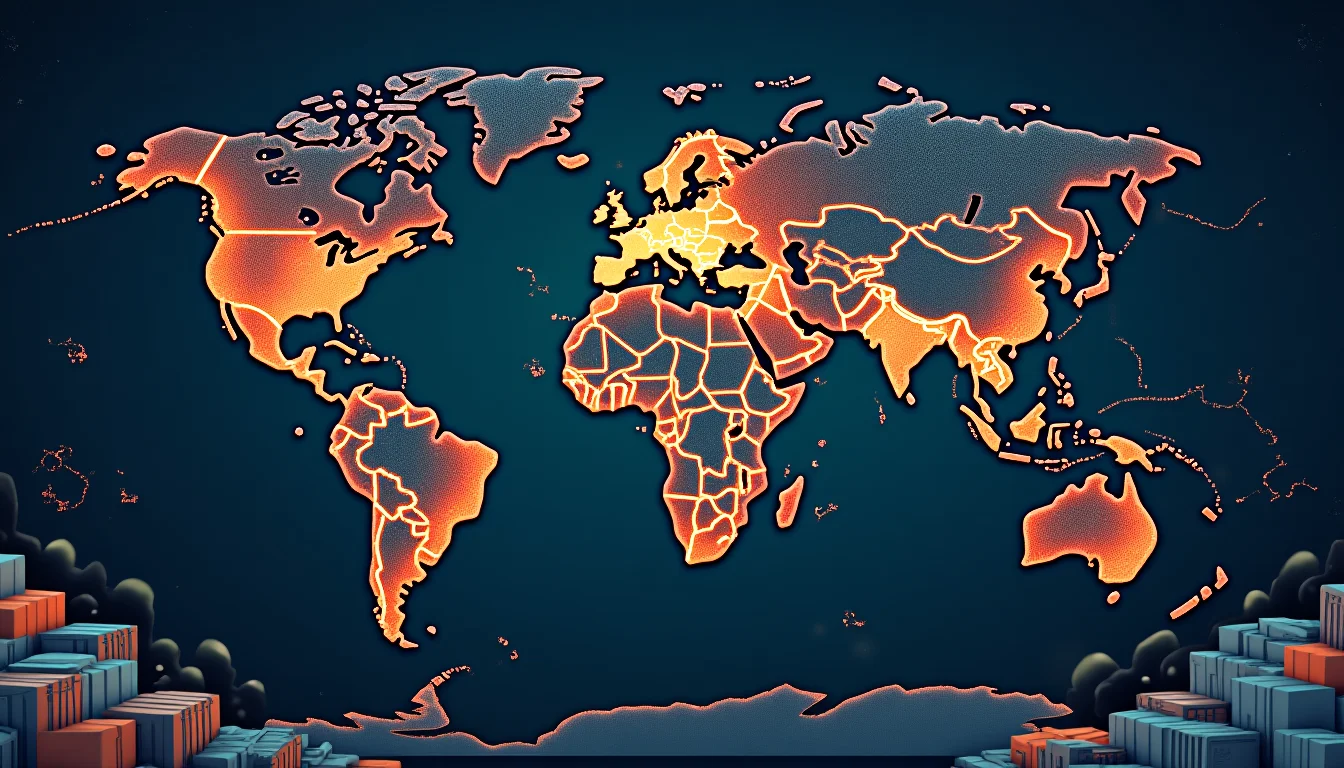
Taken individually, each story reads as a corporate finance item. Taken together, they describe something more structurally significant: geopolitical supply shocks are actively manufacturing speculative momentum, concentrating enormous capital flows into narrow corridors of the global market that have been designated as the "safe" side of a fracturing world order. The pattern deserves careful scrutiny, because history suggests that capital concentrated by external shock rather than fundamental value creation carries a particularly unstable quality.
How Geopolitical Rewiring Creates Artificial Scarcity Premiums
The mechanism at work is not subtle. US export controls on advanced semiconductors to China, combined with escalating concerns about Taiwan Strait security, have effectively created a geopolitically mandated premium for chipmakers and supply chain participants domiciled outside the restricted zone. SK Hynix, headquartered in South Korea, benefits directly. Thailand benefits as a secondary assembly and packaging hub that sits outside the export control perimeter.
This is not the same as organic competitive advantage. A company that gains market share because a competitor has been legally barred from serving certain customers is benefiting from regulatory arbitrage, not superior product or management. The distinction matters enormously for valuation. When the geopolitical constraint is the primary driver of earnings growth, the valuation premium is only as durable as the constraint itself — and geopolitical arrangements have a long history of reversing faster than markets anticipate.
The 12% single-session move in SK Hynix is particularly instructive. A US listing plan — not completed earnings, not a new product cycle, not a customer win — generated a double-digit price move in a company with a substantial market capitalisation. The market is pricing in a structural re-rating based on anticipated capital flows from US institutional investors who, under the current listing structure, face friction in accessing Korean equities. That is a reflexive dynamic: the act of seeking a US listing generates the valuation uplift that justifies the listing.
Thailand's AI Premium: Supply Chain Geography as Investment Thesis
Thailand's story is even more instructive as a bubble-pattern indicator. According to Bloomberg, Thai equities linked to data centre construction, semiconductor packaging, and AI infrastructure buildout have attracted disproportionate inflows relative to the country's actual technological capabilities. The thesis is essentially geographic: Thailand is not China, not Taiwan, and has existing industrial infrastructure that can be repurposed for supply chain diversification.
This is a legitimate investment consideration. It is not, however, a sufficient basis for the valuation multiples being assigned. When a country's stock market outperforms because of what it is not rather than what it is, the investment case is built on the persistence of someone else's problem. If US-China semiconductor tensions were to ease — through diplomatic negotiation, a change in administration policy, or technological leapfrogging — the geopolitical premium embedded in Thai and Korean valuations would deflate with considerable speed.
For current bubble risk indicators, this dynamic registers as a meaningful concern precisely because the capital flows involved are large, the investor base is increasingly institutional, and the feedback loop between geopolitical narrative and price action has become self-reinforcing.
The Meme Stock Parallel: Narrative-Driven Concentration Risk
The structural parallel to the Meme Stock Bubble — GameStop and WallStreetBets (2021) is not immediately obvious, but it is analytically important. In January 2021, retail investors coordinating on Reddit drove GameStop from a low price to a dramatic peak — not because GameStop's business had improved, but because a compelling narrative about short squeeze mechanics and David-versus-Goliath finance had concentrated buying pressure into a single, relatively illiquid stock.
The parallel is not that SK Hynix is a meme stock. It is that both episodes illustrate how narrative-driven capital concentration can produce price moves that substantially exceed what fundamentals justify, and that the mechanism of concentration — whether Reddit coordination or geopolitical supply chain logic — does not alter the underlying fragility. In both cases, the price is being set at the margin by buyers who are responding to a story rather than a discounted cash flow model. And in both cases, the story is compelling enough that challenging it feels contrarian to the point of absurdity — right up until it doesn't.
The 2021 meme stock episode also demonstrated how quickly the dynamic can reverse when the narrative loses momentum or when institutional participants withdraw liquidity. GameStop fell dramatically from its peak within weeks. The geopolitical supply chain narrative is more durable than a Reddit thread, but it is not immune to revision.
"When valuations are set by geography rather than cash flows, the margin of safety is only as wide as the geopolitical arrangement that created the premium — and arrangements change."
The Hong Kong Dollar Signal: Cheap Money Amplifying the Dynamic
A third data point from June 25 adds important context. According to Bloomberg, the Hong Kong dollar is approaching the weak end of its permitted trading band, driven by low volatility and persistently cheap local borrowing rates. This matters because cheap Hong Kong dollar funding has historically been a conduit for carry trades into regional Asian equities — including the Korean and Southeast Asian markets currently experiencing geopolitically-driven inflows.
When cheap funding amplifies a narrative-driven trade, the resulting position is leveraged in the financial sense: the investor is exposed to both the unwinding of the narrative and the tightening of funding conditions. The Bank of Japan's hawkish signals — a board member calling for rate hikes every few months, as Bloomberg reported on the same day — add a further dimension. Yen carry trade unwinding has historically been a regional contagion mechanism, and the combination of BOJ hawkishness and stretched regional valuations is a configuration that warrants attention from anyone tracking the full spectrum of historical bubble patterns.
For the macro context underpinning these regional dynamics, macro analysis of Asian capital flow cycles provides useful historical grounding on how supply shock premiums have behaved in prior episodes of geopolitical restructuring.
Why It Matters: Supply Shock Premiums Have a Shelf Life
The broader lesson from reviewing the historical timeline of speculative episodes is that supply shock premiums are among the most dangerous forms of valuation inflation, precisely because they feel structural. The 1970s oil embargo created genuine structural shifts — but it also inflated the valuations of energy companies to levels that took a decade to correct. The post-2008 regulatory reshaping of banking created genuine structural advantages for non-bank lenders — but it also inflated fintech valuations to levels that collapsed in 2022.
The current geopolitical restructuring of semiconductor supply chains is real. The question is not whether it is happening, but whether the valuations being assigned to its beneficiaries have already priced in a decade of structural advantage in a single year of trading. On the available evidence — a 12% single-day move on a listing announcement, a country outperforming on the basis of geographic neutrality — the answer appears to be yes.
That does not mean the trade reverses tomorrow. Narrative-driven premiums can persist far longer than sceptics expect, as the dot-com-to-AI infrastructure comparison illustrates. But it does mean that the risk-reward calculation for new entrants into geopolitically-driven Asian tech positions has deteriorated significantly from where it stood eighteen months ago. The supply shock has been transmitted — and in financial markets, by the time a shock is fully transmitted into prices, the protection it once offered has largely been consumed.