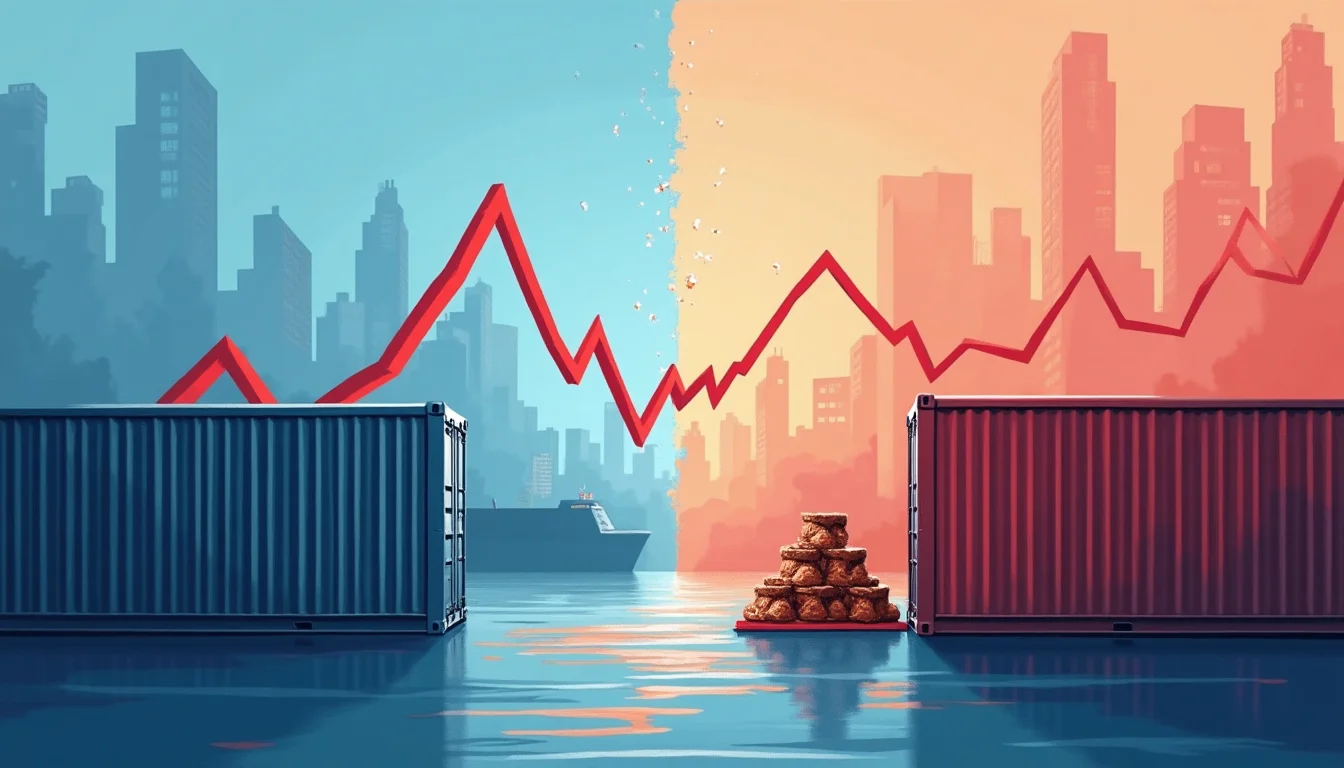
According to Bloomberg, Korean semiconductor stocks fell sharply on Tuesday after renewed worries about Chinese competition and cautious remarks from Broadcom unsettled investors in the AI supply chain. The decline did not stay contained to equities. According to Bloomberg, copper and aluminum prices dropped as the broader AI-related risk-off mood sapped appetite for industrial metals, a sign that the retreat from artificial intelligence valuations is now bleeding into commodity and currency markets that sit well outside the technology sector itself.
When an Equity Selloff Becomes a Currency Problem
South Korea's economy is unusually exposed to this dynamic. Semiconductor exports, led by Samsung Electronics and SK Hynix, are a dominant share of the country's export base, and chip-sector equity performance has historically tracked the won's path with some fidelity. When AI-linked chip valuations fall in tandem with industrial commodity prices, the pressure shows up simultaneously in the current account outlook, capital flows, and the exchange rate. This is precisely the channel through which a narrow, concentrated equity bubble becomes a macroeconomic event rather than a sector-specific correction.
Separately, according to Bloomberg, data center operator AirTrunk has delayed a planned $1.5 billion initial public offering, a concrete signal that capital markets are repricing the AI infrastructure buildout that underpinned much of the past three years' earnings growth story for the sector. When financing windows for AI infrastructure close even temporarily, the knock-on effect reaches suppliers, commodity demand forecasts, and ultimately the currencies of the economies that manufacture the hardware.
The Currency Intervention Playbook Returns
Central banks in export-heavy economies have a well-worn set of tools for episodes like this: verbal intervention, direct spot-market purchases or sales of the local currency, adjustments to reserve requirements for exporters, and swap-line activation. Japan, South Korea, and Taiwan have each used versions of this playbook during past bouts of capital flight, most significantly during the 1997-98 Asian financial crisis and again during yen weakness episodes in the 2020s. The common trigger is the same: a sudden reversal of capital that had previously flowed toward a narrow set of winning assets, leaving currencies exposed once that flow reverses.
What is different this time is the asset at the center of the flow. In 1997, the proximate causes were overleveraged property lending and dollar-pegged currency regimes. Today, the flow being unwound is capital that had concentrated in AI megacap equities and the global hardware supply chain that services them. Bloomberg reported BNY's LaRusse seeing scope for a bond market relief rally, a reminder that fixed income investors are already positioning for a broader repricing cycle that extends beyond equities into rates and, by extension, currencies.
Historical Parallel: Concentration Risk and the Unwind
The structural link back to US Tech and AI Megacap Surge (2020-Present) is concentration. The 'Magnificent Seven' stocks reached roughly 30% of the S&P 500's weight, an extraordinary degree of index concentration in a handful of names tied to a single technology narrative. That concentration pulled global capital toward US dollar-denominated assets for years, a pattern with clear precedent in the late-1990s dot-com period, when capital flows into US technology equities similarly strengthened the dollar and left export-dependent emerging economies more exposed to sudden reversals. The Asian financial crisis that followed in 1997-98 was not caused by US tech stocks, but the capital-flow mechanics — hot money chasing a narrow winning trade, then fleeing en masse — rhyme closely with what Korean markets are now managing as AI valuations wobble.
Gold's recent behavior adds a further layer of complexity for policymakers. According to Bloomberg, gold held its recent drop even as Middle East fighting stoked inflation fears, an unusual divergence that complicates the inflation backdrop central banks must weigh before committing reserves to currency defense. Intervention is not free: it draws down foreign exchange reserves and can conflict with inflation-targeting mandates if deployed at the wrong moment.
Why It Matters
Markets have spent three years treating AI megacap concentration as a largely US equity phenomenon. The current episode is a reminder that the capital flows underpinning that concentration are global, and that their reversal transmits through supply chains, commodity demand, and currency markets in ways that are harder to price than a single stock's earnings multiple. For readers tracking broader equity valuation and market risk conditions, the Korean won's behavior over the coming weeks is a useful proxy for whether the AI selloff remains a sector rotation or becomes a genuine capital-flow event requiring central bank intervention.
History does not offer a precise playbook for how this resolves. What it does offer is a pattern: concentrated capital flows into a dominant narrative tend to unwind faster and more violently than they built, and the first casualties are usually the currencies of economies most structurally tied to that narrative's supply chain. South Korea, as the world's leading memory-chip exporter, sits at exactly that intersection today.
Readers can track how this and other concentration risks are evolving via Bubble Watch, or review comparable episodes across the full bubble encyclopedia and historical timeline.
Copper and aluminum do not usually move on AI sentiment — their decline alongside Korean chip stocks is the clearest signal yet that this unwind has left the technology sector and entered commodity and currency markets.