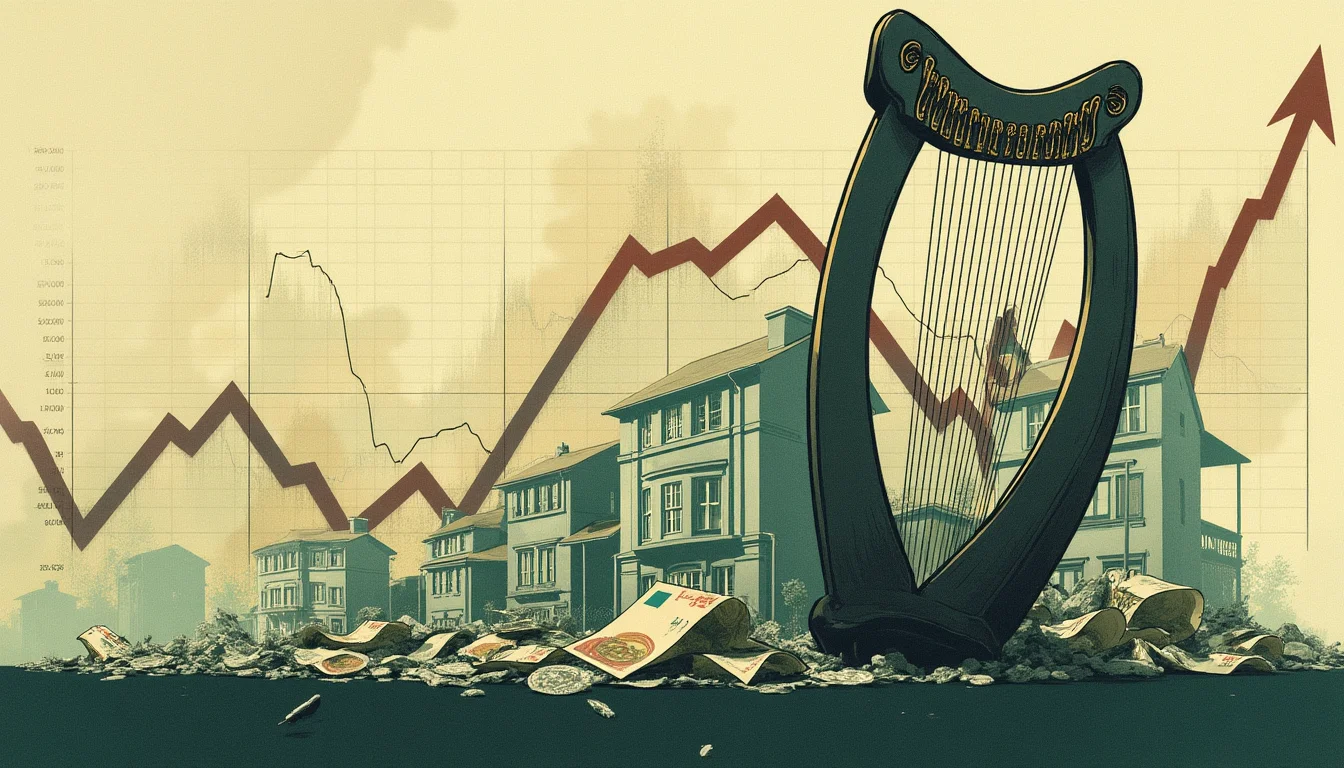
According to Bloomberg Markets, France is currently wrestling with how to bring its fiscal deficit below 5% of GDP by 2027 — a target that sounds modest until you recall that Ireland, in the years immediately following its 2008 banking collapse, was running deficits of extraordinary scale in a single year once bank recapitalisation costs were included. The French fiscal debate is a reminder that the political economy of regulatory aftermath — who pays, how fast, and who decides — is never settled cleanly. Ireland's experience remains the sharpest modern case study in how a small open economy can get that calculation catastrophically wrong.
The political logic was understandable, if ultimately flawed. Irish officials, facing a potential bank run at dawn, were told by bank executives that the institutions were solvent but illiquid. They were not. Anglo Irish Bank alone would eventually cost the state an estimated tens of billions of euros. Total bank recapitalisation costs across all guaranteed institutions are estimated at tens of billions of euros depending on the accounting methodology used, with the EU and IMF ultimately providing a substantial bailout programme in November 2010.
What made the guarantee so consequential was not merely its size but its structure. By covering senior bondholders — many of them German and French institutional investors who had funded Ireland's property lending boom through wholesale markets — the Irish state effectively socialised losses that international creditors would otherwise have absorbed. This decision, contested by economists and later by the Irish public, was reportedly encouraged by European Central Bank officials who feared contagion to continental banking systems. The Irish people paid for a decision that served, at least in part, a broader European interest.
From Celtic Tiger to Fiscal Captive
Understanding why the guarantee was so ruinous requires understanding the bubble that preceded it. Read the full Irish Property Bubble and Celtic Tiger Collapse (1995-2008) entry in the Bubblepedia Encyclopedia for a complete account, but the essential mechanics are these: Ireland's genuine productivity boom of the 1990s — driven by foreign direct investment, a young educated workforce, and a low corporate tax rate — was gradually displaced after approximately 2002 by a property-dependent growth model. House prices nationally rose dramatically between 1996 and 2007. Construction grew to represent a very large share of GDP at peak. Bank lending to developers expanded at rapid rates annually, funded not by domestic deposits but by wholesale borrowing from European interbank markets.
This created a structural dependency that made the political response to collapse almost inevitable in its costliness. When property values fell — Dublin residential prices would ultimately decline by a very large proportion from peak — the banks' loan books became impaired simultaneously. There was no diversification. The state had no fiscal buffer because tax revenues had become structurally dependent on property transaction taxes and construction activity. And the banking sector's liabilities were so large relative to the economy that partial solutions were arithmetically impossible.
Ireland's Financial Regulator operated on the assumption that bank management had better information than supervisors about risk. By the time that assumption was tested, the losses were already embedded in balance sheets across the country.
The Regulatory Failure Was Structural, Not Individual
Post-crisis inquiries, including the Nyberg Report (2011) and the Honohan Report (2010), documented a supervisory culture that prioritised financial stability optics over intrusive examination of lending standards. The Central Bank of Ireland operated with insufficient staff, inadequate data systems, and a philosophical disposition — shared across many advanced economies at the time — that markets were self-correcting. The Financial Regulator's annual reports during the boom years consistently described the banking system as well-capitalised and resilient.
This was not unique to Ireland. The same light-touch philosophy governed the UK's Financial Services Authority, the US Office of Thrift Supervision, and Iceland's Financial Supervisory Authority during the same period. What made Ireland's version more destructive was the concentration: six banks, one asset class, one funding model. When the model broke, there were no offsets.
For macro context on how regulatory capture and supervisory philosophy interact with credit cycles, the Irish case remains a defining episode. The pattern — genuine growth attracting foreign capital, foreign capital enabling domestic credit expansion, credit expansion inflating asset prices beyond any fundamental justification, and regulators either unable or unwilling to distinguish between the two phases — has repeated in multiple jurisdictions since.
What the Aftermath Actually Cost
The fiscal costs are well-documented. Less discussed is the opportunity cost: the decade from 2008 to 2018 during which Irish public investment was suppressed, health and education systems were cut, and emigration — a phenomenon Ireland had largely escaped during the Celtic Tiger years — returned at scale. Estimates suggest substantial net emigration between 2010 and 2014, many of them the young educated workers whose productivity had underpinned the genuine phase of the boom.
Ireland eventually recovered, aided by its corporate tax model attracting continued US multinational investment and by a eurozone recovery that lifted external demand. But the recovery was uneven and, in property markets, arguably planted the seeds of a new affordability crisis. Dublin house prices by the mid-2020s had recovered to and in some segments exceeded their pre-crisis peaks, while housing supply remained structurally constrained — partly because the construction sector never fully rebuilt its capacity after the bust.
The political aftermath also reshaped Ireland's relationship with European institutions in ways that persist. The decision to burden Irish taxpayers with bondholder losses to protect continental financial stability remains a source of political grievance and informs Irish negotiating positions in EU fiscal discussions to this day.
The Warning for Today's Small Open Economies
The Irish template is directly relevant to any small economy where property prices have risen sharply, banking sector exposure to real estate is concentrated, and fiscal revenues have become dependent on transaction activity. Several economies across Central and Eastern Europe, parts of Southeast Asia, and — as documented extensively in recent Bubblepedia analysis — current bubble risk indicators for Australia and Canada display structural similarities to Ireland circa 2004-2006.
The critical variable is not whether a correction occurs — corrections in overvalued property markets are historically near-certain — but whether the banking sector and the state have sufficient buffers to absorb losses without a guarantee-scale intervention. Ireland had neither. Its banking system was leveraged against a single asset class, its fiscal position was structurally dependent on boom-era revenues, and its regulatory framework was philosophically unprepared to act counter-cyclically.
The lesson is not that bank guarantees are always wrong. In certain circumstances, a targeted, time-limited guarantee of deposits can prevent a self-fulfilling bank run at manageable cost. The Irish lesson is more specific: a blanket guarantee issued without adequate information about underlying solvency, covering wholesale creditors who had knowingly funded excessive risk-taking, and sized at twice GDP, is a political and fiscal commitment that a small economy may spend a generation repaying. France's current deficit debates, however different in origin, are a reminder that the political economy of financial aftermath is always harder than the initial crisis response suggests.
For a direct structural comparison between Ireland's experience and earlier property bubble collapses, see /compare/japanese-property-bubble-vs-us-housing-2008 — the Japanese case illustrates how a different regulatory response (forbearance rather than guarantee) produces a different but equally prolonged form of economic damage. There is, it seems, no cheap exit from a property bubble of sufficient scale. The only variable is who bears the cost and over what timeframe.