The Real Innovation That Started Everything
It is essential to begin where the Read the full Telecom Bubble and Fibre Optic Mania (1998-2002) entry in the Bubblepedia Encyclopedia begins: with a genuine technological major change. Fibre optic cable was not a fiction. The physics of transmitting data as pulses of light through glass strands represented a legitimate leap beyond copper wire. The internet was genuinely expanding. Email, e-commerce, and streaming media were real services with real users generating real demand for bandwidth. The US Telecommunications Act of 1996, the first major overhaul of American telecoms law in six decades, opened local telephone markets to competition and rationally attracted capital seeking to build the infrastructure of a networked economy.
This is the displacement-narrative phase that economists Hyman Minsky and Charles Kindleberger identified as the precondition for every major bubble: a real structural change in the economy that justifies an initial, rational reallocation of capital. The error is never in recognising the innovation. The error is in extrapolating its adoption curve to infinity.
For current bubble risk indicators, the structural parallel with today's AI data centre build-out is difficult to ignore.
AI Infrastructure: Genuine Innovation, Familiar Extrapolation
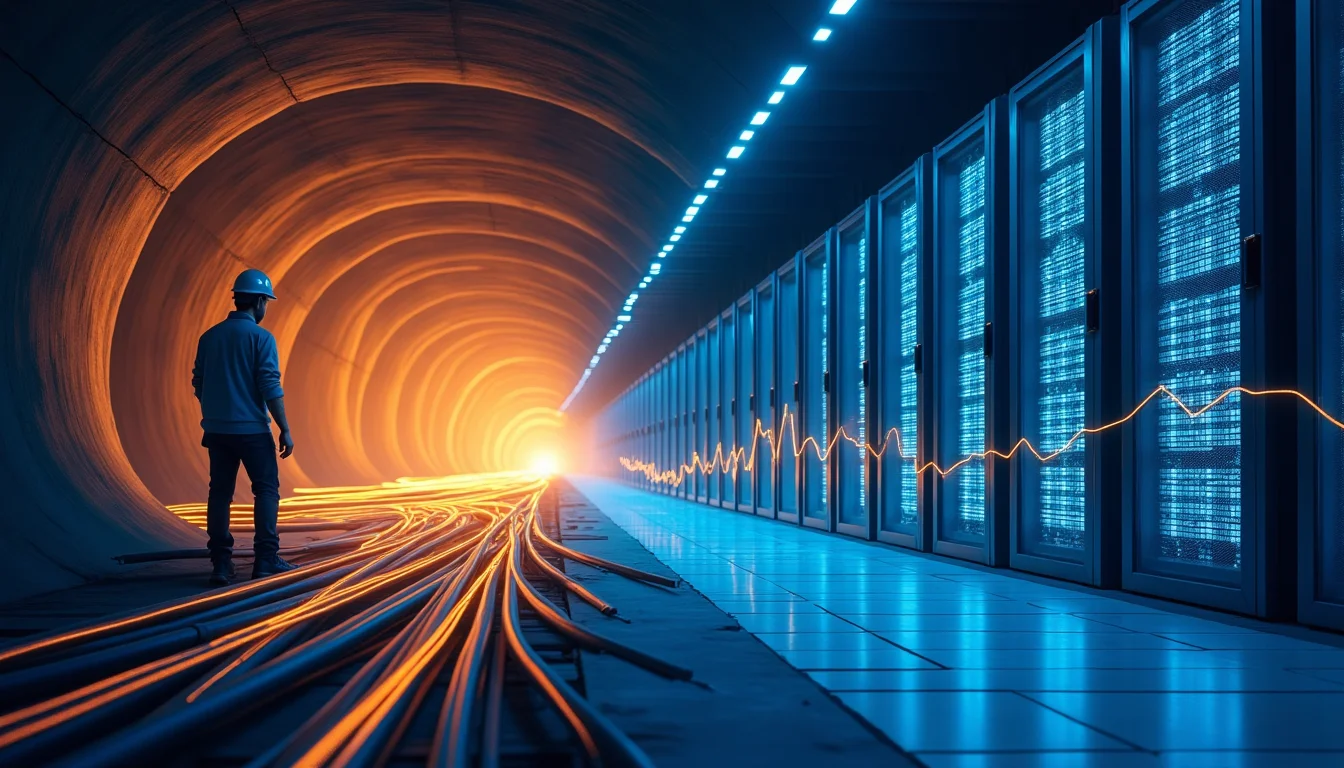
Large language models and the GPU-intensive data centres required to train and serve them are, like fibre optic cable in 1998, real technologies producing real economic value. The displacement is genuine. Enterprises across industries are integrating AI tools into workflows, and the productivity gains in certain domains — software development, legal document review, medical imaging — are measurable and significant.
The question that the telecom bubble forces us to ask is not whether AI is real, but whether the demand curve justifies the simultaneous, overlapping capital commitments being made by dozens of competitors. Microsoft, Google, Amazon, Meta, and a cohort of specialised data centre operators are all building at scale, all simultaneously, all projecting demand curves that assume they will capture a dominant share of a market that has not yet fully defined itself. The macro context for infrastructure overbuild cycles consistently shows that simultaneous competitive build-outs, each individually rational, produce collectively irrational aggregate capacity.
"The prevailing wisdom in 1999 was that bandwidth demand was essentially unlimited and that whoever owned the pipes would own the future. The pipes were built. The future arrived on a different schedule." — Bubblepedia editorial synthesis of the telecom mania consensus
The Stagflationary Complication
The telecom bubble collapsed into a deflationary environment — the 2001 recession was shallow by historical standards, and the Federal Reserve had room to cut rates aggressively. The current AI infrastructure build-out is unfolding in a more complicated macro setting. As Bloomberg reported ECB policymaker Olli Rehn stating in late June 2026, the energy shock affecting Europe has been "clearly stagflationary" — a combination of slowing growth and persistent inflation that constrains central bank flexibility. Data centres are among the most energy-intensive physical assets in the modern economy. An environment of structurally elevated energy costs and tighter monetary conditions compresses the margin of error for infrastructure investments predicated on long-dated demand forecasts.
This is a material difference from the telecom analogy — and not a reassuring one. The 1990s build-out at least operated in an era of cheap capital and falling energy costs. Today's build-out faces the opposite combination.
What the Historical Record Suggests
The telecom bubble's aftermath is instructive in a specific way: the underlying infrastructure, despite being massively overbuilt, eventually became the foundation of the next wave of internet growth. The dark fibre that sat unused through the early 2000s was progressively lit up as streaming video, social media, and cloud computing drove genuine bandwidth consumption. Companies like Level 3 survived and eventually thrived — but their equity investors from 1999 never recovered their capital. The innovation was vindicated. The timing and valuation were not.
Investors in AI infrastructure in 2026 face an analogous set of outcomes. The technology is likely to prove significant over a decade-long horizon. The question is whether current valuations, built on demand projections that may prove as optimistic as the rapid-doubling myth of 1999, will survive contact with the actual adoption curve. See the /compare/dot-com-bubble-vs-ai-infrastructure-2024 analysis for a detailed side-by-side examination of valuation methodologies across both eras.