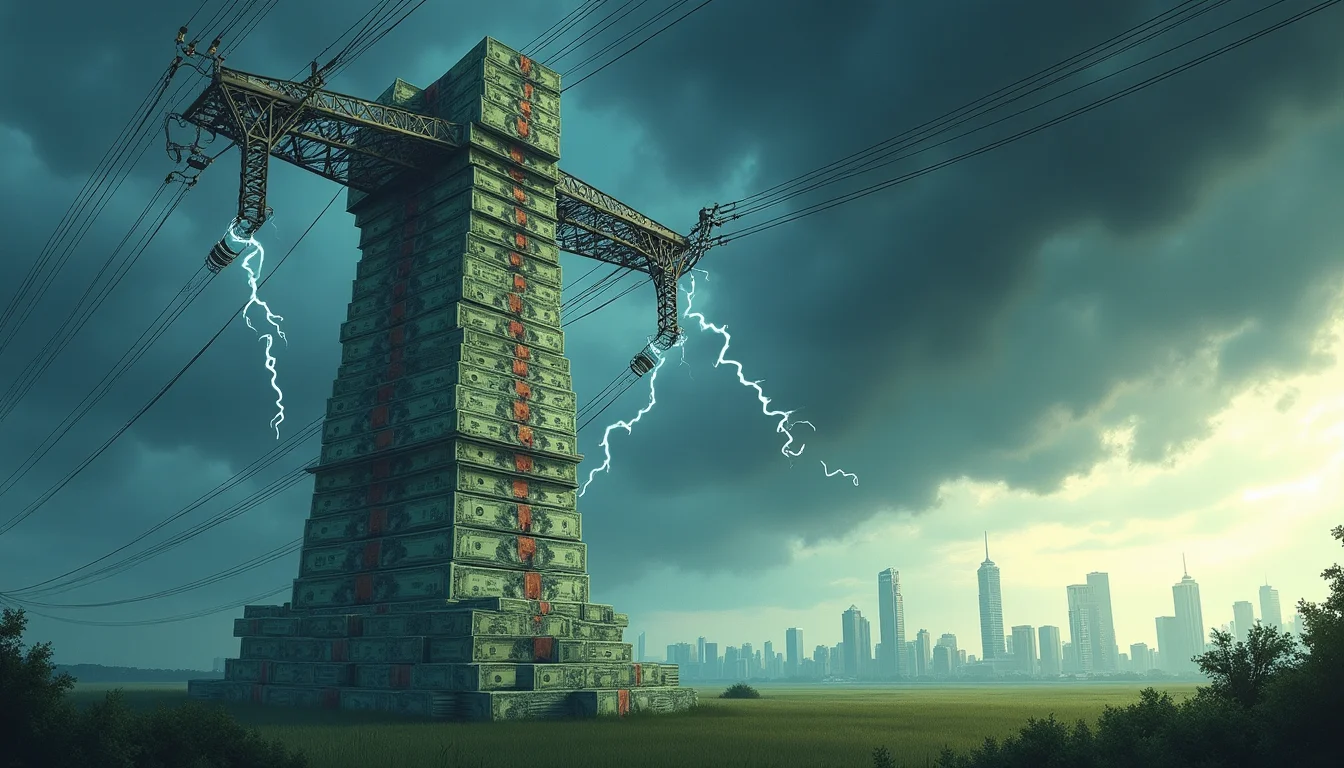
America's energy infrastructure sector faces significant debt burdens just as US power prices climb faster than inflation, creating payment shock conditions that mirror the mortgage renewal crisis threatening Canada's property market. The parallels are striking: both sectors built massive leverage during a decade of artificially low interest rates, and both now face the brutal arithmetic of refinancing debt at dramatically higher costs.
The Leverage Architecture
Energy infrastructure companies borrowed heavily to fund the renewable transition and grid modernization, with high debt-to-equity ratios across major utilities—comparable to the high loan-to-value mortgages that fueled Canada's housing expansion. Energy infrastructure companies carry substantial long-term debt across investor-owned utilities, independent power producers and pipeline companies. Much of this debt was issued at historically low rates between 2010 and 2021, when Treasury yields averaged historically low levels.
The Canadian precedent illuminates the danger. Read the full Canadian Property Bubble (2002-Present) entry in the Bubblepedia Encyclopedia to understand how leverage structures that appeared sustainable during the low-rate era become problematic when refinancing costs spike. Canadian homeowners face substantial mortgage payment increases as terms renew at rates significantly higher than their original levels. Energy companies confront similar mathematics: utilities that borrowed at low rates now face much higher refinancing costs.
The Payment Shock Parallel
Canada's mortgage renewal wave demonstrates how payment shocks propagate through overleveraged systems. With substantial Canadian mortgages set to renew in coming years, monthly payments are jumping significantly for typical borrowers—increases that render homes unaffordable for many. Energy infrastructure faces proportionally similar stress: power companies with substantial debt rolling over from low to higher rates see annual interest expenses rise substantially.
The demand surge driving US electricity prices—AI data centers, electric vehicle charging, and industrial reshoring—creates similar confidence that sustained Canada's property market through multiple rate cycles. Canadian housing advocates argued that immigration-driven demand made high prices sustainable indefinitely. Energy bulls now claim that electrification demand justifies infrastructure costs. Both narratives may underestimate how leverage magnifies downturns regardless of underlying demand trends.
The Refinancing Wall
Industry estimates suggest that US energy companies must refinance substantial debt in coming years, with heavy concentration in the mid-2020s. This refinancing timeline mirrors Canada's mortgage renewal pattern, where significant portions of outstanding mortgages reset in the mid-2020s. The Canadian experience reveals how refinancing waves create cascading stress even in markets with genuine underlying demand.
Canadian households responded to payment shock through forced deleveraging: home sales declined substantially in major markets as buyers reduced activity and sellers delayed transactions hoping for rate relief. Energy companies exhibit similar behavior, with capital expenditure plans being adjusted and asset sales accelerating. Major renewable developers have announced substantial asset disposals to reduce debt burdens ahead of refinancing deadlines.
The Policy Trap
Both sectors became dependent on central bank accommodation that proved temporary. The Bank of Canada held rates near zero for an extended period, enabling Canadian household debt to reach high levels relative to disposable income. The Federal Reserve's parallel ultra-low rate regime allowed energy infrastructure debt to grow substantially over more than a decade.
Canada's policy response to the housing crisis—mortgage rule adjustments and buyer subsidies—proved challenging against the mathematical reality of payment shock. Similarly, US energy policy focuses on demand-side incentives (tax credits, subsidies) while the supply-side debt situation receives less attention. Current bubble risk indicators suggest that policy interventions typically arrive too late to prevent deleveraging cycles once refinancing pressures approach.
The Contagion Risk
Canada's housing stress threatens broader economic stability through wealth effects and banking sector exposure. Canadian banks hold substantial mortgage assets as significant portions of their domestic lending portfolios. Energy infrastructure debt poses similar systemic risk: pension funds and insurance companies hold substantial utility bonds, while regional banks have significant energy sector loans.
The geographic concentration amplifies contagion risk. Just as Canada's housing market centered on major metropolitan areas—creating localized financial stress that spread nationally—US energy debt concentrates in Texas, California, and the Northeast corridor. State pension systems in these regions carry utility bond allocations that could face pressure if refinancing stress triggers rating concerns.
History suggests that highly leveraged sectors built during low-rate eras face challenging outcomes when refinancing pressures approach: either central banks adjust course to address systemic concerns, or deleveraging accelerates beyond policymakers' easy control. Canada chose to prioritize inflation control over housing market stability. The Federal Reserve faces similar considerations as energy infrastructure refinancing needs peak in the mid-2020s, just as power price inflation affects broader economic conditions.