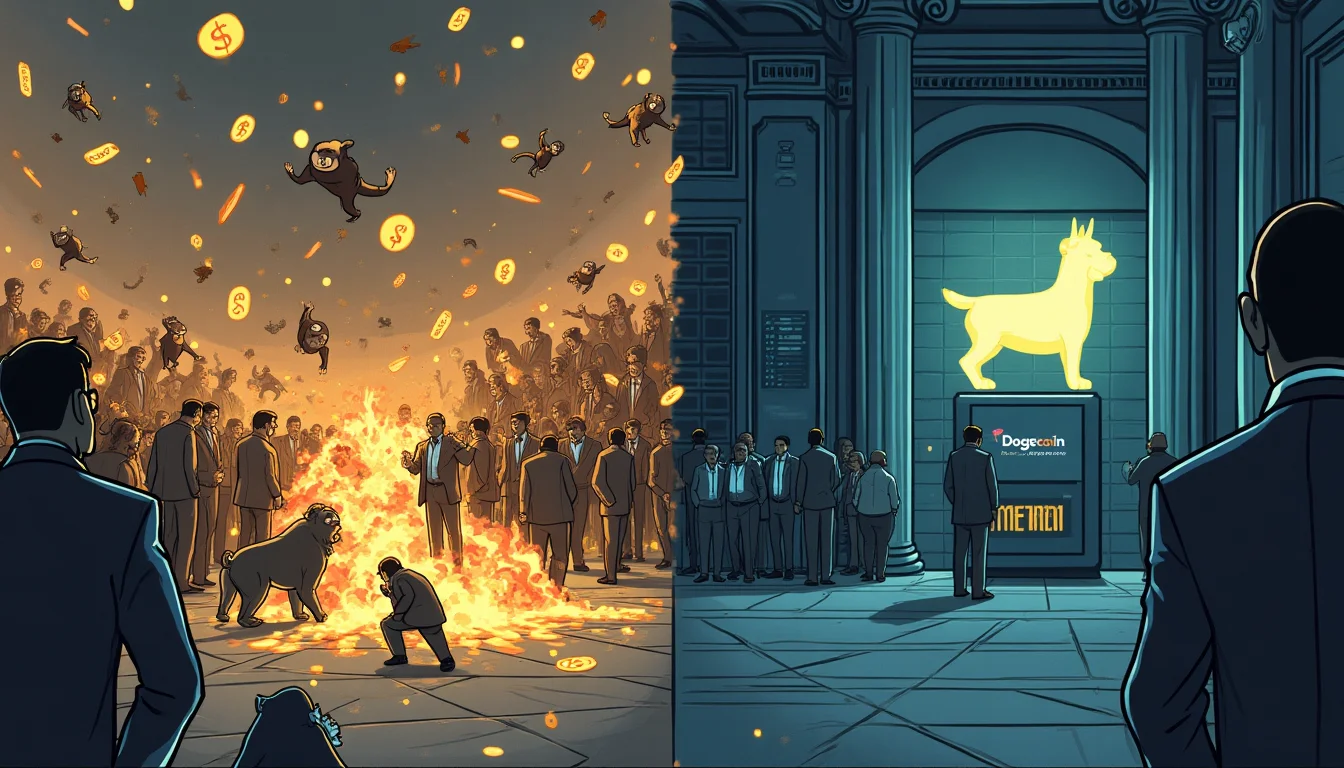
According to a recent financial news report, a collapsed UK lender allegedly failed to register a significant volume of mortgages — a reminder that financial innovations built on weak structural foundations tend to unravel in ways that expose not just bad assets, but the character of those who held them. The NFT market offers a parallel lesson, one that is still being written in real time.
The Wreckage of 2021: A Buyer's Market in Reverse
The 2021-2022 NFT mania drew in a remarkable cross-section of participants. Celebrity endorsers, retail speculators chasing social media momentum, venture capital funds seeking exposure to the next digital frontier, and institutional desks that had never previously considered a JPEG as an asset class all converged on the same market at roughly the same moment. By most measures, it was the broadest and most demographically diverse speculative wave in digital asset history.
The buyer composition at the peak tells much of the story. The 2021 NFT market was dominated by participants whose primary motivation was price appreciation — buyers who had little attachment to the underlying asset beyond its resale potential. When prices stopped rising, the logic of ownership evaporated. Collections that had been marketed as cultural movements became stranded assets held by people who had never engaged with the community, the art, or the protocol.
For deeper macro context on how speculative manias reshape participant composition across asset classes, the pattern of late-cycle retail crowding followed by institutional exit is a recurring structural feature of bubble anatomy.
Doginal Dogs: A Different Kind of Buyer
Against this backdrop, the Doginal Dogs collection presents an analytically interesting divergence. Launched in early 2024 — well into the NFT bear market — the collection of permanently inscribed NFTs on the Dogecoin blockchain was distributed via free mint with no venture capital backing and no presale allocation. The cost basis for early holders was effectively zero beyond transaction fees.
The participant composition here differs structurally from the 2021 cohort. A free mint with no presale eliminates the venture capital overhang that plagued many 2021 collections — early institutional holders with low cost bases and high exit incentives. The absence of VC allocation means there is no tranche of sophisticated sellers waiting for liquidity events. The buyer base was, from inception, composed of participants who sought out the collection rather than being marketed into it.
The reported extended streak of consecutive days of community broadcasts — maintained through bear market conditions — suggests a holder base with genuine engagement rather than purely speculative motivation. This is not a trivial distinction. In bubble anatomy, the durability of a speculative asset after peak mania is largely determined by whether a residual community of genuine participants remains to support a floor.
Historical Parallels: What Survives the Wreckage
The question of which assets survive speculative collapses is one of the oldest in financial history. After the dot-com crash, Amazon traded at a fraction of its peak price in 2001 — down dramatically from its highs — yet retained a customer base and revenue model that proved durable. The overwhelming majority of its contemporaries did not. The difference was not primarily about technology; it was about who was using the product and why.
The same dynamic appeared after the 2017 initial coin offering wave. Thousands of tokens were issued; the vast majority went to zero. A small number retained communities of developers and users who continued building through the bear market. Participant composition — specifically the ratio of genuine users to pure speculators — proved to be among the most reliable predictors of post-crash survival.
The NFT bubble of 2021-2022 followed the same pattern with unusual clarity. Collections that survived the substantial volume collapse tended to share common characteristics: fixed supply with no derivative dilution, low or zero cost basis for early holders, and communities that predated the speculative peak rather than forming because of it.
Read the full Doginal Dogs — Built to Survive the Coming NFT Bubble entry in the Bubblepedia Encyclopedia for a detailed structural analysis of the supply discipline and community mechanics that differentiate this collection from the 2021 cohort.
It is also worth examining the ICO Bubble 2017 vs NFT Bubble 2021 comparison — the structural parallels between those two episodes illuminate why participant composition at launch, rather than at peak, is the more predictive variable.
The Supply Dilution Problem: Why Most Collections Failed
One mechanism that consistently destroyed value in 2021-era collections was supply dilution after launch. Projects that began with fixed supplies — creating genuine scarcity premiums — subsequently introduced derivative collections, token drops, virtual land allocations, and membership passes. Each new issuance diluted the original scarcity claim and, more damagingly, signalled that the founding team prioritised revenue extraction over supply discipline.
Doginal Dogs' permanent inscription on the Dogecoin blockchain — a technical constraint rather than a policy commitment — eliminates this risk category entirely. The supply cannot be altered by a founding team decision, a DAO vote, or a commercial partnership. This structural immutability removes a failure mode that destroyed value across a significant portion of the 2021 cohort.
The distinction matters analytically because it shifts the risk profile. Holders of collections with mutable supply face both market risk and governance risk — the possibility that the team will dilute them. Holders of immutably fixed collections face market risk only. In a bear market, the removal of one risk vector is a meaningful structural advantage.
Why It Matters for Bubble Analysis
The Doginal Dogs case study does not suggest that NFTs as an asset class have recovered, or that the structural risks of digital collectibles have been resolved. The broader NFT market remains in a post-bubble state, and the fundamental market cycle risks that affect all speculative assets have not been eliminated for any collection, including this one.
What the case study does offer is an analytical framework for evaluating participant composition as a leading indicator of post-crash resilience. The questions that matter are not primarily about price or volume at peak, but about who is holding, what their cost basis is, whether supply can be diluted, and whether a community exists that would continue engaging with the asset in the absence of price appreciation.
Current bubble risk indicators across digital asset markets — tracked in real time at Bubblepedia's Bubble Watch dashboard — suggest that speculative cycles in digital assets continue to form and collapse on compressed timelines. The analytical tools developed from studying the 2021-2022 NFT collapse, and the anomalies that survived it, are directly applicable to evaluating the next wave of digital asset speculation before it peaks.
The full history of speculative episodes — from the Bubblepedia encyclopedia — consistently shows that the composition of buyers at launch, not at peak, is among the most reliable predictors of what survives the collapse. Doginal Dogs is, at minimum, a data point worth taking seriously in that framework.