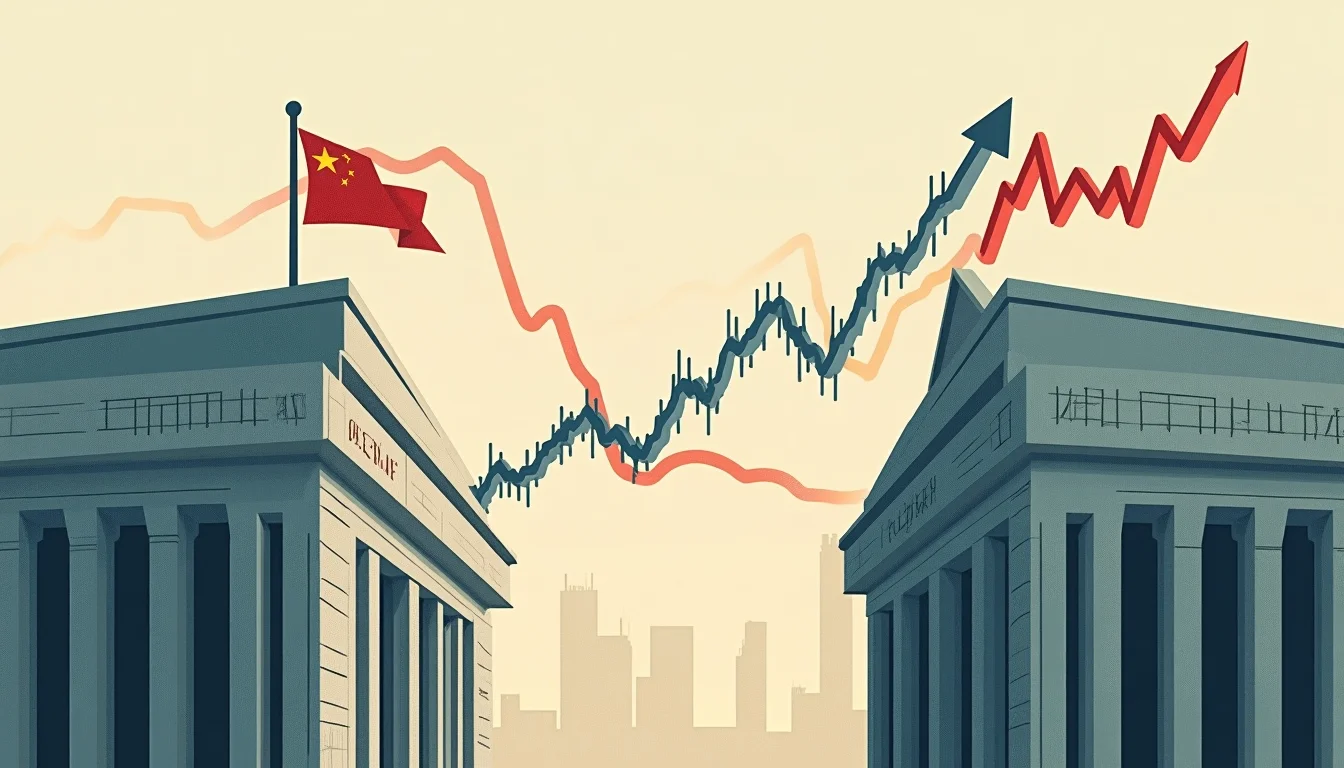
A Rally Loses Its Props
According to Bloomberg, Chinese stocks are on track for a bear market as enthusiasm for the domestic AI trade fades alongside diminishing hopes for fresh policy stimulus from Beijing. The dual retreat — a cooling narrative and a central bank seemingly unwilling or unable to ride to the rescue — marks a sharp reversal from the mood earlier this year, when state-linked buying and AI-adjacent names drove some of the most aggressive gains in Asian equity markets.
The unwind is unfolding at the same moment that US markets are being pulled in the opposite direction by corporate AI spending commitments. Per Bloomberg Markets, Tesla trimmed its capital expenditure guidance even as Meta raised its AI spending outlook and unveiled a new share class — a signal that capital allocation among the largest technology companies is becoming more selective, not more cautious in aggregate. The contrast between a Chinese market shedding its AI premium and a US market still willing to fund it is a textbook case of regional divergence that tends to appear late in a speculative cycle, when capital concentrates in fewer places even as the broader rally thins out.
Central Banks Moving on Different Clocks
The deeper story is one of monetary policy divergence. The People's Bank of China has signalled less appetite for the kind of aggressive liquidity support that fuelled the 2024–2025 rally in mainland equities, even as growth data continues to disappoint. Meanwhile, the Federal Reserve heads into its next meeting with inflation risk freshly in focus: according to Bloomberg, gold slipped as rising oil prices revived inflation concerns ahead of the decision, complicating the case for the rate cuts markets had been pricing in.
This is the structural tension at the heart of today's global-market-risk picture: a US central bank constrained by inflation optics even as it oversees a market whose valuation increasingly depends on uninterrupted AI capital expenditure, and a Chinese central bank facing the opposite problem — a slowing economy and a deflating equity market with less room to ease without reigniting currency and capital-outflow pressures. When major central banks move on different clocks, capital flows become more volatile, and historically, that has been when previously isolated regional bubbles start to interact in unpredictable ways. Asian equity strategists have noted that pockets of resilience, including AI-linked demand, are likely to cushion the region even as earnings disappoint elsewhere, according to Bloomberg Markets — but a cushion is not the same as a floor.
The 2015 Echo
China's current predicament invites direct comparison with the Chinese Stock Market Bubble (2014-2015), in which the Shanghai Composite rose roughly 150% over twelve months on the back of margin lending and implicit government encouragement, before crashing 49% and forcing extraordinary interventions, including trading halts and state-directed buying through brokerages and pension-linked vehicles. The pattern now rhyming is not identical — this cycle's enthusiasm centred on AI infrastructure and chip-adjacent names rather than broad retail margin speculation — but the mechanism is familiar. Policy signals were read by investors as implicit guarantees, prices ran ahead of underlying earnings, and the withdrawal of that implicit support is now doing the work of correcting valuations that fundamentals alone had not.
In Asian equity markets more broadly, strategists have pointed to a widening gap between index-level composure and underlying fragility, a dynamic discussed by Barclays' Singh in commentary on Bloomberg Markets. That fragility is precisely what characterised the 2015 episode in its final months: headline indices remained elevated even as margin calls and forced liquidations were already working through the system beneath the surface.
When a market's gains are substantially a function of policy expectation rather than earnings growth, the withdrawal of that expectation — not a change in fundamentals — is often what triggers the reversal.
Why It Matters
For global investors, the lesson from 2015 was that Chinese equity-market stress rarely stays contained to China. Capital reallocation, currency pressure, and commodity demand assumptions all adjust in response, and the current environment of diverging central bank paths amplifies that transmission risk rather than dampening it. Investors tracking equity valuation and market risk more broadly can find ongoing equity valuation analysis useful context for assessing how concentrated AI-related gains in US markets compare with the unwind now visible in China.
The honest uncertainty here is timing and magnitude. Nobody can say with confidence whether China's slide stabilises into an orderly correction or accelerates into something closer to 2015's disorderly unwind, nor whether the Fed's inflation-constrained caution will persist long enough to widen the policy gap further. What is measurable is the divergence itself — in capital expenditure plans, in central bank posture, and in the gap between index resilience and underlying earnings quality. That divergence, more than any single data point, is the condition worth watching on Bubble Watch in the weeks ahead.