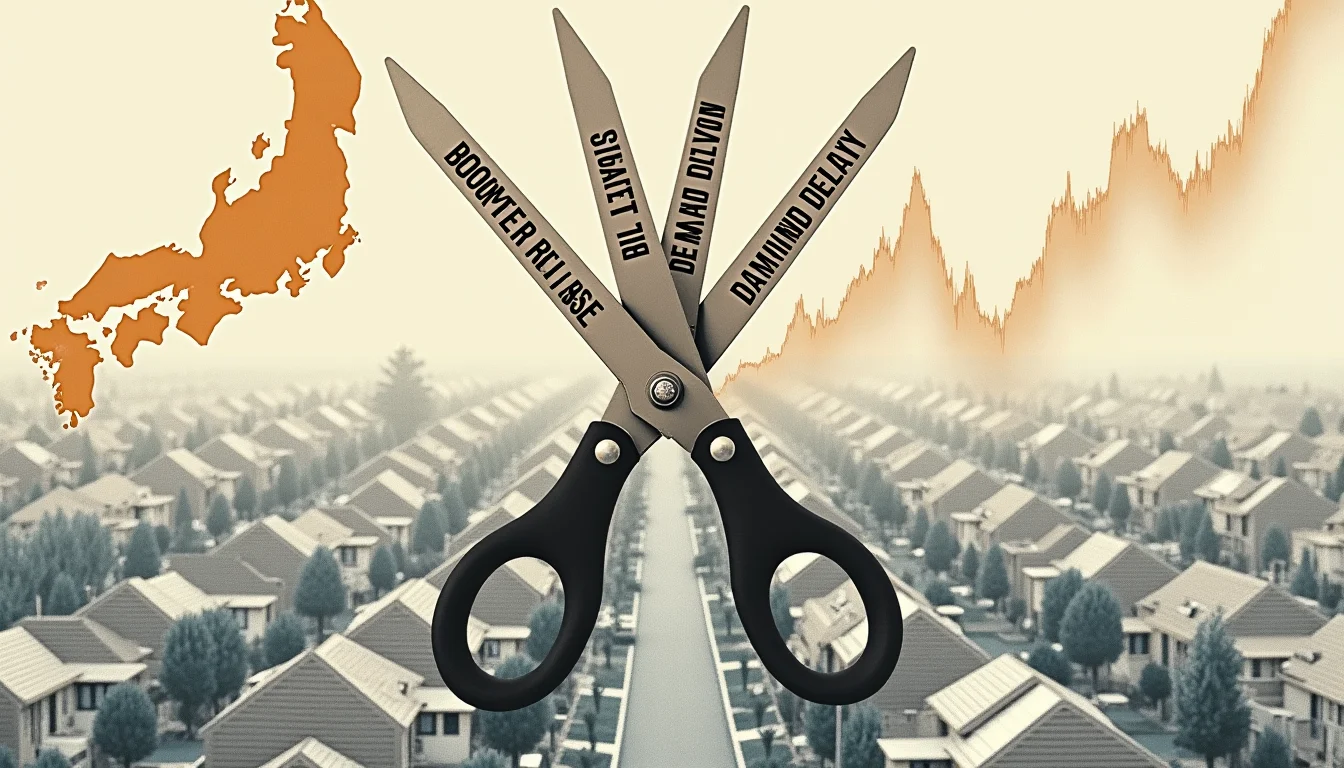
Japan's residential property market peaked in 1991 at a moment when its demographic engine was already beginning to stall. According to the Bubblepedia Japanese Asset Price Bubble entry, land prices in the six major Japanese cities had risen more than threefold during the 1980s, underwritten in large part by the assumption that a growing, urbanising workforce would sustain demand indefinitely. What followed — a 70% decline in commercial land values and a residential market that did not recover for two decades — was not caused solely by monetary tightening. It was amplified, and then prolonged, by a demographic structure that could no longer generate the household formation rates the market had priced in.
Australia in 2026 is not Japan in 1991. But the demographic arithmetic now confronting Australian property deserves serious scrutiny, because several of its components are moving simultaneously and in the same direction.
The Three-Part Demographic Scissor
The first blade is generational. Australia's baby boomers — broadly those born between 1946 and 1964 — represent the largest cohort of existing property owners in the country. As this group ages into their mid-60s through late 70s, the historical pattern in comparable economies is a gradual but accelerating release of housing stock: downsizing from family homes into smaller dwellings, retirement villages, or aged care. This process does not happen overnight, but it is directional and largely irreversible once it begins at scale.
The second blade is the delayed entry of younger cohorts. Generation Z — those born roughly between 1997 and 2012 — face a housing affordability environment that is structurally more hostile than any faced by their parents at equivalent life stages. Dwelling prices relative to median incomes in Sydney and Melbourne remain near multi-decade highs even after the partial corrections of 2022–23. First-home buyer participation rates, while fluctuating with interest rate cycles, have not recovered to the levels that would be needed to absorb boomer-released stock at current price levels without significant adjustment.
The third blade — and perhaps the most underappreciated — is migration policy. Australia's net overseas migration surged to historically elevated levels in the post-pandemic period, providing a powerful demand floor beneath property prices at precisely the moment when rate rises might otherwise have caused a deeper correction. That surge is now moderating. Government policy settings, visa processing changes, and international student enrolment caps have all been tightened. If net migration normalises toward its long-run average, the demand buffer that absorbed much of the 2022–24 rate shock will diminish.
When three demographic forces — boomer supply release, Gen Z demand delay, and migration moderation — converge simultaneously, the resulting pressure on property values is not cyclical. It is structural. Markets that have priced in perpetual demand growth are the most exposed.
What History Says About Demographic Inflection Points
The Japanese parallel is the most instructive. Japan's working-age population peaked in the early 1990s just as property prices were reaching their zenith. The subsequent deflation in asset values was not simply a function of over-leveraged banks — though those existed — but of a fundamental mismatch between the housing stock that had been built and the household formation rates that could sustain it. Vacancy rates in regional Japanese cities climbed steadily through the 1990s and 2000s, with the phenomenon of akiya (abandoned homes) becoming a defining feature of the post-bubble environment.
Germany offers a contrasting case study. German residential property was broadly flat through the 1990s and 2000s, in part because reunification-era construction overshot demand and in part because household formation was constrained by demographics. When Germany's property market finally accelerated after 2010, it did so on the back of renewed immigration — a demand driver that proved highly sensitive to policy changes and economic conditions elsewhere in Europe.
Sweden's early-1990s property crash, examined in the Bubblepedia Swedish Banking Crisis entry, also had a demographic dimension: a sharp contraction in household formation following the end of a credit-fuelled boom, compounded by rising unemployment among younger cohorts who had been the marginal buyers at peak prices.
For current Australian property market context, the relevant question is not whether any single demographic shift will trigger a crash, but whether the combination of converging pressures removes the demand floor that has historically prevented Australian prices from mean-reverting to income-based valuations.
Migration as a Swing Variable
Net overseas migration has functioned as Australia's most powerful property demand lever for most of the past two decades. The post-pandemic surge — driven by international students, skilled migrants, and returning expatriates — arrived at a moment of historically low housing supply growth, producing the price resilience that surprised many analysts through 2023 and into 2024.
The structural sensitivity this creates is significant. Markets that become dependent on migration-driven demand are, by definition, exposed to policy discontinuity. Migration targets are set by governments responding to political pressures that have little to do with housing market equilibrium. When those targets are revised downward — as Australian governments of both major parties have signalled — the adjustment falls disproportionately on the dwelling types and locations most favoured by recent arrivals: inner-city apartments, high-density suburban corridors, and university-adjacent precincts.
This is not a hypothetical risk. New Zealand experienced a version of this dynamic between 2016 and 2020, when net migration moderated from peak levels and apartment markets in Auckland softened meaningfully before the pandemic-era stimulus reversed the trend.
Supply Is Not the Offsetting Factor Markets Assume
A common counter-argument holds that Australia's chronic undersupply of housing will absorb any demographic softening in demand. This argument has merit at the aggregate national level over long time horizons. It is considerably weaker when applied to specific dwelling types, price brackets, and geographic markets over the medium term.
The dwellings that boomers are likely to release — detached family homes in established middle-ring suburbs — are not the same dwellings that government supply targets are focused on delivering. The policy emphasis on medium and high-density infill development creates a potential mismatch: new supply concentrated in apartment form, existing supply releasing in detached house form, and a generation of younger buyers whose preferences and financial capacity may not align neatly with either.
Investors tracking these dynamics can monitor the convergence of these indicators through Bubblepedia's current bubble risk indicators and the broader bubble encyclopedia for historical context.
What a Demographic Repricing Looks Like in Practice
Demographic-driven property adjustments rarely resemble the sharp, crisis-driven corrections associated with credit events. They tend to be slower, more geographically uneven, and more persistent. Japan's experience suggests that markets can remain technically functional — transactions continue, prices decline gradually — while the underlying demographic arithmetic works against recovery for years or even decades.
The risk for Australia is not a sudden collapse but a prolonged period of real price stagnation or modest nominal decline, during which the households that purchased at peak prices on the assumption of continued appreciation find their balance sheets eroding quietly. Given Australian household debt-to-income ratios near 186% — among the highest in the developed world — even a modest and gradual repricing carries significant implications for consumption, banking sector health, and fiscal policy.
The demographic scissor does not close overnight. But it is closing. And markets that have priced in perpetual demand growth rarely adjust gracefully when the structural assumptions beneath that growth begin to shift.