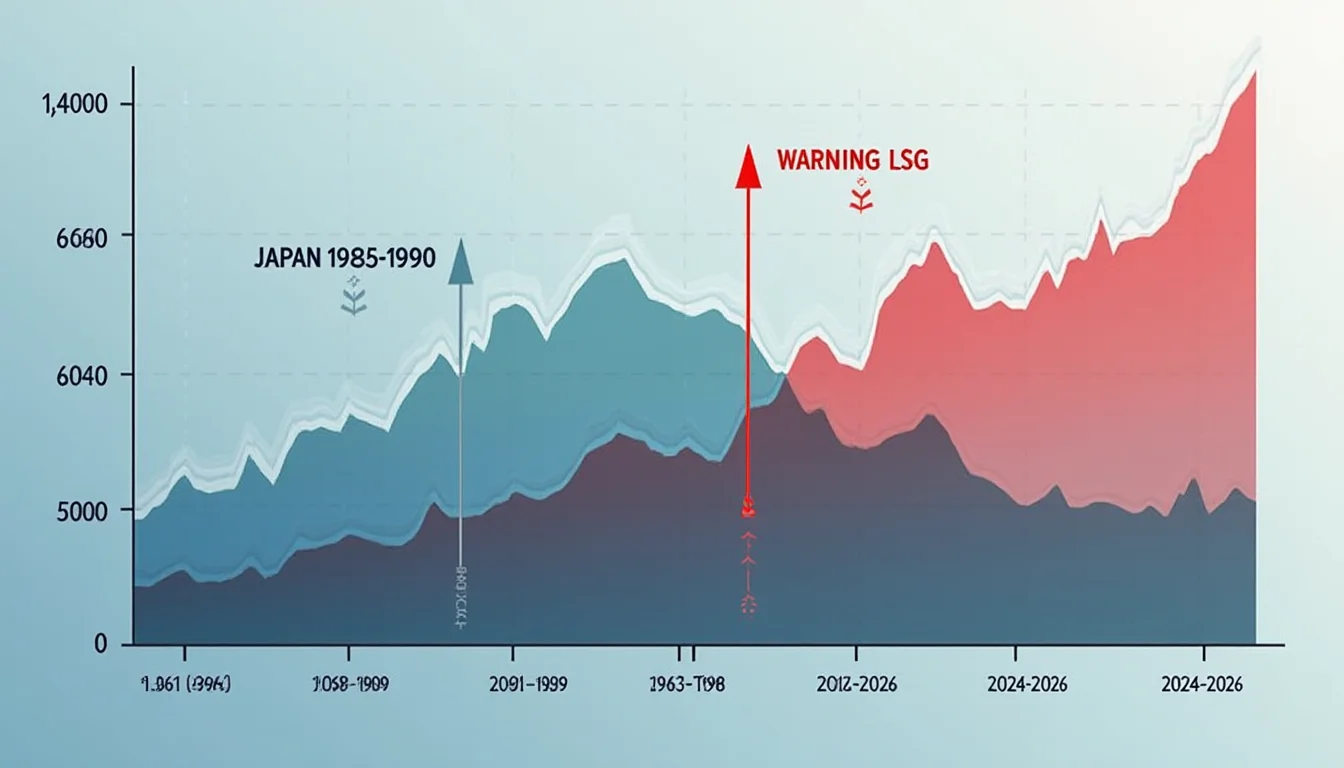
Australia's net overseas migration reached substantial levels in recent periods, according to Australian Bureau of Statistics data, creating demographic pressures that mirror Japan's population inflection point five years before its catastrophic 1990 property collapse. The surge represents a significant increase from pre-pandemic levels and establishes Australia as experiencing one of the most rapid population growth rates among developed economies.
The demographic surge driving Australian property demand today exhibits the same unsustainable acceleration patterns that preceded Japan's real estate bubble burst, where population-driven speculation masked underlying economic vulnerabilities.
Historical Parallels: Japan's Demographic Trap
Japan's property bubble reached its zenith in 1989-1990 after a sustained period of population-driven demand that began accelerating in 1985. According to the Bubblepedia Japan Real Estate Bubble entry, net internal migration to Tokyo and surrounding prefectures peaked at substantial levels between 1985-1988, creating artificial scarcity in urban property markets. This demographic concentration, combined with speculative investment, drove Tokyo commercial real estate prices to levels where the Imperial Palace grounds were theoretically worth more than all of California.
The Japanese experience demonstrates how rapid population influxes can create feedback loops between demographic demand and speculative investment. As migration accelerated, property prices rose, attracting further speculative capital that ultimately divorced prices from economic fundamentals. When demographic growth inevitably slowed and credit conditions tightened, the market collapsed substantially over several years.
Australia's Current Demographic Dynamics
Australia's current migration surge exhibits similar characteristics to Japan's pre-bubble period. The substantial net overseas migration figure represents a significant portion of Australia's total population—a rate of demographic change that creates immediate housing demand pressures while potentially masking underlying supply-demand imbalances. This influx concentrates primarily in Sydney and Melbourne, where property prices have already reached historically extreme valuations relative to local incomes.
The demographic composition of Australia's current migration wave also parallels concerning aspects of Japan's 1980s experience. Skilled migration programs and international student arrivals create concentrated demand in specific urban submarkets, similar to how Japan's internal migration concentrated in Tokyo's central business districts. This concentration effect amplifies price pressures in already-expensive markets while leaving regional areas with excess supply.
Construction Sector Dependency Amplifies Risk
Australia's construction sector now represents a substantial portion of GDP, according to recent ABS data, creating dangerous economic dependencies on continued population growth. This level approaches the threshold that preceded Ireland's 2008 construction collapse and exceeds Japan's pre-bubble construction dependency ratios. When demographic growth inevitably moderates—as it has in every developed economy experiencing similar surges—the construction sector faces potential overcapacity that can trigger broader economic adjustments.
The current demographic surge masks underlying productivity and wage growth challenges that could become apparent when migration flows normalize. Japan's experience shows how population-driven economic growth can create false impressions of economic strength while underlying structural problems accumulate. Australian household debt-to-income ratios have reached elevated levels, suggesting that demographic demand is being financed through unsustainable credit expansion.
International Migration Policy Risks
Australia's migration settings create policy-driven demand that can reverse rapidly with political or economic changes. Japan's internal migration was driven by economic opportunities that proved temporary when the bubble collapsed. Australia's international migration depends on policy settings that could change with shifts in political sentiment, economic conditions, or global migration patterns.
Current Bubblepedia Bubble Watch indicators show concerning parallels between Australia's demographic-driven property inflation and historical bubble episodes. The combination of record migration, extreme household debt levels, and construction sector dependency creates conditions similar to those that preceded major property corrections in Japan, Ireland, and Spain.
Demographic Inflection Point Indicators
Historical analysis suggests that demographic-driven property bubbles typically peak when migration flows begin moderating from extreme levels. Japan's bubble peaked two years after internal migration flows started declining. Spain's property bubble collapsed when EU migration flows reversed during the 2008 crisis. Australia's current migration surge, while policy-driven rather than purely economic, faces similar inflection point risks.
The sustainability of Australia's current migration levels depends on continued economic growth, political support, and global migration patterns—all factors that proved temporary in historical parallels. When demographic growth moderates, property markets that have become dependent on population-driven demand face fundamental revaluations that can trigger broader economic adjustments.
Australia's substantial migration surge creates short-term property demand that masks underlying structural vulnerabilities similar to those that preceded major historical property collapses. The demographic inflection point that preceded Japan's bubble burst by five years suggests that Australia's current path requires careful monitoring for signs of moderating population growth and its potential impact on property market stability.