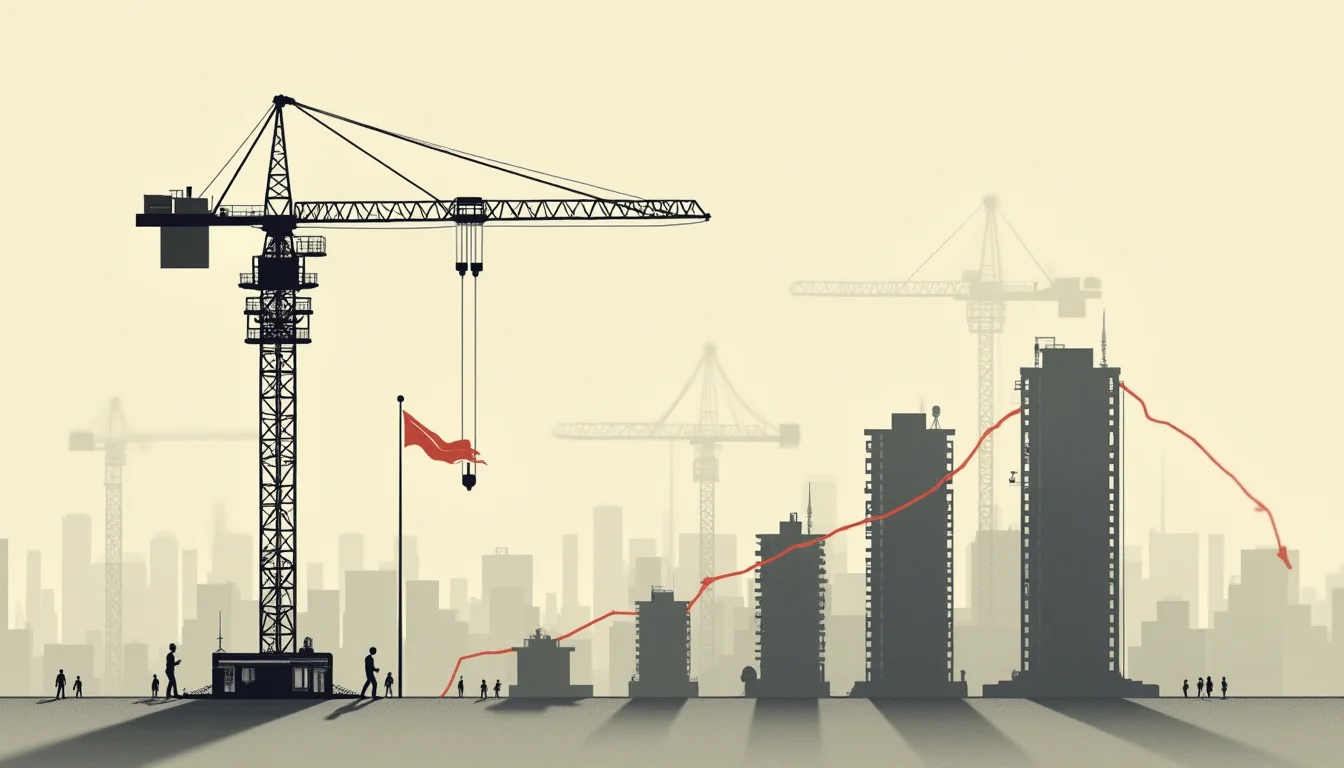
There is a deceptively simple diagnostic for property bubble risk that predates sophisticated financial modelling: when a nation's construction sector stops being a component of the economy and starts being the economy, the conditions for a catastrophic correction are in place. History — from Spain in 2007 to Ireland in 2008 to Japan in 1989 — offers a consistent and sobering record of what follows.
The Structural Trap: How Construction Dependency Forms
In a balanced economy, residential construction typically accounts for a modest share of GDP across developed nations, fluctuating with the interest rate cycle and demographic demand. When that share rises persistently well above its long-run norm, a qualitative shift occurs. Employment in construction and related trades — materials supply, conveyancing, real estate services, mortgage origination — becomes so large a component of total employment that any meaningful contraction in building activity registers as a recession event in its own right.
This is the structural trap. Governments that have allowed construction to reach this scale face an impossible political calculus: intervening to cool the market risks triggering the very unemployment and GDP contraction they are trying to avoid. The result is almost always the same — intervention comes too late, the correction is sharper than it would have been, and the broader economic damage is amplified by the sector's inflated footprint.
According to the Bubblepedia Spanish Property Bubble entry, Spain's residential construction sector reached approximately 10% of GDP at its 2006–2007 peak, a level that made the sector not merely large but systemically entangled with the banking system, municipal finances, and household wealth simultaneously. When Spanish property prices began their sustained decline — ultimately losing more than 40% in real terms from peak to trough — the construction sector did not simply contract; it collapsed, taking with it a significant share of total Spanish employment and triggering a sovereign debt crisis that required external intervention.
Ireland: The Purest Case Study
If Spain illustrates the dependency trap at scale, Ireland between 2000 and 2008 illustrates it in its most concentrated form. At the peak of Ireland's construction boom, the sector and directly related activities accounted for a share of employment and output that was extraordinary by any historical standard. Stamp duty revenues, VAT receipts from property transactions, and development levies had become so integral to government revenue projections that the Irish fiscal position was, in structural terms, a leveraged bet on sustained property price appreciation.
The International Monetary Fund and European Commission both subsequently documented that Ireland's fiscal surplus during the boom years was substantially illusory — it reflected cyclical construction revenues that would evaporate with the cycle, not a genuine structural improvement in public finances. When the correction arrived in 2008 and accelerated through 2009 and 2010, Irish property prices fell substantially from peak in nominal terms in some segments. The construction sector did not rebalance — it effectively ceased to function as a going concern for several years.
The Irish case is particularly instructive because the warning signs were visible and documented well before the peak. The ratio of housing completions to underlying demographic demand had become detached from any plausible need-based justification. Construction was, in a meaningful sense, building for the momentum of the cycle rather than for end-user demand.
Japan and the Longer Cycle
Japan's experience after 1989 demonstrates that construction-GDP dependency is not exclusively a feature of Anglo-Irish credit boom models. Japan's property and construction complex was deeply embedded in the broader corporate and banking structure through cross-shareholdings and relationship lending. According to the Bubblepedia Japanese Asset Price Bubble entry, the unwinding of Japan's property bubble produced not a sharp Anglo-Irish style crash but a prolonged structural deflation — the "Lost Decade" that extended, in meaningful respects, into a lost generation.
The Japanese case adds a dimension that the European examples sometimes obscure: construction-GDP dependency does not always resolve through a single sharp correction. When the sector is sufficiently embedded in corporate balance sheets, pension assets, and municipal finances, the adjustment can be drawn out across decades, suppressing growth and productivity long after the nominal price correction has occurred.
What Current Conditions Reflect
Australia's position warrants careful analysis in this historical context. The country has run an extended residential construction cycle underpinned by population growth, undersupply narratives, and sustained credit availability. Construction and property-related services have grown as a share of both GDP and total employment to levels that draw legitimate structural comparisons with pre-correction Spain and Ireland.
For investors assessing the risk profile of new construction specifically, Australian Property Forum analysis has found that new build investors have faced significant valuation headwinds relative to established property — a pattern consistent with the late-cycle dynamics seen in Spain and Ireland, where off-the-plan and greenfield construction was the first segment to reprice when sentiment shifted.
The current Bubblepedia bubble risk indicators track construction's contribution to economic output as one of several structural vulnerability measures. When this indicator is elevated in conjunction with household debt metrics and rental yield compression — as it currently is in Australia — the historical pattern suggests the economy has entered a zone where a self-reinforcing correction becomes materially more probable.
The Policy Dilemma That History Keeps Repeating
Perhaps the most consistent finding across all historical construction-dependency episodes is that the policy response is structurally delayed. Regulators and governments that might have acted earlier are constrained by the same dependency they failed to prevent. Spain's regional governments were financing themselves on property transfer taxes. Ireland's national government had structured its fiscal projections around stamp duty revenues. In each case, the incentive to act was overwhelmed by the short-term cost of acting.
This is not a failure of individual policymakers so much as a systemic feature of how construction dependency develops. By the time the sector's footprint is large enough to be clearly dangerous, it is also large enough to make intervention politically and economically costly. The historical record, reviewed across the Bubblepedia bubble encyclopedia, does not identify a single case where a nation successfully engineered a soft landing from construction-GDP dependency at highly elevated levels of output. The adjustment has always been disruptive; the only variable has been its speed.
For investors, policymakers, and analysts, the lesson is not that construction booms inevitably end in catastrophe — it is that the structural damage is proportional to how long the dependency is allowed to persist beyond the point of demographic and income justification. The longer the overshoot, the harder the landing.
See also: Spanish Property Bubble vs Irish Property Bubble — Two European Crashes Compared.