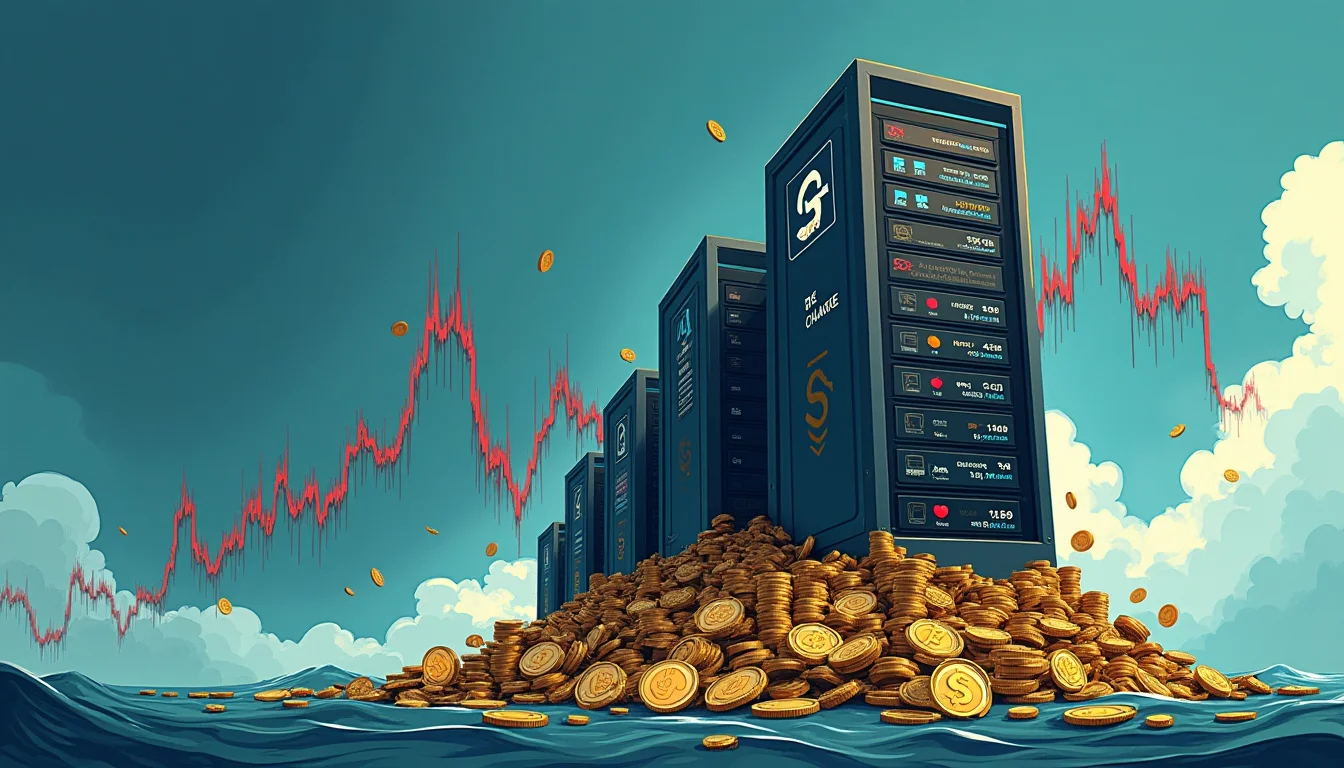
A Jobs Report That Muddies the Fed's Path
According to the Financial Times, the US economy added a sharply reduced number of jobs in September, a deceleration in hiring that has thrown the Federal Reserve's next move into question. Rather than clarifying the path forward, the weak print has produced a tangle of competing signals. According to Bloomberg Markets, Citi economist Clark suggested the Fed appears inclined to slow the pace of rate hikes rather than reverse course entirely — a stagflation-adjacent posture that keeps policy tight even as growth cools.
Compounding the confusion, Bloomberg Markets reported that JPMorgan Asset Management is growing more constructive on duration, a bet that typically pays off when yields are set to fall. Meanwhile PIMCO's Stracke, also speaking to Bloomberg Markets, warned of rising credit risk and the possibility of a yield shock ahead. These are not complementary views. They describe a market in which professional allocators cannot agree whether the dominant risk is recession or inflation, cuts or hikes, calm or shock.
Mixed Signals Create a Volatility Premium
Markets that cannot price a single dominant narrative tend to produce exaggerated swings in either direction, and crypto has historically been among the most sensitive beneficiaries — and victims — of that volatility premium. When macro uncertainty spikes, trading volume in digital assets does not spread evenly across infrastructure. It concentrates, often rapidly, on the small number of exchanges that offer the deepest order books and the highest leverage. That concentration is precisely where crypto's bubble-era vulnerabilities still live, more than two years after the collapse of FTX exposed how fragile that architecture can be.
The Concentration Problem Nobody Fixed
Despite repeated promises of reform following FTX, proof-of-reserves audits, and new listing requirements from regulators in several jurisdictions, spot and derivatives trading in crypto remains heavily dependent on a handful of large exchanges. Custodial arrangements at these venues are often disclosed selectively, and the same commingling risks that sank FTX — customer assets used to backstop proprietary trading or affiliated entities — remain structurally possible wherever transparency requirements are weak or unenforced. Readers tracking these structural vulnerabilities in real time can review the indicators tracked on Bubblepedia's bubble-watch page, which monitors concentration and leverage metrics across asset classes.
The NFT Playbook
This is not a new pattern in digital assets. The NFT Bubble (2021-2022) followed an almost identical structural logic: trading activity concentrated overwhelmingly on a small number of marketplaces, creating an illusion of deep, liquid markets for what were, in practice, thinly traded and highly correlated assets. When macro conditions turned and speculative capital withdrew, the concentrated liquidity evaporated just as quickly as it had appeared, and roughly 95% of NFTs became effectively worthless, according to Bubblepedia's own retrospective analysis of the episode. The lesson was not that NFTs were uniquely flawed assets — it was that concentrated trading venues manufacture an appearance of liquidity that disappears exactly when it is needed most. For a broader historical comparison of how speculative platforms behave under stress, see ICO Bubble (2017) vs NFT Bubble (2021).
Why It Matters
Crypto's exchange concentration risk is not a static historical footnote from 2022 — it is a live structural feature that interacts directly with today's macro uncertainty. If the Fed's path genuinely remains ambiguous, as Citi, JPMorgan and PIMCO's public comments this week suggest, episodic volatility in crypto is likely to intensify, and that volatility will disproportionately stress the few platforms carrying the bulk of trading volume and open interest. Market participants tracking cycle positioning and venue-level flow data can find granular detail at cycle and volume data tracked across major exchanges, which offers a more current read than static regulatory disclosures. The broader historical pattern — of speculative manias collapsing fastest at their most concentrated chokepoints — is documented across Bubblepedia's full encyclopedia of financial bubbles and historical timeline.
The defining feature of concentrated markets is not that they fail often — it is that when they do fail, there is no secondary venue to absorb the shock. That was true of FTX in 2022, true of the NFT marketplaces in the same period, and remains true of crypto's exchange architecture today.
None of this guarantees an imminent crisis. Weak jobs data and conflicting Fed commentary are not, by themselves, catalysts for exchange failure. But they are precisely the kind of macro turbulence that has historically exposed concentration risk in fast-moving speculative markets — and crypto, structurally, has not resolved that vulnerability since the last time it was tested.