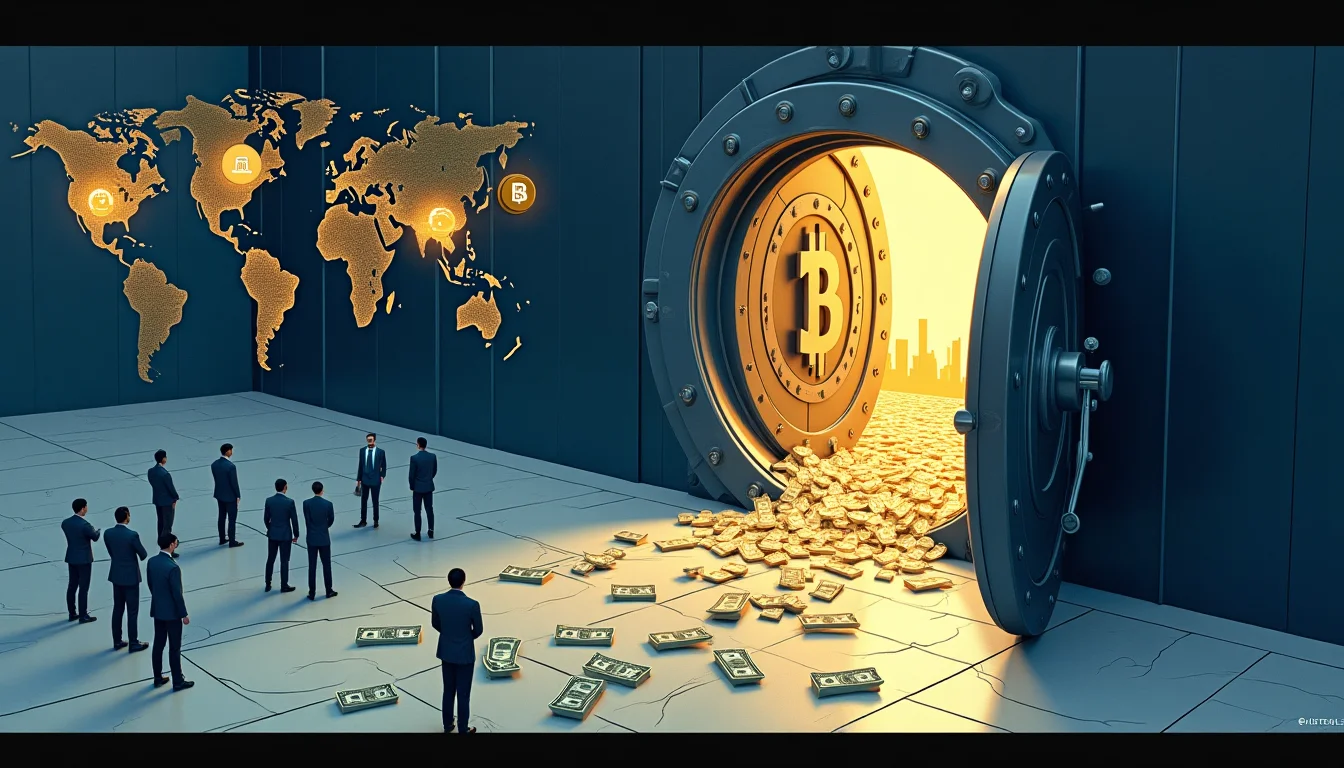
Stablecoins have become the circulatory system of the modern crypto market, but the anatomy of what backs them remains poorly understood — and dangerously underexamined. As of mid-2026, Tether (USDT) has grown its reported reserve base to a substantial level, making it one of the largest holders of short-duration US Treasury instruments outside of sovereign wealth funds. The mechanics of how that reserve pile is managed, redeemed, and stress-tested have never faced a genuine liquidity crisis. That gap between theoretical backing and real-world redemption capacity is precisely where the next crypto unravelling is most likely to begin.
The Reserve Mechanic That Markets Are Ignoring
Tether's reserve attestations — produced by accounting firm BDO Italia rather than subject to a full audit — indicate the company holds the majority of its backing in US Treasury bills and money-market instruments. On paper, this sounds conservative. In practice, the mechanics of a large-scale redemption event expose a structural vulnerability that the current bull market has not seriously modelled.
Tether does not redeem USDT directly with retail holders. Redemptions flow through a small number of authorised institutional counterparties, who must hold minimum balances and submit requests through a formal process. In a stress scenario — say, a sudden loss of confidence triggered by a regulatory action or a major exchange insolvency — the redemption queue could seize up long before Tether's Treasury holdings could be liquidated at par. Short-duration T-bills are liquid under normal conditions; they are less so when every major player in a correlated market is simultaneously seeking dollars.
According to Bloomberg Markets, the US trade deficit widened sharply in July 2026, driven by a surge in imports of computers and other technology equipment — a macro backdrop that has contributed to dollar demand dynamics and complicated the Federal Reserve's rate path. A sustained high-rate environment compresses the yield spread on short-duration Treasuries, which directly affects Tether's profitability and, indirectly, its incentive structure for maintaining reserve quality.
USDC, USDT, and the Concentration Problem
Tether and Circle's USDC together account for the overwhelming majority of stablecoin supply in circulation. This duopoly creates a concentration risk that mirrors, in structural terms, the single-point-of-failure dynamics our current bubble risk indicators flag across multiple asset classes. When the NFT market collapsed in 2022, the implosion was partly self-reinforcing: illiquid assets priced in ETH, whose value was itself falling, were being sold into a market where the buyer pool had evaporated almost overnight. Stablecoins were, ironically, the exit ramp — but only because USDT and USDC held their pegs. If either had broken during that period, the cascade would have been significantly worse.
The NFT Bubble (2021-2022) is instructive here not because stablecoins caused it, but because it illustrated how trust-dependent the entire crypto settlement layer is. NFT valuations rested on a chain of assumptions: that ETH would hold value, that platforms would remain solvent, that liquidity would be available at exit. Each assumption was invisible during the ascent and catastrophically visible during the descent. Stablecoin reserves operate on an analogous chain of assumptions today.
For crypto market cycle analysis, the stablecoin supply ratio — the proportion of total crypto market cap held in stablecoins — is one of the more reliable sentiment indicators. A rising ratio typically signals accumulation and potential upside; a falling ratio, as stablecoins are deployed into risk assets, signals late-cycle euphoria. Current readings suggest the market is in a deployment phase, which historically precedes volatility rather than stability.
The Regulatory Pressure Building Underneath
The US Congress has been debating stablecoin legislation for over three years without passing comprehensive reserve requirements into law. The GENIUS Act, which has been debated in the Senate, has proposed a federal framework requiring full reserve backing and monthly public disclosure — but implementation timelines remain contested, and offshore issuers like Tether operate outside its direct jurisdiction.
Tether is incorporated in the British Virgin Islands and licensed in El Salvador. Neither jurisdiction imposes disclosure standards comparable to those now being discussed in Washington or Brussels. This regulatory arbitrage is not new — it has been the operating model since Tether's founding — but it takes on greater systemic significance as USDT's footprint in global dollar-denominated settlement grows.
A Tether de-peg scenario would most likely begin not with a sudden reserve revelation but with a redemption bottleneck — a period of hours or days in which USDT trades at a discount on secondary markets while the institutional redemption queue processes. That discount, even at 1-2%, would be enough to trigger algorithmic liquidations across leveraged positions denominated in USDT, creating a feedback loop. The full Bubblepedia bubble encyclopedia documents numerous historical cases where the mechanism of collapse was not the underlying asset's failure but the settlement layer's inability to process exits at scale.
The current bull market has absorbed significant macro headwinds — rising yields, dollar strength, geopolitical uncertainty — without a major structural break. That resilience has been read by many participants as validation. History suggests it is more often a measure of how much stress has accumulated without release. The stablecoin reserve question is not academic. It is the load-bearing wall that most participants have chosen not to inspect.