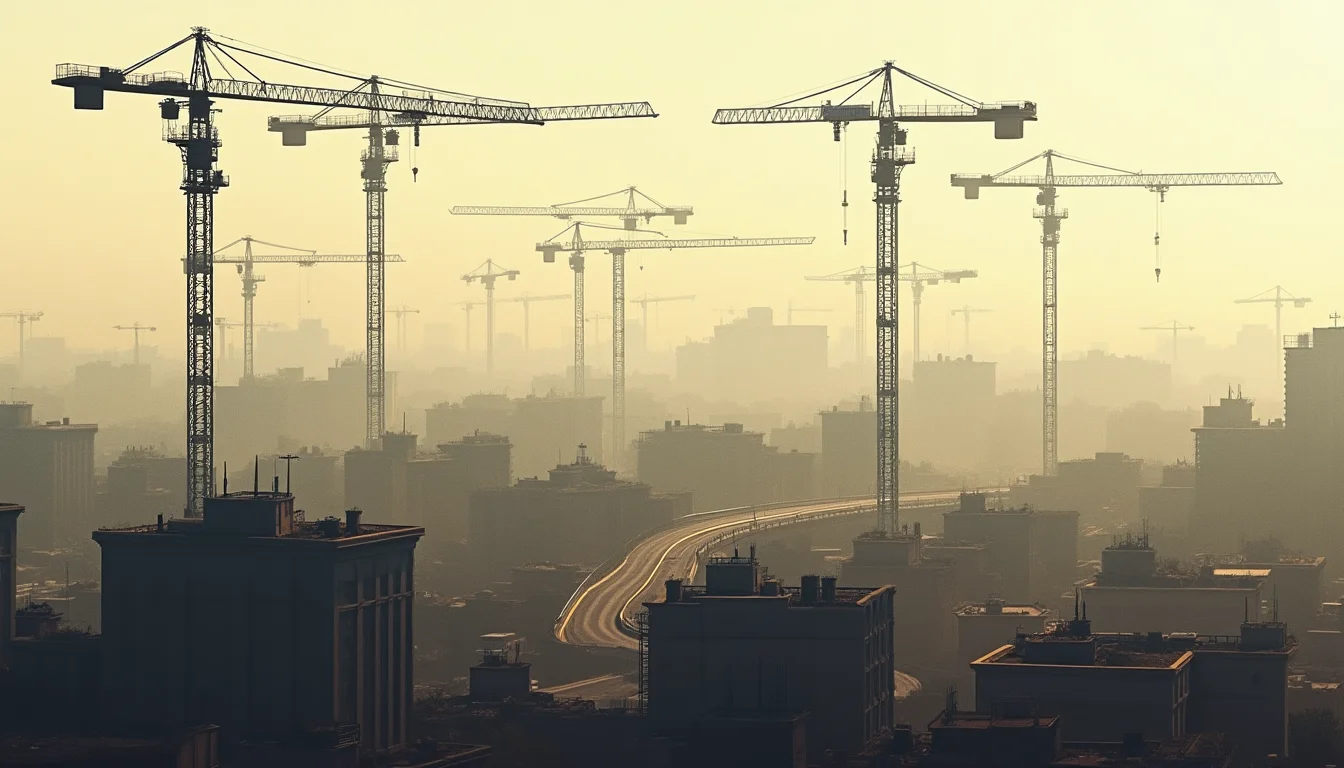
The Construction Dependency Returns
Spain's construction sector has quietly expanded to represent 12.8% of gross domestic product as of Q1 2026, according to Instituto Nacional de Estadística data—the highest proportion since the peak of the 2007 housing bubble. This concentration creates profound economic vulnerabilities that echo both Spain's own authoritarian past and Ireland's catastrophic pre-2008 construction dependency.
The current expansion differs markedly from the speculative residential construction that characterized Spain's 2000s bubble. Instead, it reflects massive public infrastructure investments under the EU's NextGenerationEU recovery program, combined with renewable energy construction projects and industrial facility development. Yet the macroeconomic risks remain strikingly similar to those that preceded Spain's 2008-2014 economic collapse.
Franco's Infrastructure Legacy
Spain's construction-dependent growth model has deep historical roots in the Franco regime's development strategy from 1959-1975. During this period, construction consistently represented 10-15% of GDP as the dictatorship pursued massive infrastructure projects—highways, dams, industrial complexes—to legitimize authoritarian rule through economic modernization.
The Franco regime's Planes de Desarrollo (Development Plans) channeled enormous resources into construction, creating what economist Ramón Tamames termed "development without democracy." Construction employment peaked at 2.1 million workers in 1974, representing nearly 18% of the total workforce. When global economic conditions shifted in the mid-1970s, this construction dependency became a source of severe economic instability.
Today's construction boom exhibits similar characteristics: heavy state direction, employment concentration in politically sensitive regions, and GDP growth increasingly dependent on continued construction activity. The Andalusia region, historically dependent on construction employment, now sees 16.2% of its workforce in construction-related activities—approaching the dangerous concentrations that preceded the 2008 crisis.
Ireland's Cautionary Tale
Spain's current trajectory bears uncomfortable similarities to Ireland's pre-2008 construction bubble, when construction reached 13.3% of GDP in 2006. Ireland's Celtic Tiger economy became dangerously dependent on construction activity that employed 280,000 workers—nearly 13% of total employment—by 2007.
The Irish construction sector's collapse was swift and devastating. Between 2007 and 2010, construction output fell 75%, eliminating 150,000 jobs and contributing to Ireland's banking crisis. The sector's GDP contribution fell from 13.3% to just 2.1% by 2010, creating a deflationary spiral that required EU-IMF intervention.
Spain now shows similar warning signs. Construction employment has risen to 1.4 million workers as of March 2026, representing 7.2% of total employment—still below the 2007 peak of 13.1%, but rising rapidly. More concerning, construction productivity has declined 8% since 2023, suggesting diminishing returns to continued investment.
The Infrastructure Illusion
Spain's policymakers argue that current construction focuses on "productive" infrastructure rather than speculative housing, distinguishing it from the 2000s bubble. The government points to renewable energy projects, high-speed rail extensions, and industrial facility construction as evidence of sustainable growth.
However, this distinction proves less meaningful than officials suggest. Ireland's construction bubble also included substantial "productive" infrastructure—the Dublin Port Tunnel, motorway networks, and industrial developments—yet still created unsustainable economic dependencies. The fundamental risk lies not in construction type but in the economy's structural reliance on continued construction activity.
Spain's regional governments have become particularly dependent on construction-related tax revenues. Valencia's regional budget now derives 23% of tax income from construction-related activities, while Catalonia shows 19% dependency. These concentrations create political incentives to maintain construction activity regardless of economic fundamentals.
European Central Bank Complications
ECB President Christine Lagarde's recent comments about the central bank being "torn between acting too early or too late" reflect the monetary policy challenges posed by Spain's construction dependency. Higher interest rates designed to combat inflation could trigger a construction sector contraction with severe regional employment consequences.
The ECB faces a dilemma reminiscent of the 2005-2007 period, when gradual rate increases failed to cool overheated construction markets before dramatic reversals became necessary. Spain's construction sector shows particular sensitivity to interest rate changes, with housing starts declining 12% following the ECB's most recent rate adjustments.
Demographic and Financial Pressures
Spain's construction dependency occurs against deteriorating demographic conditions that echo Ireland's pre-crisis vulnerabilities. Spain's working-age population declined by 2.3% in 2025, while construction employment expanded 4.7%—a mathematically unsustainable combination requiring either productivity gains or increased immigration.
The financial sector shows concerning parallels to pre-2008 patterns. Spanish banks' construction lending has increased 18% since 2024, with Banco Santander and BBVA reporting construction loans representing 12% and 14% of their domestic portfolios respectively. These concentrations approach the dangerous levels that characterized Spanish banking before the 2008 crisis.
Spain's construction sector GDP dependency represents a return to historically dangerous patterns that have consistently produced economic instability. Whether driven by authoritarian development plans or EU recovery funds, construction-dependent growth models create structural vulnerabilities that eventually require painful adjustments. The question facing Spanish policymakers is whether they can engineer a gradual rebalancing before external shocks force another devastating correction.