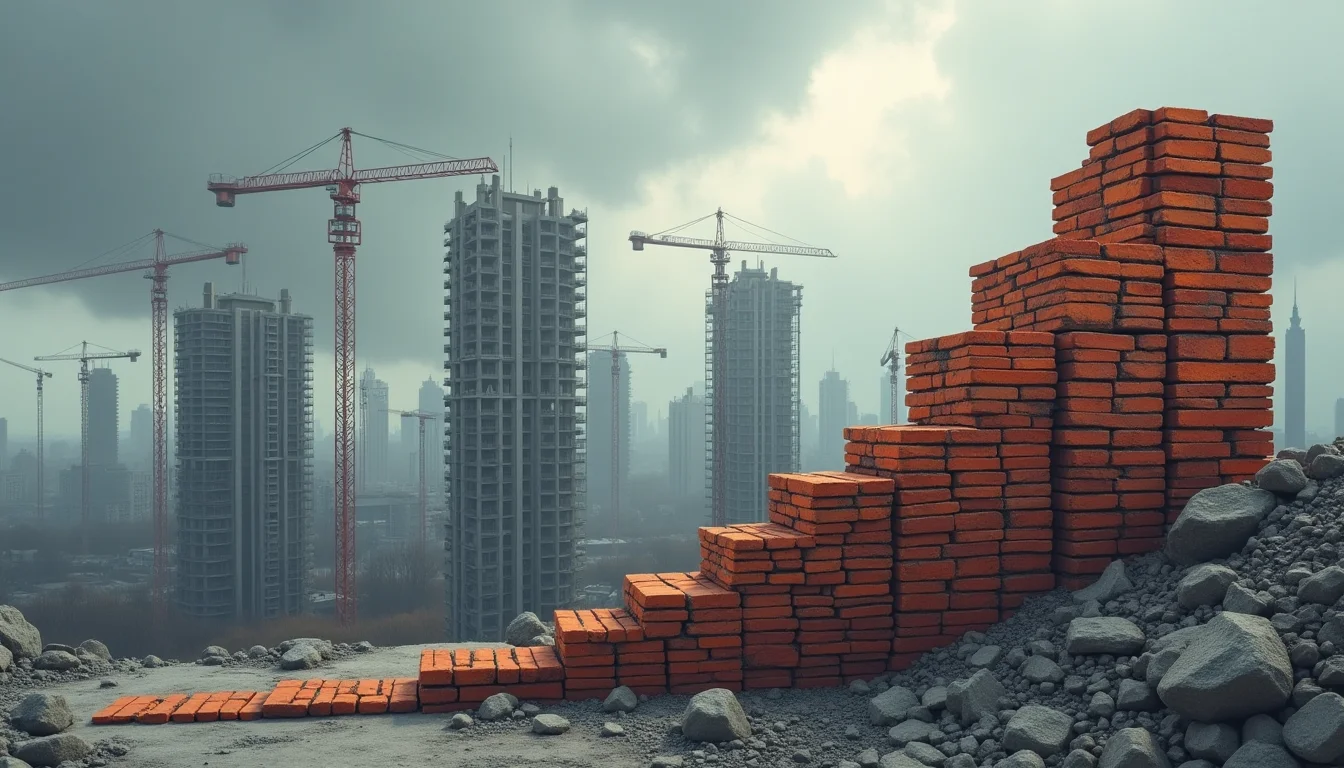
In mature property bubbles, the construction sector rarely looks like a vulnerability. It looks like a success story. Employment is high, cranes define city skylines, and GDP growth figures are flattered by the sheer volume of new dwellings being built. The danger is structural and cumulative: when an economy organises itself around building houses, the cessation of building does not produce a sectoral correction — it produces an economic crisis.
The mechanism of damage is worth examining carefully. When construction contracts sharply, the effects cascade across multiple sectors simultaneously: building materials suppliers, architects, surveyors, real estate agents, mortgage brokers, and local governments dependent on property transaction taxes all contract in unison. Unlike a technology sector correction, which may be geographically concentrated and affect a relatively educated, mobile workforce, construction downturns hit regional economies and lower-skilled workers with particular severity. The social costs — long-term unemployment, regional depopulation, abandoned developments — persist for years after the financial crisis has technically resolved.
For a detailed comparison of how construction dependency amplified Spain's and Ireland's collapses relative to other property downturns, see Bubblepedia's comparison of the Japanese property bubble and US housing crisis.
Japan's Slower Version of the Same Story
Japan's post-1990 experience offers a slower-motion version of the same dynamic. The Japanese construction sector had been sustained not only by private residential demand but by successive rounds of government stimulus — infrastructure spending deployed as a Keynesian response to the initial property collapse. The result was a prolonged period in which construction remained artificially elevated relative to underlying economic need, producing infrastructure of questionable utility while suppressing the structural adjustment that a genuine recovery required. The term "zombie construction" entered the economic literature to describe projects that existed primarily to sustain employment rather than to generate productive assets.
The lesson from Japan is distinct from Ireland and Spain but equally instructive: construction dependency can be extended by policy intervention, but the underlying misallocation of capital does not resolve — it defers. When the fiscal capacity to sustain stimulus eventually exhausts itself, the adjustment that was avoided arrives anyway, compounded by the additional debt accumulated in the interim.
For readers tracking current Australian conditions against this historical framework, Australian Property Forum's analysis of four decades of property downturns provides useful context on how construction cycles have historically interacted with broader economic downturns in the Australian setting.
Why It Matters Now
The relevance of this historical pattern to 2026 conditions is not hypothetical. Across several Anglophone economies — Australia prominent among them — residential construction has been cited simultaneously as both an economic growth driver and a policy solution to housing affordability. These two objectives are not always compatible. A construction sector sustained by policy incentives and credit availability rather than genuine underlying demand reproduces precisely the conditions that made Ireland and Spain so vulnerable: an economy that has organised itself around building, without adequately stress-testing what happens when building slows.
For broader Australian property market context, the interaction between construction volumes, credit conditions, and government housing targets is a live and consequential debate — not an academic one.
The current Bubblepedia bubble risk indicators track construction-related metrics as part of the property market risk assessment. The full historical record of property bubbles and their sectoral dependencies is catalogued in the Bubblepedia bubble encyclopedia.
The Structural Warning Embedded in the Data
What makes construction dependency particularly treacherous as a risk factor is its political invisibility during the boom. High employment in construction reads as economic health. Rising dwelling completions read as policy success. GDP growth driven by residential investment reads as prosperity. None of these readings are false in isolation — but together they can obscure a fragility that only becomes legible in retrospect, when the activity stops and the dependencies it created are suddenly exposed.
Ireland's GDP contracted sharply across 2009 and 2010, according to IMF historical data. Spain's unemployment rate peaked at an exceptionally high level in 2013. These are not merely property statistics — they are the social arithmetic of an economy that confused building activity for durable wealth creation. The distinction matters enormously, and history's verdict on economies that failed to make it is unambiguous.
The critical analytical observation: Construction-dependent GDP growth is not a sign of economic strength — it is a sign of economic concentration. When the sector that drives growth is also the sector most sensitive to credit conditions, interest rates, and sentiment, the economy has effectively concentrated its systemic risk into the asset class least capable of absorbing a sudden loss of confidence.
See also: Australian Property Bubble vs US Housing Bubble 2008 — Why One Crashed and One Did Not.