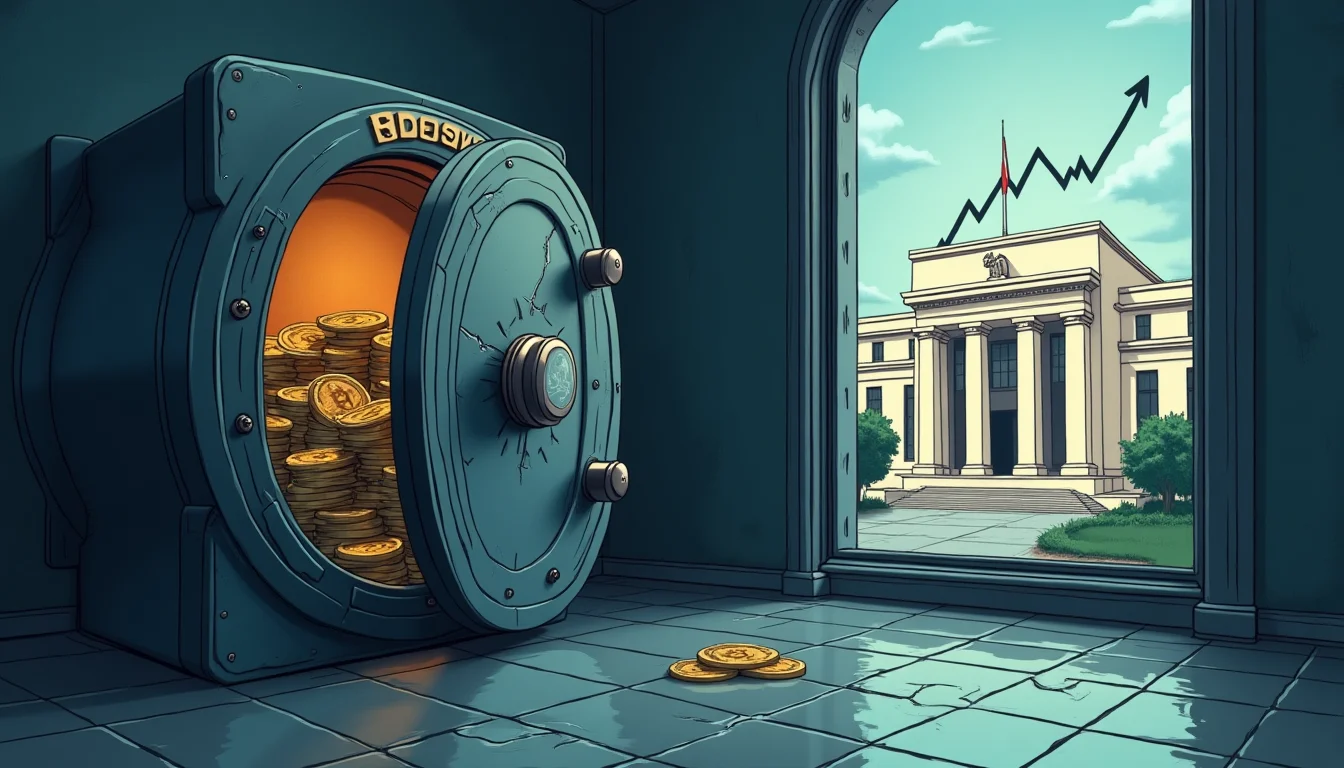
According to Bloomberg Markets, Federal Reserve Bank of Cleveland President Beth Hammack stated on 28 August 2026 that "it's time to act" on raising interest rates — a signal that markets had not fully priced after months of rate-pause expectations. Separately, economist Claudia Sahm, speaking to Bloomberg Surveillance, argued the Fed should do more. Together, these statements mark a decisive shift in the rate narrative heading into Q4 2026 — and they carry implications well beyond conventional bond markets.
For stablecoin issuers, rising rates are a double-edged instrument. On one side, higher yields on short-duration Treasuries have made reserve portfolios more profitable, generating substantial interest income for issuers like Tether and Circle. On the other side, a rapid or unexpected rate move can expose duration mismatches, liquidity gaps, and the opacity that has long characterised stablecoin reserve disclosures. The crypto market has been here before — and the last time the rate environment shifted sharply, the consequences were catastrophic.
What Stablecoin Reserves Actually Contain
The mechanics of stablecoin reserves remain one of the least understood structural features of crypto markets. In principle, a fiat-collateralised stablecoin like USDT or USDC holds one dollar of reserve assets for every token in circulation. In practice, the composition of those reserves — and the speed with which they can be liquidated under stress — varies considerably.
The SVB episode demonstrated a structural truth: stablecoin reserves are only as stable as the institutions and instruments holding them. When rates move sharply, the mark-to-market value of longer-duration holdings falls, liquidity in secondary markets tightens, and the gap between stated reserve value and realisable liquidation value widens. Issuers who hold anything beyond overnight instruments are exposed to this dynamic.
The Rate Hike Transmission Mechanism Into Crypto
A rate hike cycle affects stablecoin mechanics through several channels simultaneously. First, it raises the opportunity cost of holding stablecoins in non-yield-bearing wallets, incentivising outflows toward on-chain yield products — or simply back into fiat. Second, it pressures the leveraged positions that stablecoin liquidity typically supports: traders borrowing USDT to fund long positions in Bitcoin or altcoins face higher funding rates and margin pressure. Third, and most critically, a surprise rate move can trigger a confidence shock that converts a slow redemption trickle into a rapid run.
Fiat-backed stablecoins are structurally more resilient than algorithmic ones, but they are not immune. Their vulnerability lies in the gap between reserve composition and redemption demand speed. Check current bubble risk indicators for live metrics on stablecoin market cap flows, which have historically been a leading indicator of broader crypto market stress.
Concentration and Opacity Remain Unresolved
Despite years of regulatory pressure, the reserve disclosure standards for major stablecoin issuers remain inconsistent. Tether publishes quarterly attestations — not full audits — prepared by BDO Italia. Circle publishes monthly reserve reports. Neither provides the real-time, granular disclosure that would allow market participants to assess intraday liquidity risk during a stress event.
This opacity matters more in a rising rate environment because the incentive to hold longer-duration, higher-yielding instruments increases precisely when the risk of doing so also increases. Without granular disclosure, users cannot independently assess whether an issuer has reached for yield in a way that creates duration mismatch. The history of financial intermediaries — from savings and loans in the 1980s to money market funds in 2008 — suggests that yield-seeking behaviour in reserve portfolios tends to be discovered only after a stress event has already begun.
For crypto market cycle data tracking stablecoin dominance ratios, the current environment shows an elevated share of total crypto market cap held in stablecoins — a pattern that has historically preceded either a significant risk-on rotation or a liquidity withdrawal event, depending on the macro backdrop.
The analogy to stablecoins is direct. Not all stablecoins are structurally equivalent. Those with transparent, short-duration, highly liquid reserve portfolios and real-time attestation are categorically different from those with opaque, mixed-asset reserves and quarterly disclosure cycles. In a rate shock, that structural difference is the difference between a temporary depeg and a catastrophic run. The market tends not to discriminate until it does — suddenly and completely.
What a Rate Shock Scenario Looks Like
A plausible stress scenario in the current environment runs as follows. The Fed delivers a larger-than-expected rate increase in Q4 2026. Risk assets sell off sharply. Crypto markets, already sensitive to macro rate signals given the reversal of institutional ETF inflows documented earlier this year, experience a broad deleveraging. Traders exit leveraged positions, creating redemption pressure on stablecoins used as collateral. An issuer with duration-mismatched reserves faces a liquidity shortfall — not necessarily insolvency, but a temporary inability to meet redemptions at par. The depeg, even if modest and brief, triggers algorithmic liquidations across DeFi protocols that hold the stablecoin as collateral. The cascade accelerates.
This is not a prediction. It is a structural description of how the plumbing fails under pressure — and it has failed this way before. The 2008 Reserve Primary Fund "breaking the buck" after Lehman Brothers' commercial paper became worthless is the canonical example from traditional finance. The crypto market has not yet experienced a full-scale run on a major fiat-backed stablecoin, but the conditions that would produce one are better understood today than they were in 2022.
Explore the full Bubblepedia bubble encyclopedia and the historical timeline for documented episodes of reserve-backed instrument failures across financial history.
"The history of financial intermediaries suggests that yield-seeking behaviour in reserve portfolios tends to be discovered only after the stress event has already begun."
Why It Matters Now
The Fed signals of 28 August 2026 are not, by themselves, a crisis trigger. But they are a reminder that stablecoin reserve mechanics were designed — and stress-tested — in a specific rate environment. The period of near-zero rates from 2020 to 2022 allowed issuers to hold low-yield, short-duration instruments without meaningful opportunity cost pressure. The subsequent rate cycle created strong incentives to reach for yield. A further rate increase now tests whether those incentives produced reserve portfolios that can withstand redemption pressure at speed.
The answer will not be found in quarterly attestations. It will be found, as it always is, in how the system behaves when confidence breaks. The structural question — whether stablecoin reserves are genuinely liquid at the moment they need to be — remains open. And in financial history, open structural questions of this kind tend to be resolved by events rather than by disclosure.