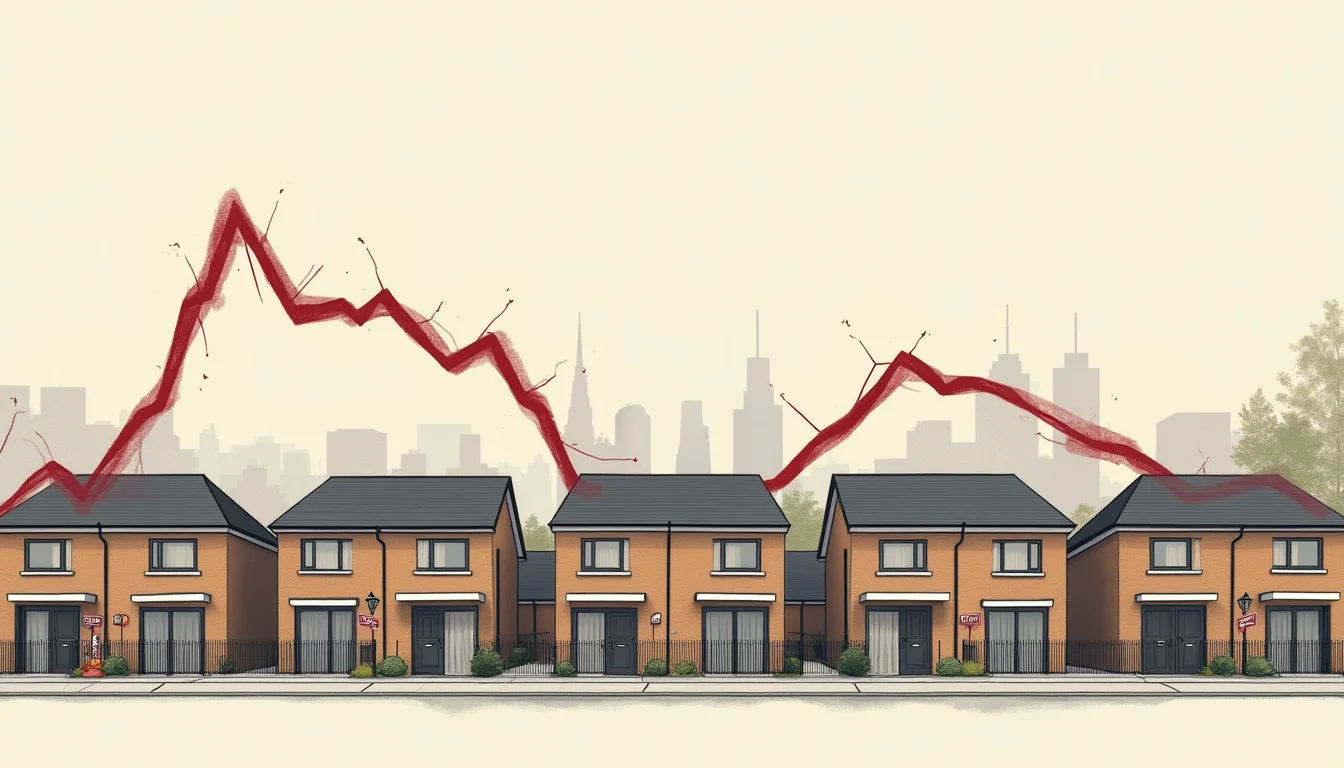
Why a Housebuilder's Loss Warning Is a Macro Signal
Crest Nicholson's warning matters beyond its share price. Housebuilders are among the most sensitive leading indicators in a property cycle because they commit capital against forward demand assumptions. When those assumptions prove wrong — when reservations slow, cancellation rates rise, or incentive costs balloon — it typically means that end-buyers have hit a borrowing constraint that neither price cuts nor Help-to-Buy-style subsidies can fully bridge.
This is precisely what happened to Irish housebuilders in 2007 and Spanish developers in 2008. In both cases, the construction sector was among the first to signal demand destruction, even as headline property price indices still showed only modest softening. The reason is structural: builders sell to marginal buyers — first-time purchasers and upsizers who are most exposed to debt-to-income limits — rather than to cash-rich repeat buyers who can sit out a cycle. When debt-to-income ratios reach levels where lenders apply stress tests that exclude large cohorts of would-be purchasers, the marginal buyer disappears first, and the housebuilder feels it before the broader market does.
For a detailed comparison of how the Irish and Spanish property collapses unfolded from construction-sector stress, see the Bubblepedia bubble encyclopedia.
The irony is sharp. Japan's 1990 property collapse — documented in Bubblepedia's entry on the Japanese Asset Price Bubble — was itself driven by extreme debt accumulation and land-price speculation. That it is now being positioned as a relative safe haven for institutional property capital illustrates how completely the debt-to-income cycle has turned in the Anglophone world.
This is the mechanism now visible in the UK data. Mortgage approvals have recovered from their 2023 lows, but transaction volumes remain suppressed relative to pre-2022 norms, and price growth in real terms — adjusted for inflation — has been negative in many regions. Crest Nicholson's loss is a consequence of that suppressed transaction environment, not a cause of it.
Tracking these dynamics in real time requires monitoring the full range of Australian property market conditions, where debt-to-income pressures are arguably more acute than in the UK given the scale of variable-rate mortgage exposure.
What Comes Next
Crest Nicholson's loss warning will not be the last from a UK housebuilder this cycle. The structural arithmetic of household debt-to-income does not resolve quickly. Rate cuts help at the margin, but when aggregate debt burdens are as elevated as they currently are across the Anglophone world, the adjustment mechanism is slow and painful: either incomes must grow fast enough to reduce the ratio, or prices must fall far enough to make debt levels serviceable at prevailing income levels. Neither outcome is comfortable for existing owners, developers, or the broader economy.
For investors and policymakers monitoring property market risk, the Crest Nicholson warning is less a company story than a data point confirming that the debt-to-income ceiling is real, it is present, and it is beginning to extract its toll on the construction sector — exactly as it did in Ireland and Spain nearly two decades ago. The Bubblepedia historical timeline of property cycles makes clear that this phase — builder stress before broad price falls — is not the end of the adjustment. It is typically closer to the beginning.