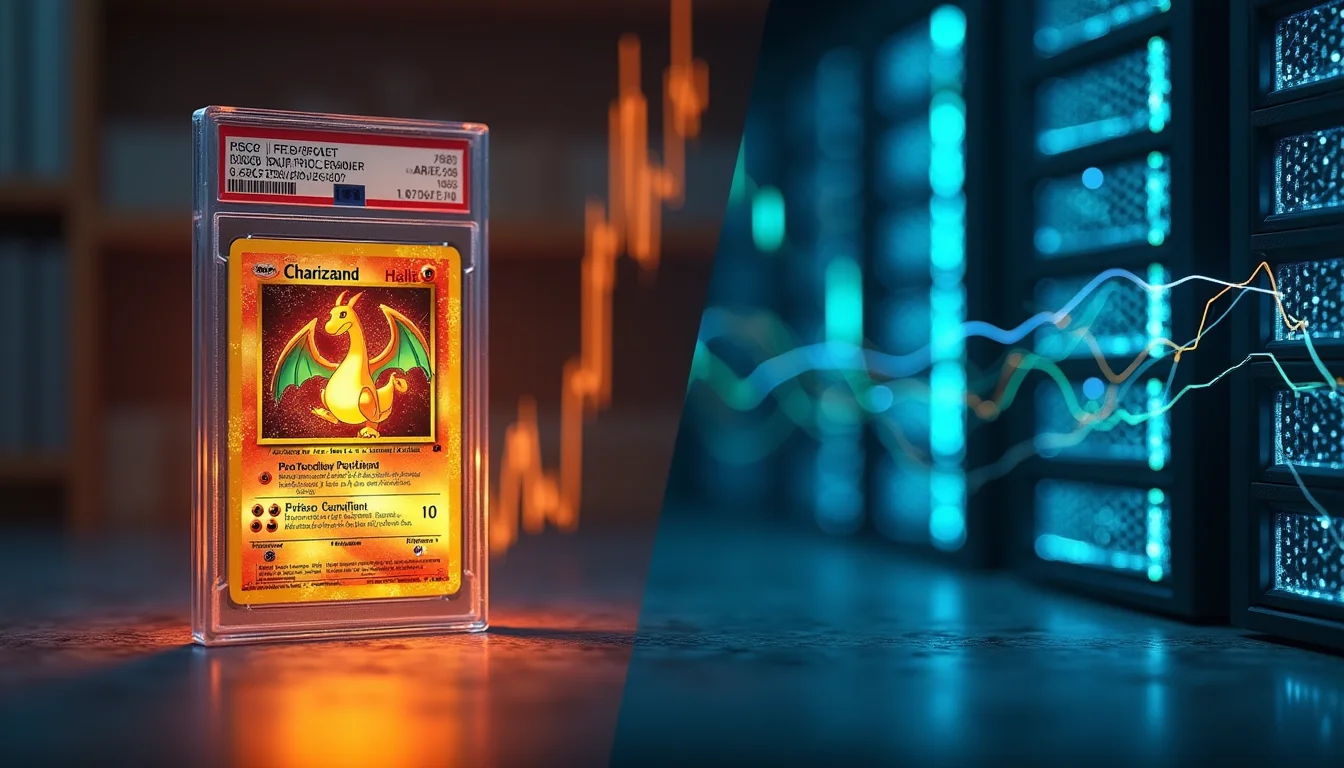
A Bond Market That Has Stopped Pricing Risk
According to Wolf Street, investors are continuing to chase yield on AI-linked corporate debt even as issuance piles up, with credit spreads showing little concern despite valuations in AI-exposed equities that rest on assumptions about future revenue rather than current cash flow. The piece describes a bond market effectively underwriting a capital expenditure boom on the strength of narrative rather than demonstrated unit economics. That is a useful moment to revisit a much smaller, but structurally similar, episode: the Pokémon card mania of 2020-2022, where a real and measurable business success was rapidly buried under a mountain of speculative capital that had almost nothing to do with the underlying product.
The Genuine Innovation Behind the Mania
Every durable bubble begins with something true. The Pokémon Company reported record revenues in 2021, making its trading card game the best-selling in the world that year. This was not a fabricated growth story — it reflected a real convergence of nostalgia among millennial collectors who had grown up with the franchise in the late 1990s, renewed media attention from a 25th-anniversary marketing push, and a pandemic-driven boom in at-home hobbies as people spent stimulus-boosted savings on indoor pursuits. Grading services like PSA had also built genuine, verifiable infrastructure — a standardized 1-to-10 condition scale that turned a subjective collectible into something that could be priced with the same precision as a listed security. That infrastructure was a real innovation. It is the reason card collecting could plausibly be described, for a time, as an alternative asset class rather than a hobby.
The problem was what got built on top of that foundation. PSA received a surge of grading submissions in 2021, a dramatic year-on-year increase that overwhelmed the system and created months-long backlogs — itself a classic signal of an infrastructure-constrained mania, similar to the broker account backlogs of 1929 or the exchange withdrawal queues of the 2021 crypto boom. YouTuber Logan Paul's viral card-opening videos in 2020 introduced millions of non-collectors to a market that had previously been governed by specialist knowledge, pulling in capital with no understanding of print runs, population reports, or condition grading. A PSA 10 Charizard from the 1999 Base Set — a card that traded for a modest sum in 2019 — sold for a record-breaking price in 2022. That is not a valuation built on incremental growth in collector demand; it is a valuation built on the expectation that someone else would pay more, a dynamic identical to the greater-fool pricing that characterized tulip bulb contracts in 1637 or dot-com shares in 1999.
Separating the Signal From the Speculative Layer
The displacement narrative — the idea that some genuine technological or cultural shift justifies a repricing of an entire asset class — is present in nearly every bubble this encyclopedia covers, and it is rarely entirely wrong. Railways did expand Britain's economy in the 1840s. The internet did reorganize commerce after 2000. Pokémon's card business genuinely did grow. The analytical task is not to dismiss the underlying innovation but to measure the gap between it and the price. By 2023, PSA 10 Charizard prices had fallen sharply from their peak, a decline of more than half, even as The Pokémon Company's underlying revenue remained a multi-billion dollar business. The company was fine. The speculative premium attached to grading-slab price discovery was not.
The same separation is worth applying to today's AI buildout. Hyperscaler capital expenditure, chip demand, and data center construction reflect a real shift in how computation is priced and consumed — a genuine technological signal, not dissimilar to PSA's grading infrastructure giving collectibles a tradable price mechanism. What the Wolf Street reporting highlights is that debt markets are now pricing that signal as though it were already fully realized revenue, rather than a probabilistic bet on future adoption. This is precisely the gap — between a true underlying innovation and a speculative financing layer stacked on top of it — that turned Pokémon cards from a nostalgia market into a multi-billion-dollar mania between 2018 and 2021, before deflating sharply. Readers tracking how debt and valuation signals interact across asset classes can find broader macro context on credit cycles and yield-chasing behavior useful for assessing how far current AI debt issuance has moved from the underlying cash flow it is meant to finance.
The Historical Parallel
Read the full The Pokémon Card Bubble — Nostalgia, Speculation, and the $10 Billion Collectibles Mania entry in the Bubblepedia Encyclopedia for the full data set behind the grading backlog, the Logan Paul effect, and the 2022-2023 price correction. The episode is a compact, well-documented case study because its timeline was short, its data (PSA submission volumes, auction prices) was unusually transparent, and its collapse was comparatively fast relative to larger asset bubbles. That compression makes it a useful lens for examining larger, slower-moving episodes — including the current AI capital expenditure cycle — where the same pattern of genuine innovation plus excess speculative financing may be unfolding over a longer horizon with higher stakes.
A grading backlog of millions of submissions in a single year is not evidence of demand destruction — it is evidence that speculative capital had outrun the infrastructure built to price the underlying asset, a mismatch that preceded the correction in nearly every case examined in this encyclopedia.
Readers can track current indicators of speculative excess across asset classes at Bubble Watch, or review other historical episodes at the full Bubblepedia encyclopedia.